
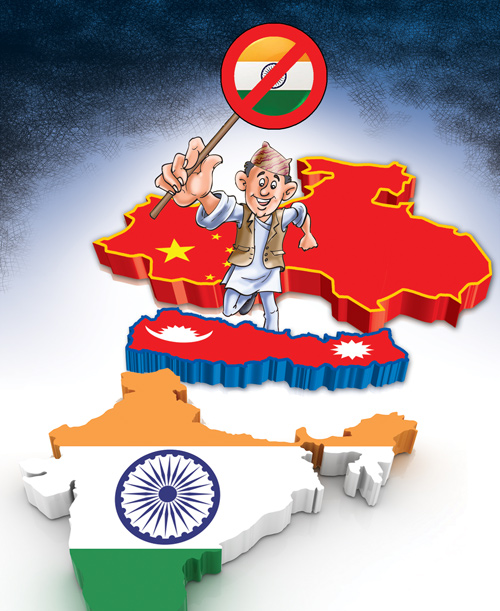
There has been a marked surge in nationalism in Nepal of late, which is largely due to New Delhi’s tendency to poke its nose into the country’s internal affairs.
India has always interfered in Nepal’s domestic politics ever since the two countries signed a friendship treaty in 1950. As long as India continues to meddle in Nepal, there will be nationalism which could lead to ultra-nationalism, and eventually even militancy.
New Delhi is pressuring Kathmandu to amend Nepal’s constitution, and is always keen to decide who becomes Nepal’s next Prime Minister or security chief. This has led to a rise in anti-India sentiments, and Nepali nationalism is becoming synonymous with anti-Indianism. As a result, Indian projects are not getting public support in Nepal.
Nationalism creates a binary of us and them, and cultivates a culture of fragmentation. In Nepal, the rise of nationalism and anti-Indian sentiments threaten to create a divide between the peoples of the two countries.
The rise in anti-India sentiment is also pushing Nepal closer to China. Indians call it Nepal ‘playing the China Card’, just as King Mahendra once did in the early 1960s when his relations with New Delhi soured. Every time Kathmandu-New Delhi hits a low or China announces more investment in the Himalayan nation, India accuses Kathmandu of using the ‘China Card’.