Carl Feb 26, 2011
The tourism figures about Austria mentioned in Mr. Hofer's article are complete nonsense.Secondly, Nepal will not have 1 million tourists.
Thirdly, has anybody checked flight prices to Nepal from Europe??? For the ticket price alone I can get 2 weeks Sri Lanka, Thailand, you name it.
Shan Feb 27, 2011
Can't be any better analysis than this!
Chandra Gurung Feb 27, 2011
Austria got 20 million visitors in 2005 and earned 15.46 billion dollars, according to http://www.unwto.org/facts/eng/ITA&TR.htm. It is doubtful that the figure mentioned in the article above about Austrian tourism is true.
However, it doesn't undermine the main point of the author. We should definitely work hard to attract more people.
Our effort should be largely based in India and China, making restaurants or amenities that people from these countries like. We can also organize Chinese cultural shows and invite Chinese troupe/Beijing Opera on a regular basis in the future. We should facilitate more air travel between Nepal and India/China, and allow Indians/Chinese to buy apartments and start some sort of business in Nepal. Europe and Arabian countries are incidental to our progress. Americans are totally irrelevant, and most of them I have met are nuisances (missionary, anti Chinese rabid Republicans etc), so I am not sure we will gain anything by attracting them. If large number of Indians/Chinese are convinced Nepal is a great destination, Europeans/Americans will follow anyway.
bobbie Feb 27, 2011
To Carl,
Would u care to explain how the tourism figures about Austria are complete nonsense??
Daniel Gajaraj Feb 27, 2011
Very good advice. Let this be circulated to all stake- holders;and those whoare envolved in tourism promotion or promoting Nepal
Let it come out in Nepali version also..
NEXT IS TO MAKE THE JOURNEY TO AND FROM INDIA EASY , AND TROUBLE FREE;SPECIALLY FROM THE POLICE AND CUSTOM PERSONS-STAFFS, NO HASSLE.
Remove them from the scene and use more instruments like CCTVs etc;so that crime van be more effectively. They only create hurdles an make mony that way. Make the access road wider and avoid mile long jamat the entry point. Allow free entry for the vehicles from India ;the camera can keep better records against crimes r than the police or custom persons who take bribe They allow any thing if given money. Let them remain in the background foe analysis of the data or collecting revenue or monitoring and controlling duty without harassing the guest visitors. .
Smile and curtsy be our motto at the receiving points and also while saying good-bye.
jange Feb 27, 2011
Good, sound, logical advice. And for these very reasons it will not be heeded by the powers that be.
Carl Feb 27, 2011
@bobbie: there is Google, have you heard of it?
Radha Krishna Deo Feb 27, 2011
Tourism Development Board should takes notes from his articles, the board when ever approach to Islamic world they should provide in formations for hal ood and location of important tourist destination.
sacnepal
Hurtful Feb 27, 2011
Now Ministry Tourism should employ Mr. Hofer as a consultant with an exorbitant fee to give it advice. That is how the cookie crumbles here.
Shree Shrestha Feb 28, 2011
Tourists are Guests! Right. They have to caugh up more money for the flight inside Nepal (they do not occupy extra space and they do not get into the destination any faster). They have to pay more in the restaurants (they eat less than average Nepalese). They have to pay just to enter cities in the Kathmandu Valley. Hello? Do anybody have idea that they have to pay lots of money just to get to Nepal and stay in the hotels which charges about the same like Europe and America. Then what we show them: dirt in the streets and dirts in Singha Darwar. Please, Grow up.
Hans Hoefer Feb 28, 2011
Thanks Carl, I stand corrected.   ÂÂ
In my enthusiasm for the opportunity to comment on tourism I wanted to emphasize on the question of how, and not how much. But you are right : the landlocked mountain country Austria has 20 million visitors every year, not 50 (that would be annual arrivals in Spain, Italy, France). Still, for those with a sense of economic reality, that brings in over 20 thousand million US $ of foreign cash net into that country, every year.ÂÂ
  ÂÂ
Do I believe that Nepal can reach 20 million visitors within one generation ?   Hell yes !   If you want it and understand the potential and importance of tourism for Nepal. You have 20 years of single minded pursuit, intelligent planing and execution to make your guests happy � and you will reach that goal.   Get to work, get them out of the polluted cities, to the edge of the valleys, into the country, onto the hilltops and treat them well !  ÂÂ
(If anybody among you has a better idea for another, equally sized industry for Nepal to reach a similar annual revenue, please let me know� write hhoefer@mac.com)   ÂÂ
Soni (Slarti) Mar 1, 2011
Your optimism is infectious Hans. When I saw your note, the first reaction was good, I smiled. Then I came back to reality.
No, there is no other industry which has the same (immediate) potential as tourism in Nepal, but there is also no hope that this would ever become reality.
This is all down to the fact that, intelligence, planning, single mindedness, and execution are among qualities which are not this country's leadership's strong points.
I do, however, recognise that there are center's of excellence in Nepal which do actually do what you suggest they should.
Meanwhile, taking this whole thing on another plane, I don't even think that having to depend on tourism is such a hot idea for Nepal. I would rather have several smaller, more sustainable and less intrusive industries contribute to this country's (moderate) prosperity. This could include tourism, but the economy can't be dependent on it.
I don't see why Nepali's should be the world's curiosity. But, that'a just me.
Over the longer term, (and this is only because you talk of a generation and since we are in the realm of dewy-eyed optimism) I believe there is more potential (and better margins) in value add industries which fill the gap for both China and India.
Chandra Gurung Mar 1, 2011
"I don't see why Nepali's should be the world's curiosity. But, that'a just me."
Yes, that's just you. I have no idea what you mean by "world's curiosity" and why it is okey for France, Spain, Switzerland, Italy, China to be that and not us.
" I believe there is more potential (and better margins) in value add industries which fill the gap for both China and India"
This is what I call a perfectly ass's argument. Why don't you give us a good example of such industry when you have time to write this much?
I think Nepal will have small sized industries, supporting tourism and producing high quality stuffs for which our land is suitable. For example, production of warm woolen hand-knitted clothes (REI in United States carries ski caps which are almost always made in Nepal), production of Himalayan flowers (to be used in perfumes) and vegetables where possible, and other medium sized industries to support these industries. But Tourism has the biggest potential. When well managed, it is clean, it is lucrative, and it is the best hope for future.
hange Mar 1, 2011
A very thoughtful and pragmatic piece- and Mr. Hofer should be thanked for his sage advice versus being slammed for getting a number wrong. Mr. Hofer hit the nail right on the head: we Nepalis see tourists as money trees and, worse, actually look down upon them with a certain amount of cynicism as in, "Oh, here comes another kweeray idiot tourist for me to milk dry and tease." We should take a page from Thailand: tourists are not only guests, they are royalty. Treat them well, make it a lifetime experience for them, and, as Mr. Hofer has pointed out, this will pay dividends in and of itself via word of mouth. What goes around, comes around: if we treat tourist like idiots, we're simply being idiots ourselves.
bidesinepali Mar 1, 2011
As a child growing up in Nepal my mother used to tell me a story. A dog will lick its wound and heal itself. A monkey will scratch it all the time and make it worse and eventually die of infection. Nepali are like the monkey. They do not have it in them to lick the wound and heal themselves. But like a monkey they will scratch it and finally kill everything they touch. So, Mr. Hofer, for all your optimism, tourist industry in Nepal will eventually die out.
Soni Mar 2, 2011
Austria, with a population of just 8.3 million, gets 50 million visitors per year and they stay an average of ten days. That is 500 million room nights a year at an average of 300 euros per day. The country earns 150 billion euros per year from tourism. How much does Nepal expect to earn from 1 million visitors � time to get out the calculators?
I have stats from 2000 to 2008 for the following countries, Austria, China, France, Spain, and Nepal.
Nepal earned $12.25 per capita from tourism. China, which has about 46 people for every Nepali earned $33.31 per capita. All of this in 2008. Meanwhile, Austria earned $2919.90 per person.
This would not mean much unless we looked at another stats. What portion of the GDP is earned through how many visitors, would tell us a better story.
Austria earns 5.9% of its GDP through tourism, China about 1% and Nepal 2.8%. Good.
How many visitors do we attract as a %age of population?
For Austria, China, France, Spain and Nepal it is 263.11%, 4.00%, 125.97%, 125.82%, and 1.74%, respectively. So, Austria by attracting 2.6 times the number of people earns 5.9% of its GDP, while we by attracting a tiny little 1.74% earn a whopping 2.8%. That is a story!
I could not stop here, so I looked at the second most important aspect of it, what is the per tourist spend?
The figure is as follows in the same order as above, Austria $1109.78, China $831.87, France $851.78, Spain $1225.38 and Nepal $706.00.
Given all these numbers, I am pretty sure that tourism is a great idea. The stream can keep flowing in and we can keep improving. As China shows, it does not take such a long time to increase the number of visitors. In absolute numbers they (China) attracted 5,30,49000 tourists compared to Austria's 2,19,35000.
For all of Hans' boast, and I assure you with all sincerity, I loved the article, Austria depends chiefly on Germans for its earnings.
Now, Chandra (#13) is that I owe everyone an apology for my pointless intrusive remark and my asinine suggestion.
Firstly, allow me to clarify, it is just me, I know that because I have always had exactly the same outraged response every time I tell someone that.
The reason, as I always end up explaining is that it always conjures up two images in my mind.
One, an old man running after a foreigner to buy some trinkets, it almost always makes my heart heavy. Second, of a bunch of men and women dancing their "traditional" dance for the amusement of some thoroughly amused visitors. I know it is just me that feels bad about it. I simply can't imagine myself in a Sari dancing just for someone else's amusement. Again and again, I am sorry I said that, but as I said, it really is just me, I assure you. I am sorry if that offends.
Since I am at it, and again it is just me and I do not hold that position dearly and I am absolutely, truly, and most deeply ashamed and guilt ridden by the feeling of having such criminal sentiment, but here it is.
While, Spain, France and all of the above countries, I am sure have their own unique culture that they treasure, we kick them to dust when it comes to having a fragile cultural environment.
You can go to a ring and watch an incredibly handsome Spaniard kill a bull and watch a French do whatever it is they do only in France but it is only in Nepal that you can just walk in any direction and see something wonderful that would simply want you to kill yourself so your spirit lingers here longer.
The very fact that so many visitors would come makes me wonder if we won't lose that unique and incredible beauty. I know I am not expressing the right sentiment here, but then I am so in love of all of this, I begin to get scared that their would be some dopey little backpacker with a lot kids trying to become like him and forgetting their own self and losing their own unique identity. Its just me and I simply don't want this to become an argument. I already know I am wrong. I am sorry, I really am.
I have time to write more, so I am going to in another box.
Slarti Mar 2, 2011
The second thing that you came on me about was the asinine and mad suggestion which suggested a potential in value add industries which fill the gap for both China and India, it was stupid of me.
I frankly don't know which specific industries that could be. As a matter of fact, I don't think anybody does. But what I did have in mind were tertiary and service industries which are enabled by technology such as component manufacturing, product assembly, even outsourcing. There is nothing specific really.
The genesis of that thought comes from a report I read somewhere that China is facing a problem with spiraling wages etc, surely there are opportunities. The problem is with how to exploit them, how do we find out what we could do and where we would be good?
Everybody comes up with brilliant ideas, such as your own - which are brilliant. My problem is that I can't think of anything specific that would actually work. Instead, I know that it would take a lot of failure to find one success and that it would be a continuous cycle of failures and successes which will help us move forward, not one great idea which could anchor our prosperity.
Again thats just me, an insufferable idiot who comes up with hopeless little comments simply because she has some time to spend in the evenings. The reason for that is simple, but I will waste that reason some other day.
Bibhu Mar 2, 2011
Mr Hofer had mentioned some good points but rhetoric and reality should be analysed with equal magnitude. Hospitality industry is the biggest industry and Tourism an inevitable part however we should be first clear, what it stands for in which context. Just blabbering about manifolding tourists and revenues need a second thought. Holfer talked about sustainable tourism, about defining tourism and boisterously compare Austria with Nepal. I find the comparison itself ludicrous.
Foremost, every country has its unique geo-political, socio-cultural factors that is considered as push and pull factors in Tourism world. Capitalizing those within the context of the country in an efficient manner is appreciated and appraised. We being dependent on Mountain and Adventure
Tourism, need to add values to our products. We need to diversify our areas and infrastructure...but again that is a serious threat to sustainability. So planning something to be accomplished after a decade needs specific details, imagination and creativity. Quality Vs Quantity has always been debated since ages. Bhutan could be an example. Since we know, this generation of ours will not reap the fruit in general but atleast if we plan immaculately, we can let next generation smile.
I agree about the Word of Mouth theory, Mr. Hofer discussed, there is no alternative to customer satisfaction and that is a proven fact, however we should reflect and understand, What tourist wants from Nepal? What we have? What we can provide and produce? Exponential growth or sustainable.....cultural heritage and natural landscape.....or garbage mountains in Himalayas. No only locals even Tourists needs disciplines and sensitivity. Unfortunate to experience, few people tarnishing the whole Nepalese hospitality culture but for that reason we need check and balance from both input and output factors.
Let us not forget, we do not need Nepal to be Paris or Vienna, the world simply cannot afford/sustain 10 more Paris or Vienna. So we should be modestly adamant to promote our home as ours in its own uniqueness and context. I agree, just because 1million tourist landed means nothing. 1million modest tourist...honest tourist should be our target. Economic upsurgement cannot be ignored as that is what people want immediately and rightly so in their context but from the government level, conscious tourist, civil society, so called international organisation and development agencies need to think,
What about those people in the mountains who are not associated with Tourism? How has its impact been on the other population who sometime just becomes the "best picture of the year" for the tourist? We need some homework and thoughts from different perspective....it is surely not a cake walk like Mr. Hofer mentioned...changes in terminology and things are welcomed and appreciated...but the bottom line should be about our own Values, Attitudes, Engagement, Empowerment, Dedication and so forth. Those are the real Value adding factors to compliment with our majestic mountains and landscape.
Hans Hoefer Mar 2, 2011
I am very glad that my provocative sound bites on Tourists or Guests, about Austria and Nepal and about social and economic consequences have generated such distinct commentary and thought.
Allow me another comment to Tourism Year 2011:
In the years 1995/6 I arranged for"Student visits" between the Singapore
German School and the pupils a the village school in Phulbari, Kavre, district.
The German students
arrived at the village (most of them wired into their Walkmans) and as part of our arrangements stayed as guests
for a few days in the Nepali homes of their chosen "exchange hosts". Even after years have passed, I am still told what a profound experience these visits have been for all of them, German or Nepali .
On the evening before departure the local school boys staged a farewell party and
one of the Nepali kids went up to the improvised stage and read out a
poem he had written in english for his new Germans friends.
( his name was Prakash, about 16/17 at the time and I was told he was best in his class ...)
After he had read his poem, I went to the stage and asked him if he could give me his
manuscript as a souvenir, which he did.
Here it is, word by word as written by him.
FALLING IN LOVE WITH YOU
Dear Strangers,
The soil of this part of the world has fallen in love with you. . .
Did you see Northwards this morning ?
What a cheerfull smile
was on the faces of those lofty mountains !
I know, dear strangers
It was the expression of their ecstasy
For they have fallen in love with you.
Dear Strangers,
Did you see Eastwards this morning ?
The first rays of the sun
Were so reupturous with delight
That they rushed to meet you
For they had fallen in love with you.
And,
Did you see Westward this evening ?
The last rays of the sun
Were so sad to part away
from you
For they have fallen in love with you.
My dear ones,
Look carefully on the innocent faces of my villagers
what do you see ?
It is true,
They cannot communicate with you in your tonge
But they can communicate with you in their hearts
For they have fallen in love with you.
Beloved Strangers,
My soul is crying with its utmost force
Please, do not forget this land of ours
Do not forget my people
And these precious moments of intimacy
For my soul has fallen in love with you.
Soni Mar 3, 2011
I can't help it. I would call the combination of your article and the comments evocative, instead of provocative Hans. Thanks for saying such nice things about Nepal.
The poem is lovely, I hope the boy is doing well now. I am sure he would be delighted if he is looking at this.
Jayant Ale Mar 3, 2011
Slarti,
Your comments are very weird. It reminded me a comment, generally attributed to Trotsky, "Everybody has the right to be stupid. But comrade MacDonald abuses this privilege."
What is wrong if a group of people make money by amusing/entertaining others? Actors, athletes, singers everybody does that.
I don't look down upon anyone's job. As long as they are not forced to do so, we should respect their choice. We have rights to comment on our job, not more than that.
If you have problem being looked at by tourists, go to an island and live a life of Robinson Crusoe. Also, once you realized that your comments are incomplete and perhaps dumb, you should be wise to acknowledge it rather than try to act smart about it. I mean, what value added industry are you talking about rightnow? What value can we add in Nepal that Chinese/Indians can't do? At least be more articulate about your ideas. shabda thupari ke hunchha, bhaw bhae po kabita hunchha bhanne poem sunnubhaeko hola.. don't just write words that carry no meaning.
By the way, I can see that Mr Hofer is a sentimental man. He means good for Nepal. I concur with him that , at least in the short term, tourism industry is the major employer for Nepal. More than that, I think we should learn from the experience of tiny countries like Austria that has made themselves successful tourist destination. I liked Vienna very much when I visited the city, Mr Hofer.
Rakesh Mar 3, 2011
This is how we can improve tourism in Nepal.
1. Make a system in the Tribhuvan International Airport very clear and professional. Prevent some shameful airport officials wander around asking, "What have you brought, sir?"
2. After the tourists come out of the airport, make sure they are not pulled from all sides by the manner-less taxi drivers.
3. As a long term strategy, improve infra-structures like wide-roads, trafic signals, public bathrooms, transportation system, etc.
4. Make sure, the country runs with a "system", which makes sense to the most people around the world.
5. Keep law and order in the country.
Then everything will fall into right place.
The tourists will keep coming, Nepalis will make progress in every aspect of life and thus positive things will flood us.
jange Mar 3, 2011
Tourism is first and foremost a social endeavour with economic consequences, and should not be mistaken as an economic endeavour with social consequences.
I wonder if one of the consequences of so many Nepalis going abroad to work will be the impact on tourism and the way tourists are treated. The fact that so may Nepalis have suffered/benefitted from being guests abroad will, hopefully make a positive impact on this sector.
Slarti Mar 4, 2011
Way out of line #21.
"If you have problem being looked at by tourists, go to an island and live a life of Robinson Crusoe. Also, once you realized that your comments are incomplete and perhaps dumb, you should be wise to acknowledge it rather than try to act smart about it."
Just go back and read the comment again. You seem to have some sort of a problem. What is the connection of your comments with my apology to Chandra for offense that was never meant. To anybody or any idea.
Which part of my comment stuck you as offending?
Then you go on to say "I mean, what value added industry are you talking about rightnow? What value can we add in Nepal that Chinese/Indians can't do? At least be more articulate about your ideas."
I have clearly articulated my ideas. However, I will again have a go at it. I will do this by answering in reference to your question, "What value can we add in Nepal that Chinese/Indians can't do?"
This is a question that one person simply cannot answer. It involves many factors.
For instance, what regulatory environment do you have in the country?
Why is Switzerland a leading center for banking and not Germany? Why is Cayman Island such an attractive destination for business registration? Meanwhile, Germany is one of the world's foremost exporters of machinery.
While the answer is that each has skill sets which are conducive to that industry and they have regulations, training and other supporting environment for that industry.
The real question is who created that skill set, why are such regulations created, which dictator and which panel of egg-heads did the countries such favour?
Did any of these countries know before hand which industry they should be promoting. The answer is no, they found that some particular industry needed special attention ex-post, after the event.
Even Austria, the country that we are talking about did not develop the tourism industry following the Hapsburg directive. It was the consequence of the fact that its a damn good sight. Guess what, one of the favorite tourist destination has something to do with the movie the sound of the music. Now, what authority or who could have predicted that?
I had earlier said "My problem is that I can't think of anything specific that would actually work. Instead, I know that it would take a lot of failure to find one success and that it would be a continuous cycle of failures and successes which will help us move forward, not one great idea which could anchor our prosperity."
The issue that we are discussing, is complex enough to attract many brilliant minds to debate it in many books.
As you would find in some Ostrom (Nobel prize) books and interviews, it is again the same thing. There is no way of knowing for certain what would work where, unless you have tried.
Coming to the more specific portion of the question, what can Nepal do that China and India can't.
The answer as a matter of fact is that I don't know because there is no way to know. I could say that it would be agriculture, but that is 16% of land. I could say it is outsourcing, but India rules that space along with Vietnam, Philippines, and other countries. I could also suggest that it would be product assembly.
For instance, Chinese firms build toys, can we displace them? You can't know, you would have to let entrepreneurs try their hand it by building regulations which allow them to file bankruptcy protection if they fail, to allow creditors ways to recover their capital, and a whole host of other things. To allow people to swiftly set up businesses.
We can't issue a proclamation that from now on people may only manufacture Toys if they are to set up an industry. Instead, we need to create regulations and institutions which would make it easy for investors to try and find out where they can build, what and how well.
The result of all of this would be to ensure that we have souvenir shops as I imagine you found in Vienna, instead of a poor man chasing you, begging you to buy his trinkets. Instead, we too can have people working at souvenir shops if they chose, or as a clerk at an office which sells toys to large buyers in US. Who the hell knows?
Again, the fact that I know all this and more does not mean that I have a go at anybody who is making a comment, I have not insulted you or Chandra at any moment. And, yet when I see your comment I am appalled. Is it really possible to be so uncivil?
Mind you, it is simply not possible to say everything in a comment box, you give indications of your intention and my purpose here is something different. Just as it is my job to understand what is being talked about, it is also my job to understand what somebody else is saying in its complete sense and then if I do not understand what they are saying to either ask or have a go at them respectfully.
Of course, that is too much to expect from the likes of you. And no matter how hard you try I am not going to let go till I have sorted things out completely.
Insult me as much as you like. But close the deal, respond if you are annoyed, go for the worst terms, and I will clarify.
Jayant Ale Mar 4, 2011
Slarti,
I don't understand people like you.
So you are suggestig something (have industries for Nepal), but you think
(i) You don't know what those industries are
(ii) You think it entails costly endless experimentations (perhaps endless) to figure them out.
You come here, criticising something someone made and yet you have no idea what you have said. This is called classic jackass argument. I see you have lots of time at your hand, and you can amuse yourself making these asinine comments.
Hans Hoefer Mar 4, 2011
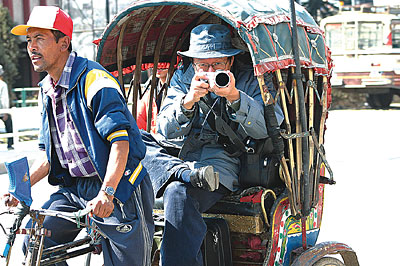
In my experience the reason why the tourism industry, even so one of the biggest in the world (after weapons, drugs and energy), gets such a bad rap is because it remains a relative unsophisticated industry and in the majority of countries is badly managed. Maybe this is because it is perceived not to offer much of a carrier path and therefor doesn't attract the cream of intelligence among graduates, or simply because it growth within each new country of destination from scratch. There is little exchange of expertise from one developing destination to the next and no mistake is big enough not to be repeated over and over again. I don't want to go into the details, but I bet, for example, no person "in charge" of the airport has ever visited well functioning airports, like Singapore and Hong Kong (which move millions of people and their luggage with ease and speed) and study and copy their systems. Such "isolationism" is not only true in Nepal : I travel through the constant and colossal mess of London's Heathrow for the last 40 years and taxis there still line up one by one, while in Singapore's passengers board about 20 taxis simultaneously side by side ! On the other hand the most stupid habits of 'tourist entertainment' are copied instantly from country to country and as a result people are animated and join the obligatory local dance group, making fools of themselves worldwide. No wonder that the caricature image of the "ugly tourist" who just snaps pictures from a back seat of a trishaw pops up everywhere in Asia (even to illustrate my comments above), and is turned into a soulless commodity. Believe me, it doesn't have to be that way. I yet have to meet a person who will declare with pride "I am a tourist". "I am a guest", maybe ...
Soni Mar 5, 2011
#25, it is not surprising that you do not understand people like me. I am going to try and help you do that.
(i) You don't know what those industries are
No, I do not. I do know that it should be industry, including tourism, but not which specifically which would succeed. For instance, I do know that tourism would be a big hit. But I also know that it would not happen till we sort out the issues with the reliability of our hotels and other such infrastructure facilities.
(ii) No. It would not be costly at all. Fact is that an entrepreneur would never risk her money till she has a reasonable chance of success. Nevertheless, a reasonable chance does not spell success in itself.
What I am advocation is creating the environment which would enable an entrepreneur to risk that failure. I am advocating an environment where contracts have sanctity, property and other rights accorded by the state are inviolable.
Fact is that this course of action is least costly because instead of a government risking public money it would be an entrepreneur risking private money. Failure would be for the individual but the skill, knowledge and capital that she would have created would most likely be transferred to other industry or business which would succeed anyway.
I did not criticize whatever somebody else made. If I gave that impression I am sorry. But I know I did not, so I don't see why you are still insisting on taking offense.
Hans #26. That comment is very insightful and your knowledge of the industry is phenomenal, not surprisingly. What Nepal needs very urgently are good, reliable, budget hotels. In addition, have you seen this before, I was doing some research and I found it to be great www.wotif.com. Try it. We really do need something like this.
Everybody wants to visit Nepal. People just need to be able to find some convenient place to stay and a reasonable assurance of safety and certainty that their bookings etc would be respected. Is it at all possible that you can talk to these people and find out why they do not have Nepal listed as a destination where they can provide online services. Just saying, I hope you would not take offense. I am having a bad run with offending people these days even when I don't mean to.
Bibhu Mar 5, 2011
#27 Soni : "What Nepal needs very urgently are good, reliable, budget hotels" could be highly debated. As far as i understood( Clear me Hans if i am wrong), the urgency of tourism industry in Nepal has more to do with "people oriented" perception within the organisational and national culture. The very development of core values in people practice and preach. Customer satisfaction and WOM should be prioritize and evaluated time and again. Of course, Intellectual competencies(rationality, judging etc) is inevitable but the silver bullet is within the balance mixture of Emotional competencies(trust,loyalty,honesty etc) and accentuating on building quality into people. Soni talked about budget hotel and why Nepal not on those destination is actually interesting to analyse and realize...what kind of tourist we want in Nepal or what kind of Tourism industry we want to build. What is our target group? Gone are the days of hippie culture(although i like it lolz) when Nepal was one of the destination listed for budget travel. There are some place and countries which are not for budget travelers and rightly so. That is where we need to build a consensus when we talk about Tourism in Nepal. What are we promoting and for who? Those who stays in Thamel in a Rs 300/day room spend 100 bugs in sandwiches around the corner and smokes grass in Basantapur square...or who wishes to travel around the country through Dolpa to Mustang to Everest. No wrong intended in any form of tourist but We can a promoter of our country and tourism should clearly demarcate between tourist and prioritize What we want? Quality or Quantity?
The world is injected by complaining psychology ...as we find fault even in the Moon. For that matter, we need to change our mentality. I remember the famous quote by Gandhi, there is enough on Earth for everybody's need, but not enough for everybody's greed....!!! Hans we should start a blog or discussion forum so engage more people in constructive way to bring out new ideas...even if we cannot change system we can at least change oneself. Who knows we might make a difference..!!!
Soni Mar 5, 2011
Top points Bibhu, let me add a few points.
Firstly, when I talk of budget hotels, I mean 1000-3000 per day. That is given a US$/NR exchange of 79. So, by spending anywhere between 15 to 45 dollars (approx) you can actually stay in a nice hotel which is very clean and that is well within a comfortable budget of not just western, but also Chinese and Indian. So, that is on budget hotels.
Now, your other points are about changing the nation. The thing is that nations don't change that easily and you do not need to work on it, it will happen automatically.
There is no need to prioritise at the national level. Influential people like Hans, who probably know a lot of characters in this field can actually create such incremental change which over time will become widely prevalent.
Exhortations and slogans have never worked and won't. Action does and always will.
Hans Hoefer Mar 5, 2011
May I tell you about the "Nobel Savage Syndrome" ?
The human encounter that takes place when people of different level of cultural and economic backgrounds meet (called tourism) is as multilayered and complex as people themselves. And so are their reactions. The "Nobel Savage Syndrome" is a deep rooted guild feeling, combined with misinformation and misconceptions, of visitors of the financially or "culturally privileged" kind, who unexpectedly are confronted with what they perceive as poor or underdeveloped people and in "natural setting and traditional life style". Of course, they would never give up or reduce their privileged existence themselves, but hastily compensate for that by beating their chests and proclaiming the need to protect these "poor people" from the evils of progress and, of course, western style material and cultural development. (It's their 'holy day', after all, and a good time to discover the inner Mother Theresa ... at least for a while)
Beware. Nepal is full of them, and some stay for longer.
Do I want to examine the deeper reasons why some western diplomats still sympathizes with the Mao movement, which is busy every day of this "Tourist Year" to extort and intimidate the entrepreneurs of Nepals hospitality industry ? No, not really
What I want to point out is that tourism in its many forms and shapes, is part and parcel of growth and development of nations and people, an integrated part of change and progress, but simultaneous mutual respect and understanding, in a merging modern world. If you ask me, this is where Nepal belongs. The "guest industry" is one of the best vehicles for better understanding and expanding horizons on both sides of the encounter.
"What do they want?" asked me a young Nepali once. "do they want me to live like my grandfather ?"
bibhu Mar 5, 2011
#29 Utterly disappointed with your 2nd opinion. From an educated and thoughtful scholars who devotes so much time and energy in analyzing journals here...that was the least i expected. Your budget definition imbibes rationality, however,
"Now, your other points are about changing the nation. The thing is that nations don't change that easily and you do not need to work on it, it will happen automatically."
How can a nation change without human made efforts to change(be in negative or positive). So without working .....everything changes automatically...Wow..I am impressed buddy and so very true ...ignorance at times is bliss...! No offence but Management and Tourism might just not be your cup of tea. What i am discussing is to engage with constructive and productive ideas to share and there comes your conclusion.....Everything changes automatically so we do nothing....!hmmmm No Comments...! Sorry for doing the talk so far.
Slarti Mar 6, 2011
Sorry Bibhu, again my fault, you are right this time.
Hans Hoefer Mar 9, 2011
While Bibhu and Soni are sorting through their different views, I would like to explore why visitors spend their hard earned money to fly to Kathmandu airport, walk down the tarmac to visit this country. For better understanding of the reasons behind their visit I want to add a bit of touristic history :
Wherever I go in the world when asked what they would like to do instead of what they are doing, the answer from people is invariably: "I would like to travel!". To leave one�s surroundings, to expand one�s horizon, has been one of the greatest needs, pleasures and desires of all human beings everywhere.
If this is because of a collective memory of a few million years of our prehistoric nomadic beginnings (the stone age in our guts) or simply a search for an "inner self", leaving the limitations of our daily existence behind, even if it's just for a limited period, is a question I leave for others to explore. Many bring their new trekking boots or their hobbies along. But all carry a bundle of their history, and we should to be aware of the motivation of our guests if we want to be good hosts.
Pilgrimages were the first early phenomena of tourism, eventually culminating in the crusades, massive multinational events with questionable motives. Semi spiritual/religious patterns established a thousand years ago still are part of travel today. We still call them �holy days�, line up by the thousands in front of the Eiffel Tower in Paris for example, one of many "totem poles" of modern day pilgrimages, and to prove to folks back home that we have "been there", we snap pictures and collect relics in the form of souvenirs to proudly share our holiday feelings back home. Than and now, the fulfillment of once own expectations is the actual reason for the touristic pilgrimage.
After a long plunge into the dark ages, it took the renaissance, the time of enlightenment to get us back on the road again. Now the excuse to travel was the accumulation of knowledge and the rediscovery of the Roman and Greek classic. The Grand Tour to Italy, became the chic of Europe's high society, stomping through the ruins of Rome accompanied by tudors and servants � but conveniently ignoring the locals and their lifestyle.
In the last 200 years, all hell brakes lose for tourism: What was the pleasure of a privileged few suddenly came into the reach of many. From the19th century onwards, in the midst of the industrial revolution throughout the british empire, the invention of photography and new mass media advertised safaris to Egypt and a British entrepreneur called Cook offered the first around-the-world cruise tickets from his office in Paris, simultaneously with the publication of all time bestseller "Around the World in 80 Days" by Julius Verne.
A counter reaction against the hype of the industrial revolution were the burning desires expressed by the Romantic movement, which implanted a new set of values into the idea of travel. William Wordsworth romanticizing the natural beauty of the Lake District, a scenic region in North England with his poetry involuntarily helped create package tours, hotel voucher, travelers cheques and train tourism. When the first labour laws gave laborers sweating in factories a guarantied annual holiday leave, hundreds of thousands followed his footsteps, just to re-experience the emotions of a poet immersed in nature.
(Wordsworth must have also been one of the first to experience the dilemma of a publicist turned conservationist as he witnessed the consequences of arrival of the masses he inspired � )
The "authorized landscape" became the driving reason for the appearance of a new genre of media - the guide book .
Finally in the early sixties the arrival of the jet engine left 1000s of turbo planes in perfect flying condition on the runways, triggering off the invention of cheap charter flights anywhere in the world. With that modern day mass tourism kicked off for good.
Fast forward to Nepal today:
Nepal's modern image as a tourist destination was born by an external postwar "neo - romanticism" in the 60s and 70s : Mountaineering spectaculars came first, followed by the smoky spirituality of the hippy movement, both receiving massive international media exposure. The Kathmandu-Romance was born. The Nepalese in their perceived "noble existence" played only a supporting role, mostly unaware of the international social and economic phenomenon taking place around them. This Nepal Romance is still in place, and drives the arrival figures. But barely -- Nepal is in the process of destroying that image. And the Nepalese, again unaware, are slowly dismantling the reasons, why visitors should come here.
Austria today is exemplary for a destinations development towards quality tourism. It deserves a closer look. Next
Soni Mar 10, 2011
Hey Hans, I see no point in pursuing the differences beyond a point.
But, just for saying that, and since you have talked about noble savage syndrome, the hippies and romanticism, let me share a few thoughts that I had in more serious and depressing moments.
I find it hard to imagine what kind of romantic urge to see some noble savages would arise in a German visiting Austria.
Excited German kid, "Utt mein gott, look ma, zat man iz wearing no ledder paantz." German Ma, "Hush baby, you know zat's zust zis Oztrian, they are not as civilized az us Bavarianz, you know".
Since an American would have no such incentive to visit Austria, I can only think of this conversation between an American pair.
"Honey, these people don't look like savages to me, nor much noble. Are ya sure we are in Nepol"
"Utt mein gott, look Ma, Americanz."
In a lighter vein though, I think people visit other countries as tourists or guests because there is something strangely fun about being in a strange country.
For instance, the only other country I have ever been is India, and after seeing the train for the first time there were some odd things that I noticed.
The first thing that strike you is how they build their houses on top of the roads, and the children use the road as playing ground, while shops are set up further in farms. Of course, this is after you have established that they are not driving to kill other people, in sharp contrast to Nepal, where people drive with the objective of killing themselves.
The fun thing about these people is how bright they seem when they react to you being Nepali.
"Oh, you are Nepali, how come you don't look Chinese?".
"Hey, where are you from", it really is amazing how many times Indian's ask each other this question when they meet for the first time, you respond,"Nepal", "Oh, right,..ummm.....sorry...um...right..so, how come you don't look Chinese?".
Not really.
I think your point that Nepal needs tourism for its growth and development and also to bring itself closer to the rest of the world is well taken. I do not see any opposition to that view.
I am sure things will move back to normal in the long term, given how the current environment is, we could all be dead in that time.
Bibhu Mar 11, 2011
Dear Hans, "I would like to explore why visitors spend their hard earned money to fly to Kathmandu airport, walk down the tarmac to visit this country."
i relatively disagree with you Hans and agree with Soni about what u mentioned on#33. We all are discussing about the prospective of tourism in Nepal and how it could be managed or developed with the deteriorating geo-socio-political situation of Nepal.
The point i mentioned above about choosing target groups while planning tourism is an answer to your query... Why visitors spend their hard earned money...? Adding values to the product is another answer to that question. Adding Quality in people, making people(Nepalese) aware about Core Values and Emotional competencies are part of your question. The people within tourism industry and outside(local ) should have sensitivity, respect and tolerance towards tourists who come with so much pride and expectation incurring such heavy expenses. My discussion was directly related to the answers where as what you are describing now is merely a history. Although there is no flaws in your articulation about History....I was wonder it would be more productive to discuss the bullet points how to improve tourism management in Nepal? You did said a lot about surface things...but that is the problem with us...we talk in surface but fail to provide concrete answer to our own questions hence creating a paradox.
Austria today is exemplary for a destinations development towards quality tourism. It deserves a closer look. Next
I appreciate and acknowledge the Austrian tourism can be taken as an example but where should we begin from? it is easy to say it deserves closer look.....from from where? how? which way? what is done in Austria could be replicated in Nepal context? what are the pros and cons? let us be specific and not fiddle around like politician.I expect from a responsible tourist like you to come up with specific measure to help boost tourism...atleast in paper if not in practice. Lot of countries even during war(Sri Lanka, Thailand recently after political hiccups, Phillipines still a threat in Mindanao, say Mexico, Brazil etc) have done moderately decent job in terms of keeping intack their tourist. Even in Nepal's context...even during the insurgency tourist arrivals were not dramatically influenced except some particular year. Nevertheless, it does has its impact but we must learn to bring out positivity even during the dearth. That is what a visionary and immaculate planner proposition should be. That is what i tried to discuss atleast in #18 and #28.
As far as stereotype is concerned as per Soni...well brother that exists everywhere and one have to live up with it. It has been created with long history behind so hard to overcome within a short reform or change. Like we call Indian Dhoti...that will been in existence even if 80 percent Indian give up Dhotis. However, that is another part of discussion.
Strive for Quality tourism is absolutely inevitable and i completely agree with Hans, but to introduce Quality tourism we should plan, we need to have policies and change in people perception and understanding. It would be nice if we could confine ourself with such plans and policies. But to merely compare Austria with Nepal is hard for me to buy. Both are different country in different continent along with different history...with different products and culture. One of the most common thing i could see is...both are landlocked. Even though both have lot of mountains ranges....its different kinds of mountains..topography is so very different. Sking is popular and possible comprehensively in Alps but in the Nepalese mountains it is hard to imagine(except some). European Union travel policy...being a Schengen State...lot of tourist within Europe is attracted which in directly on their advantage comparing to Nepal.
The whole point is....lets not waste time on comparing rather understand the current context of our country and plan. And my first plan would be to educate and aware the people within the tourism industry and people(locals) in the destination area. Government should Target Groups(tourists) and Travel operators should introduce more values to their products. Rural Tourism should be promoted and developed. Banks and financial sectors should invest more on Rural areas. Our Embassy and consulate should advertise and market in various fares and tourism programme. More articles and paid journalism should be introduce in various top tourism and travel magazine. hmmmm....and so forth. But without people being aware, educated and imbibing the theory of Quality, Tourism in Nepal will not sustain or local rural residents will not benefits. That is what is happening for decades, it is just the people working in tourism sector or tourist themselves who reaps of material or spiritual profits. Lets us also come out of the dilemma that Quality cost. Quality service does not cost in long run...but initial investment does occur heavy. This has been proved in all multi national private or public organisation around the world..however it is not solely a rocket science.
I hope and i am optimistic...i will see things flourish in our country within my life time....Soni and i will have that discussion after 10 years from now. lolz
Soni Mar 12, 2011
"As far as stereotype is concerned as per Soni...well brother that exists everywhere and one have to live up with it. It has been created with long history behind so hard to overcome within a short reform or change. Like we call Indian Dhoti...that will been in existence even if 80 percent Indian give up Dhotis. However, that is another part of discussion."
For one, if I wear a Sari that makes me a bahini, not brother. I was being funny by using my imagination and not opening a discussion about stereotypes. Have a sense of humor please. I will never be angry at such things, I think its a great way to break the ice.
I am also a dhoti, well, a Sari if you insist on it.
If you call someone a Dhoti and that person asks you what exactly is funny about that when you are wearing a suit over pajamas, its not being offensive. It simply is being funny, or at least trying.
The greatest loss that Nepal has suffered is losing its sense of humor. Please don't get offended by it.
bibhu Mar 12, 2011
#36 I am not at all offended and i appreciate your idea behind generating sense of humour however, every stereotype begets from humour or so called 'sense of humour' which eventually looses sense and becomes insulting and ugly.
If you wear a Sari that makes you bahini or at times can make u "behanji" which might mean completely different. So it actually depends who says when and how i guess. The ulterior motive is important factor to be consider.
Anyways, i myself have spend half of my life in India and i can understand what you mean. And i believe i completely missed the point...you were behanji and not brother. lolz
Arne Walderhaug Mar 15, 2011
Whatever figures your are presenting, Nepal will not be able to accommodate more tourists before the infrastructure is improved. Better roads, more hotel rooms, a new international airport terminal at both Kathmandu and Pokhara.
Slarti Mar 18, 2011
This is the chart for Nepal's tourism growth between 2000-2008. It measured arrivals as a bps of population. The LHS scale is % of total population so 0.02 means 2%.
Chart B is Austria over the same period, here 2.6x of pop.
I am writing this note mainly to check whether these charts upload or not, if they do, I am going tell you something better.
hans hoefer Mar 20, 2011
Sorry to all. My last contribution 39 was garbled in transmission. Ignore it : here is what I wanted to say
Can Nepal learn from the Austrians ?
It is hard to imagine today that life in the alpine mountains was hardship and a constant desperate fight for survival till the beginning of the 20th century. Poverty, isolation and harsh climatic conditions shaped a culture of self-sufficiency at the edge of existence for centuries.
In contrast to this was the wealth of the cities and affluence surrounding the centres of the Austrian Church and Royal Empire where exploitation, corruption and favouritism created an imbalance between cities and country.
Nepal's young people flee the countryside in the hope that city life will provide a better chance for their personal fulfilment. The absence of effective planning fails to urbanise the valley floors to bring modern amenities, development and job opportunity closer to the population.
A brutal and horrific first world war set an end to that era and left the population in the worst economic position ever, and now without royalty. Daily survival created a fundamental change of mindset; Agriculture and farming leaped from the bottom position in society to top. Village was beautiful again.
What is significant is Austria's discovery of tourism as a new lifeline to survival and development in time following disaster ?
The misconception of courtly lifestyles surrounded by happy country folks living with happy cows in happy mountains was the perfect cocktail for romantic paintings, literature and thousands of movies. Media and art, right or wrong, set the stage for a burning human desire to go there. (The Alpine Club was first founded in London [!) in 1857 http:/en.wikipedia.org/wiki/Alpine_Club)
The country population discovered that their environment and culture allowed for a lucrative "second harvest" from their land: visitors or 'the guest' as they are revered to till today, providing added income to agriculture's role as the country's main food supply. This in turn led to an internal movement by a young generation to beautify and care for the immediate surroundings of their mountain villages, to experience the "great outdoors" and to keep visitors satisfied and give them reasons to visit their communities, and to return from season to season.
Village by village, valley by valley competed to beautify their surroundings, building well marked and comfortable footpaths to hilltops, through forests, from ridge to ridge adding parks, mountain huts and shelters for hikers. Home stays were added to farmhouses, restaurants added to outlook points, and entire families and their neighbours were engaged in service to visitor's facilities on all levels, provided by locals who grouped themselves into local organisations: Country tourism in Austria today is driven by local, regional and mainly private enterprise and revenues benefit the local communities.
Does it need a mayor disaster to change the mindset of a population? Is catastrophe the only motivation to realise the beauty, importance and economic value of a well maintained environment ?
May be. But a massive effort of information and education may achieve the same. Agriculture paired with tourism as the best economic formula for the future of Nepal should enter every school's curriculum. Such a fundamental understanding could attract the young and achieve a better understanding of development . It could create an incentive to return to a better 'life in the country' for the next generation.
Next:
Urbanisation of Nepal's valley floors ?
Lots of stuff on that issue worth exploring
http://www.google.com/search?q=urbanisation+of+the+countryside&hl=en
a.j.sacco Mar 20, 2011
get rid of that serial killer you have on your lang tang trail, i believe it will increase your tourism.
anythingfornepal Mar 21, 2011
@HANS HOFER:- I can imagine from your stats that u r great writer....dnt think so lol!!!!!