
|
|
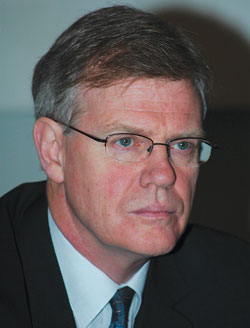
Nepali Times: How has the Commission looked at events in Nepal in the past year? James Moran: It's been an extraordinary year for Nepal and attention in Europe has certainly intensified. A year ago, there was the prospect of civil strife and Nepal was sort of put on the list of countries to be worried about. Things have of course moved on and you are now embarked on a process that is regarded in Europe as one of hope. This is important for Nepal, for the bilateral relations between the EU and Nepal, and I dare say, also for the region, where there are a lot of unresolved conflicts: Sri Lanka, Kashmir, Bangladesh's difficulties with its own elections. Seen from the South Asian perspective, Nepal is carrying the banner of hope for progress.
What is your assessment of how things are moving?
I was here with the EU Troika Mission in November just before the signing of the agreement with the parties and this time we are here to talk about our cooperation agreement. But as far as I can tell, you have enormous number of challenges still to face up to. But Nepal is on track, it's holding.
On cooperation, are you going to wait for things to get totally normal?
No we're not. The fact that we're here talking with our Joint Commission shows you that there has been a lot of progress in the last couple of months. We have been preparing our new strategy paper on Nepal for the next six years and this will be presented very soon in Brussels. It will focus on the social sectors, education, and consolidation of the peace process, where effort is needed. We have an exploratory mission on election observation that is finishing off its work now. So a number of actions are underway already.
India and China are regarded as Europe's strategic partners, how has relations evolved with these two giants?
It's certainly one of the great challenges we have in this century for Europe to get our relations right with both those countries. With China we've had a strategic parternship and we've had a honeymoon with China for the last five years economically and politically. China is now our second largest trading partner and with current trends it will be the largest in five years, overtaking the US. There are 20,000 European companies operating in China. And then of course there is a whole political agenda out there, especially on the multilateral front. I'd say relations with China have matured very rapidly in the last three or four years so it's completely unrecognisable. What we need to get with China is a more balanced relationship than we've had up to now.