
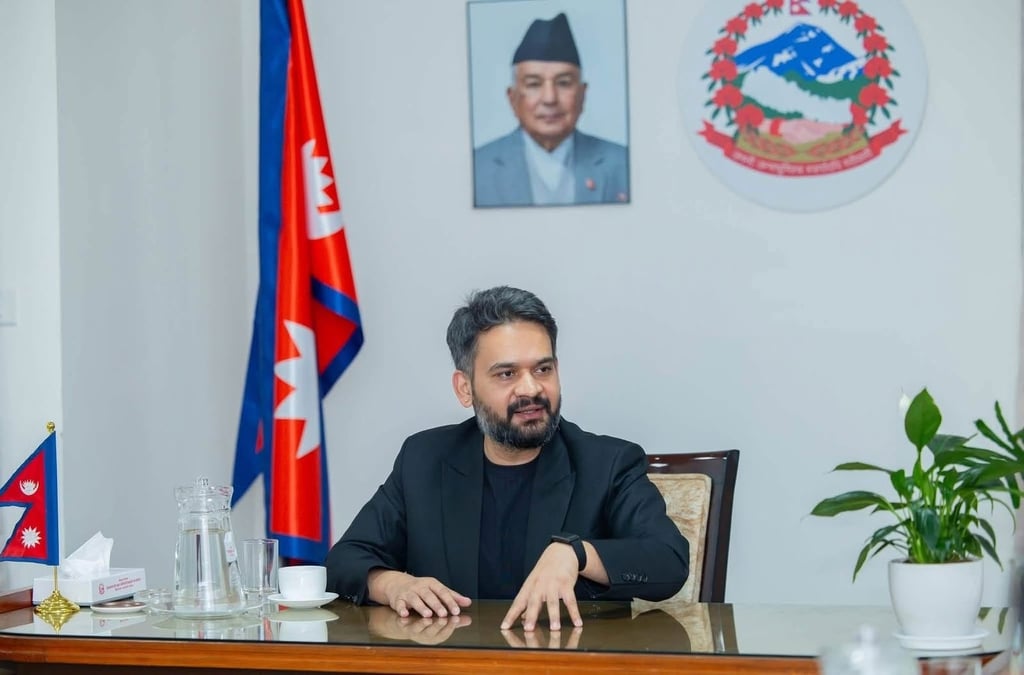
Prime Minister Balendra Shah is making his first foreign trip to speak at the United Nations General Assembly on 24 September, and just about everyone everywhere is giving him advice about what he should say.
Going by the content of the PM’s address to the nation and social media posts since the 26 August disaster, climate justice will be right at the front and centre of his delivery. Assigning blame for the climate crisis will, no doubt, be a compelling message during the year of a super-charged El Niño. It will also add counterweight to rising climate denialism and rollback on decarbonisation by populist flat-earthers.
Nepal’s annual per capita carbon footprint is 0.5 tons – only 0.1% of total global emissions. The annual per capita carbon footprint of the United States is 15 tons and is second only to China, but China has a much smaller per capita footprint. The US and other industrialised states are also responsible for historical release of carbon dioxide, the greenhouse gas that stays in atmosphere for hundreds of years.
Global average temperature is already 1.5°C above the pre-industrial baseline, and a phenomenon called ‘elevation-dependent warming’ means the Himalaya is heating up 0.7°C faster. The average temperature on the north side of Langtang Lirung in the week preceding the rock slide was 5°C at 5,200m elevation – the highest ever recorded in the area.
The Bhote Kosi-Trisuli Flood was not unexpected, scientists have been warning of even worse events. This is a global warning about warming. It is not just a Nepal disaster, but presages what is coming for the planet and life on it.
For three weeks, the global media was focused on the Trisuli. Terrifying videos of the debris flow burying towns set off a wave of sympathy for Nepal, with an outpouring of humanitarian aid. But the attention span of the international media lasts only some weeks before it moves to other hotspots.
Nepal is already falling off the map, and needs to capture the moment. When Prime Minister Shah walks up to the General Assembly podium it will have been exactly a month since the China-Nepal flood. What he says there, how he says it, and how it is received will determine whether Nepal’s soft power has disproportionately more clout than the country’s size and economic importance.
VICTIM CARD
It will be tempting for Nepal to play victim, and make the industrialised world guilty about historical emissions. We have the evidence and moral high ground to assign such blame. The international community will commiserate and offer platitudes, but one thing is clear -- empty empathy is not cash.
The Rapid Damage and Needs Assessment published by the National Disaster Risk Reduction and Management Authority (NDRRMA) has put the cost of this disaster at $4.7 billion. The Fund has a $20 million disbursement cap on claims, so why extend our arms for alms from an entity that has no money?
Besides, the Fund’s funders have set strict criteria for deciding what constitutes a ‘climate disaster’. This is like the police asking a bruised and battered victim of a mugging to get written proof that he was mugged. Fund managers will point to geotectonic factors in the 26 August disaster, and trolls will call us ‘grifters’.
Instead, let us highlight our contributions: doubling forest area to 46% in the past 30 years, most of our electricity is hydro, and 75% of new vehicles are EVs (page 5). We can say: “This is what we have done. What have you done?”
There is evidence that permafrost melting due to record high temperatures fractured the bedrock on which the ice shelf rested on Langtang. The slope collapse was only a small part of a huge mountain. Multiply Langtang by hundreds of other massifs in Nepal and southern Tibet and it is clear 26 August is a warning of even bigger Himalayan tsunamis.
Climate breakdown may have been only one factor in the Langtang rock-ice collapse, but future outburst floods from thousands of expanding glacial lakes in Nepal and China could add to the threat of even more catastrophic cascading and compounding hazards.
Nepal has only itself to blame for allowing settlements along floodplains, and locating a dozen hydropower plants on a single basin. This disaster was a wakeup call for Nepal to build back safer not just in the Trisuli Valley but also along other rivers, and to figure out how to pay for climate resilience and damage in the future.
Next week at the UN General Assembly, Nepal’s prime minister will alert the world: look at what happened to us, it will happen to you unless we all stop pumping more greenhouse gases into the air.
Kunda Dixit
Kunda Dixit is the Publisher of Nepali Times and the author of Dateline Earth: Journalism As if the Planet Mattered.