
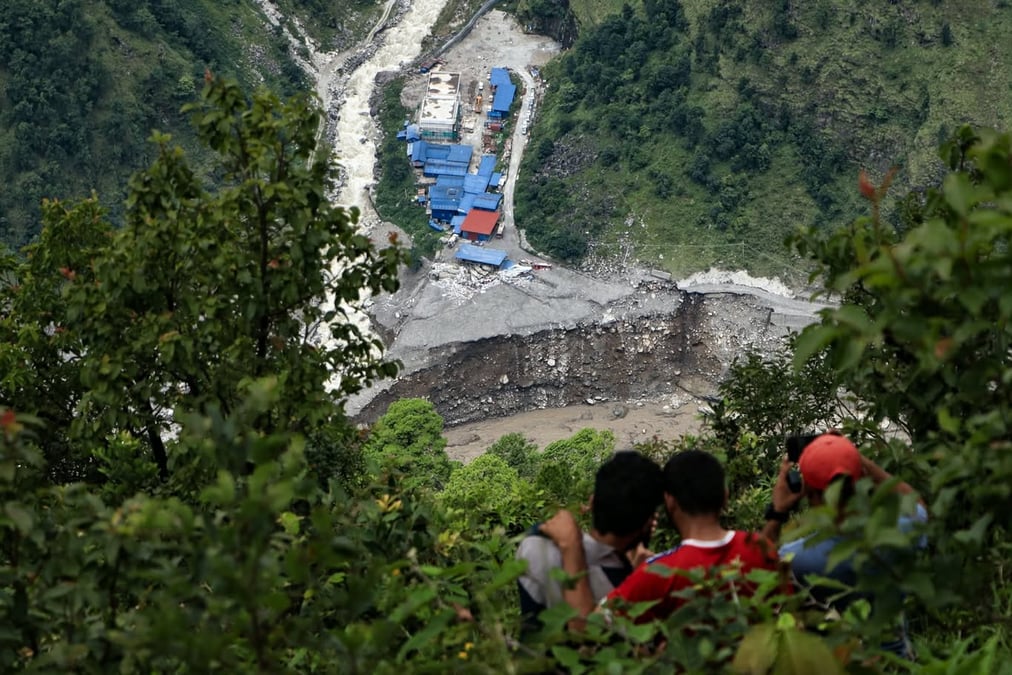
Building back from the floods that began on 26 August will cost Nepal $4.7 billion, according to a Rapid Damage and Needs Assessment published by the National Disaster Risk Reduction and Management Authority (NDRRMA). As expected, hydropower plants took the greatest financial hit at about $1 billion – more than five times the total infrastructure loss of the 2015 earthquake.
The assessment consolidates damages into four sectors, with recommendations for how Nepal should build back both today and longer-term. While many long-term recommendations are open-ended and require further analysis, early recovery activities are focused on restoring access, maintaining essential services, and enabling livelihoods to resume.
Infrastructure will be the costliest sector to rebuild by far, accounting for about 65% of NDRRMA's overall estimate at $2.6 billion. Nepal's energy and grid system alone suffered just under $1 billion in damage and losses. This figure includes damage to 13 hydropower projects and five solar plants with a cumulative capacity of about 783 megawatts – about 20% of Nepal's pre-disaster generation capacity.
Early recovery activities for the energy and grid system include restoring transmission lines and substations and undertaking micro-hydropower rehabilitation. In the longer term, the government will seek to restore damaged assets. The extent of the damage to headworks, penstock, tailrace tunnels, and powerhouses across the 13 impacted hydropower plants has not been minutely assessed and will likely add to actual long-term recovery costs.
The assessment highlights the importance of looking at the Bhotekosi-Trishuli-Narayani corridor as a connected system – and one that will continue to be impacted by global warming. Accordingly, disaster and climate risk mitigation is another costly line item, accounting for about 13% of the overall estimate.
Developing a multi-hazard early warning system within the next six months is a risk mitigation priority. While NDRRMA notes that 679,295 early-warning SMS messages were disseminated through Nepal Telecom and Ncell to populations in identified downstream risk areas, the assessment recommends further examination to determine how effective these warnings were and to inform the proposed early-warning system's development.
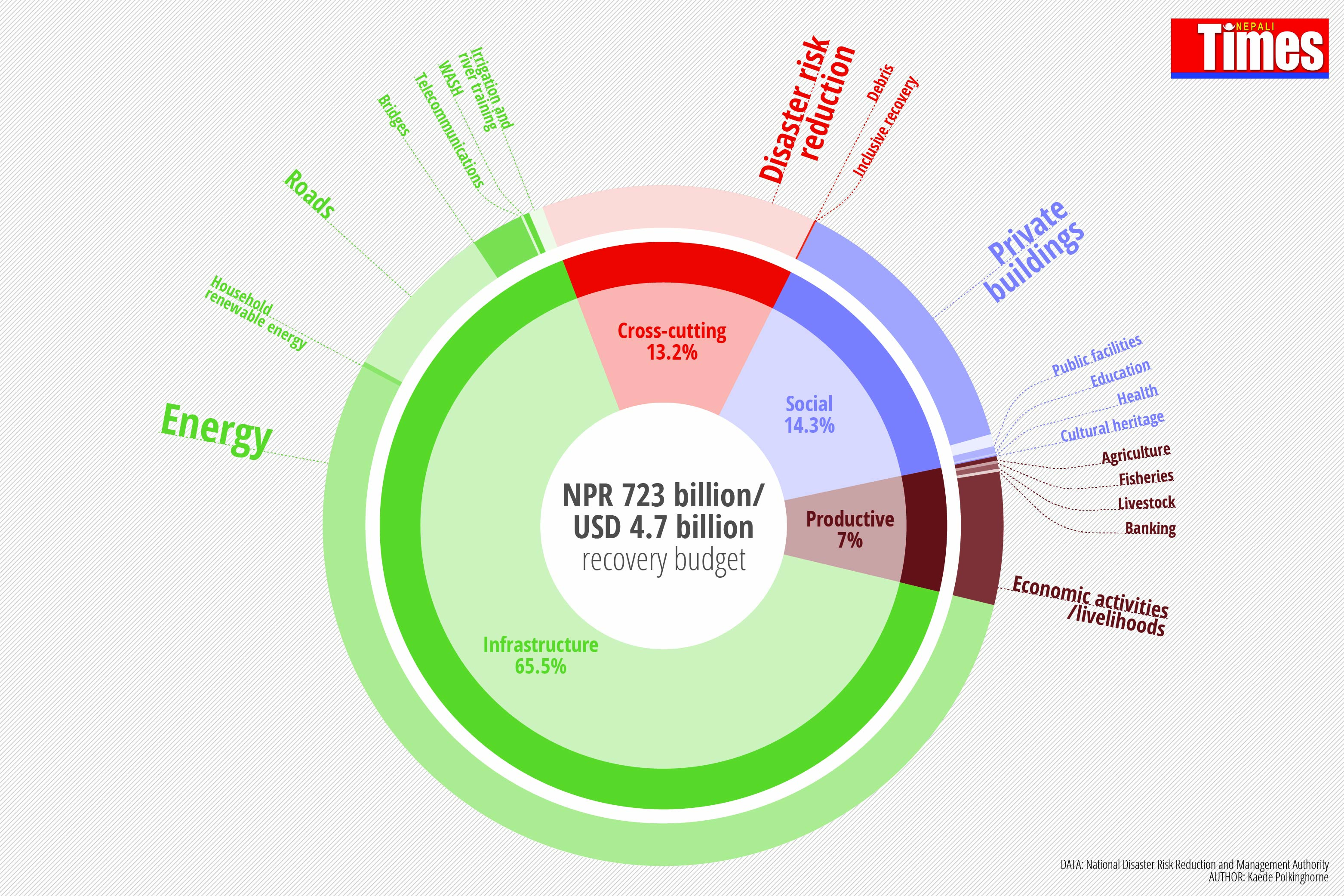
A series of general categories for risk reduction projects are also proposed: river management and settlement protection, high bank erosion and landslide protection, waterway clearance and associated filling, command-area development, and irrigation system restoration. River management and settlement protection is the most financially significant category for recommended risk reduction projects by far, but what the projects in this category will look like is yet to be determined.
Restoring roads and private buildings and re-establishing stable economic activity are other substantial line items in the cost estimate. While the assessment records damage to 18 schools – impacting more than 9,000 students – and seven health facilities, repairing or reconstructing public buildings will cost a small fraction of the budget at just under $50 million.
However, these smaller ticket items represent some of the most urgent early recovery areas, as they will make a big difference for the estimated 32,963 people that the RDNA estimates were impacted by the flood.
At present, 3,685 people are spread across 37 holding centres in Nuwakot, Rasuwa, and Dhading. More than half of all impacted households were in Nuwakot, and holding centres are also concentrated in the district.
Infrastructure Minister Sunil Lamsal recently shared that the re-settlement process is expected to take two years, although the government is working to relocate people from holding centres to temporary accommodations as soon as connectivity can be sufficiently restored.
Further analysis is needed to fill data gaps, especially around housing and road conditions, which will inform more detailed recovery strategies.
So far, 1,386 bodies have been recovered in Rasuwa, Nuwakot, Dhading, Gorkha, Tanahun, Chitwan, Nawalparasi East, and Nalwalparasi West, and 5,130 people are still missing. These incalculable losses parallel the 2015 earthquake, which took 8,773 lives.
Rapid Damage and Needs Assessment (RDNA)
Rasuwa-Bhotekoshi Fllod 2026
by National Disaster Risk Reduction and Management Authority
September 2026
110 pages