
 I generally prefer tempos to microbuses and buses, and not just because they run on gas or electricity. There’s more of a sense of community in their 6-by-6 permutation than in big buses overflowing into the aisles or jammed microbuses commandeered by sweary, phlegmy teenage conductors.
Rattling along sedately in one of these metal cans to where the Social Justice Movement was gathering, I was privy to one of those Safa tempo conversations. This one, though, was between the driver and one Dorje, also a driver. Despite myself, I began listening in; the tale lasted all the way from Bhanimandal to Sundhara.
I wasn’t even listening to the lengthy enumeration of negotiations at the workshop to fix a tempo battery. But when it came back unfixed and the Madhesi mechanic refused to reimburse Dorje, he lost it.
He was going ‘I can’t pay you back, I spent the money already to fix this, it won’t work,’ so I slapped him, twice. Then the son of a bitch started wailing, Allah Allah, and when a cop came over he made as though I was going to kill him, ‘Allah, humko mar diya een logo ne!’
I explained to the cop what had happened, how I’d been cheated, and the cop goes, ‘Well, you should have come to us directly. You hit this man. You better move on now, or I’ll take YOU to the station.’
Can you believe it? Ultai malai po! I’m the one who’s been done wrong and the son of a whore is telling me he’ll take me to jail.
I looked back at the women crowded behind me, but no one seemed bothered by Dorje’s language, let alone his ill-placed righteousness. We were at Sundhara, and the tempo paused to let off passengers, then asked the neighbouring tempo to take those of us heading on to Ratna Park. There wasn’t enough space for all of us, so I cursed the driver as I stomped across to Shanti Batika, thinking, amorality and prejudice against minorities and women is ingrained in the Nepali psyche. How many protests would it take?
*
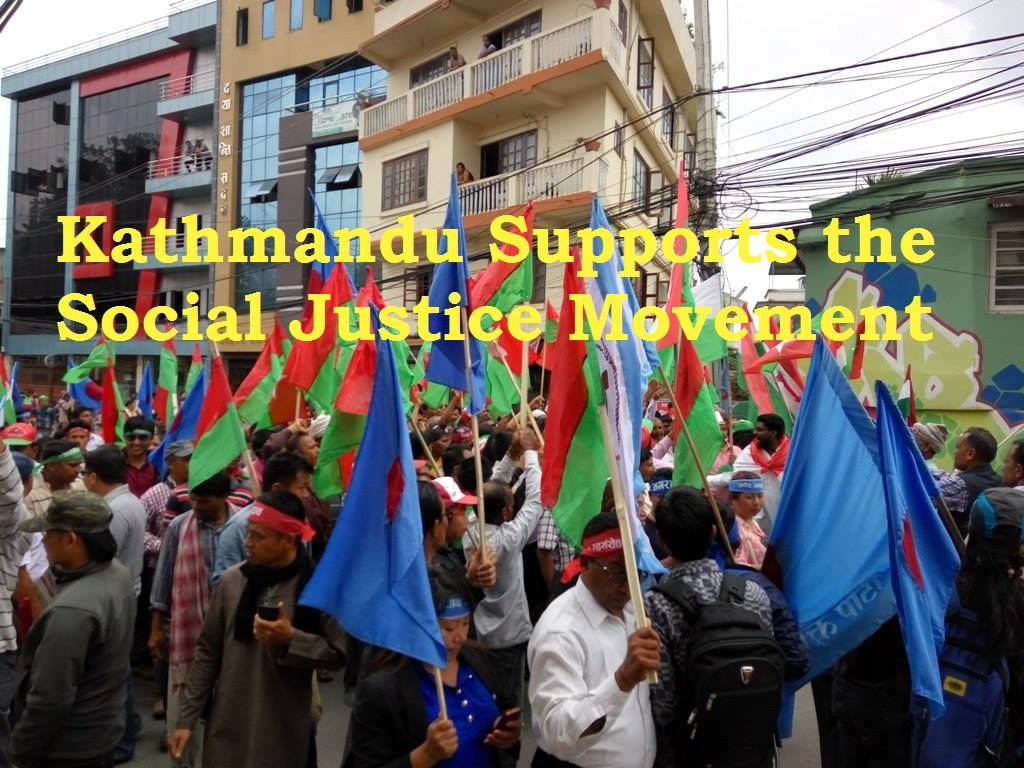
The protest itself, ‘Kathmandu’ in solidary with the Social Justice Movement, was an unremarkable event, at least until the flag-waving party activists filled the streets around Ratna Park. A thin line of us, bearing slogans for social justice and women’s citizenship rights, stood against the railings under the blazing heat, catching up with friends and acquaintances. For a few moments, it felt like being at any other Kathmandu event rather than the opening salvos of a definitive movement to penerate the nationalistic chauvinism that has long cloaked the state of Nepal at the expense of its myriad minorities. Coming as it does on the heels of last year’s protests around the promulgation of a contested constitution, and the misguided blockade that came to define it, this round did not inspire much confidence in me. But the energy of the activists from Madhesi and Janjati parties was undeniable.