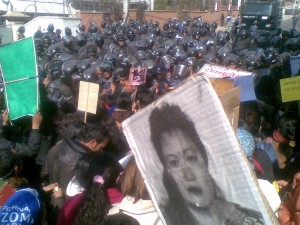
One good thing about the protests confronting Violence Against Women is that they are being organized by individuals determined to keep this fundamental blight in the limelight until the glare of collective disapproval bleaches it out of Nepali society. This takes time. Time enough, then, for one to attend a protest, stay away for whatever reason, and return to find the crowds still baying for justice. The staying power of a meaningful protest, more than the inconvenience or damage it inflicts, is what matters when it comes to bringing about lasting change.
The protests centred on Baluwatar – going strong a month since they began – are not about declaring someone a martyr, obtaining financial compensation, or releasing someone from jail. These are acts of appeasement that the government of the day seems to find too easy. The protests are about upending the entire system of impunity and corruption that characterizes Nepali society and the state that pretends to govern it. As such it is difficult to obtain tangible results.
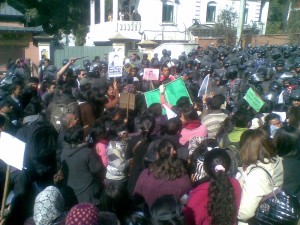
‘They don’t seem to have achieved anything, after a whole month of protests,’ grumbled a journalist friend, barely audible through the banging of pots and pans (an initiative of some exuberant Lazimpatey youths) and the toots of passing cars (encouraged by protestors). ‘That may be so,’ I replied. ‘But isn’t this – this – an achievement in itself? Kids expressing themselves for a cause, people heading to work waving to the protestors, the sense of community that has been created here? Look, even the riot police are smiling. Even if the government doesn’t do anything at all, people will have taken the message of the protest to heart, and that will contribute to change. Hoina?’
‘Maybe,’ he conceded. ‘But there has been cynicism regarding the so-called agenda of the protests. The Nepali press, for instance. Who’s funding these people, these NGO-INGO people, they ask. Why are they protesting? What are they protesting for? These sukila-mukila have nothing better to do, they say.’
It was a familiar refrain. The Nepali-language press, more naturally attuned to the rough and tumble of political protests (given that so many are openly aligned to political parties), has its reasons to be suspicious of the VAW protests. In view of the opposition’s craven bid to politicize the government’s suppression of landmark cases, even those who advocate women’s rights could find cause to stay away. But cynicism is too often a symptom of intellectual laziness (ironically, posing as the opposite). One only needs to examine the core agenda of the Baluwatar protests – demanding justice in very specific cases in order to curtail violence against women, as explained on http://meroandolan.com – to dispel doubts.
In front of us, things were hotting up. The organizers were leading a push against the battalions of riot police in a bid to offer themselves up for voluntary arrest. Doubtless inured to the challenges of managing violent protestors armed with brickbats, the police easily (and good-naturedly) held back the line. ‘I wanted to get arrested, too,’ complained a friend. ‘But my father’s ill, and I can’t leave my mother home alone.’ ‘Yes, that would constitute mental violence against your mother, wouldn’t it,’ I teased, as cheers erupted. One by one (eventually totalling 32), the more enthusiastic were managing to squeeze far enough into the police lines to warrant their being led off to a waiting van. The cameras came out; it had been a good day.
*
When I was a young man, teenage expression was limited to headbanging through the grinding rhythms of the seminal Metallica LP …And Justice for All. The album cover featured a bare-breasted, cracked statue of Lady Justice, restrained by ropes. Back then, I barely grasped the significance of that tableau, embedded as I was in a patriarchy of old fools and angry young men. Today, I watched a dignified lady in a sari, blindfolded and bearing scales, calmly walk up to a space that had opened up between the lines of protestors and policemen and policewomen. She smiled, as if to say: The angry young men have become old fools and in their place stand impassioned young men and women seeking only a fair society for all. Justice for all, is it too much to ask for?