Eschewing the more obvious themes presented by headliner sessions such as ‘Why Books Matter’ (with Patrick French, Kiran Desai et al), I followed a friend into ‘Cinema Bhojpuri’. His claim that Nepali directors were responsible for much of the resurgence in the Bhojpuri film industry in Bihar and elsewhere was an intriguing one, and I seized on the chance to explore something new.
Our focus on multiplex releases, be it Hollywood, Bollywood or Kollywood, means regional productions alien to our own cultural milieux too often pass under the scanner. With 500 movies produced in the seven years to 2009, however, Cinema Bhojpuri is not to be ignored. Avijit Ghosh, in describing the Bihar he grew up in himself, hinted at the earthy nature of the films viewed in ramshackle theatres where the “tin roofs were hotter than Helen”, in a Patna where (according to co-speaker Sharmila Kantha), “there are no secret places for lovers.” It is only now, they implied, that Bihar’s growth has allowed its incipient film industry to capitalise on a population that can afford to watch movies regularly.
Moving on to ‘Strangers in the Mist’, a discussion on the Indian Northeast’s gloomier prospects, one couldn’t help but reflect on the pitfalls inherent in a state’s dealings with ethnic communities. With 220 ethnic groups making up a population of 40 million – “an anthropologist’s delight, and an administrator’s nightmare” – according to panelist Sanjoy Hazarika, the Northeast is an example of how not to ‘do’ federal Nepal.
Here, the literary qualities of what was read out was perhaps secondary to the truth itself. But the tragedy is not only in the truth of massacres, rapes and disappearances. It lies in the fact the young novelists like Assam’s Aruni Kashyap can only write about violence, because they have “never known what it is like not to live under the shadow of a gun”. The success of Indian democracy, he concluded, “is that it has managed to create apathy amongst urban populations towards the plight of those in rural areas.”
--
Next up was the BBC’s live recording of The Forum, with our own Manjushree Thapa debating how to be
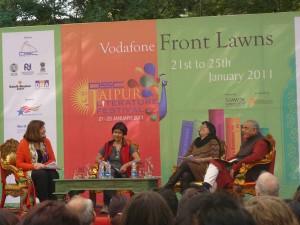
‘good’ in the modern world with Gurcharan Das and Kaveri Nambisan. The session raised interesting questions on the difficulties of sculpting one’s own modern, practical morality. But through design or chance, it appeared prepackaged for a London audience, with each panelist alloted a certain role. While Nambisan, a doctor, spoke of her struggles to connect with the poor even as she is privy to their sufferings, Das spoke (sometimes eloquently) of the importance of ‘dharma’ in furnishing moral guidance. Thapa herself chose to elaborate on how Buddhism has simplified this quest for her, though as for most of us, it’s easier to be good at work than at life for the very simple reason that you can get fired at work. These aphoristic nuggets of Eastern wisdom notwithstanding, the BBC would have been unprepared for the outburst from a young man during question time: “You come here to ask Indians about dharma, ok?…you know nothing, ok? Indians rule the world, ok!”
I missed Thapa’s session on ‘Imaginary Homelands’, which followed immediately after another of the fesival’s ghee-drenched luncheons. But it was a busy day for the Nepali delegates, with Narayan Wagle and Sujeev Shakya part of the session ‘Fractious borders; the ups & downs of Himalayan relationships’. The absence of the Bhutanese and Afghani speakers diminished the regional span of the debate that ensued, but perhaps this allowed for more in-depth discussions into the fraught Nepal-India relationship with Indian Foreign Secretary Nirupama Rao (with occasional diversions to include Pakistani author Shehryay Fazli). Rao was careful not to be controversial, but when Wagle noted the Nepali perception that their country was ‘India-locked’, she couldn’t help but reply, “India holds the key”. Audience members were quick to respond: “All South Asian nations should hold a masterkey!” The question that remained unanswered by the end, however, was whether South Asia really is a Europe in the making. Rao concluded, “South Asia needs to grow up.”
--
The evening belonged to HM Naqvi, the Pakistani author of ‘Home Boys’; he was declared winner of the first DSC Prize for South Asian Literature. Fifty thousand dollars the better for it, he bid adieu to days of back-o-cabinet scroungings for pasta.
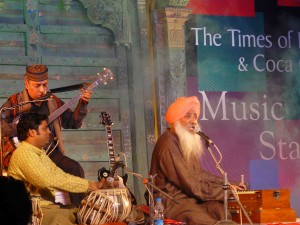
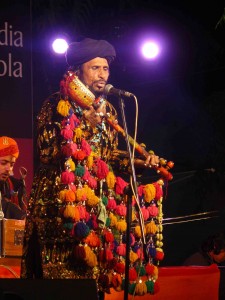
And we converged, too, a little worn, still buzzing, to the performances lined up for the evening. If the starting poetry on offer seemed anaemic, with a beer at hand, Madan Gopal Singh’s fusionistic Sufi melodies (featured in Kathmandu last year) were a balm. The soul settled, Pakistani sufi singer Sian Zahoor, all wrinkles, rings and gold sequins, roused us into ripples of blissful turbulence to the tunes of ‘Allah Hu’.