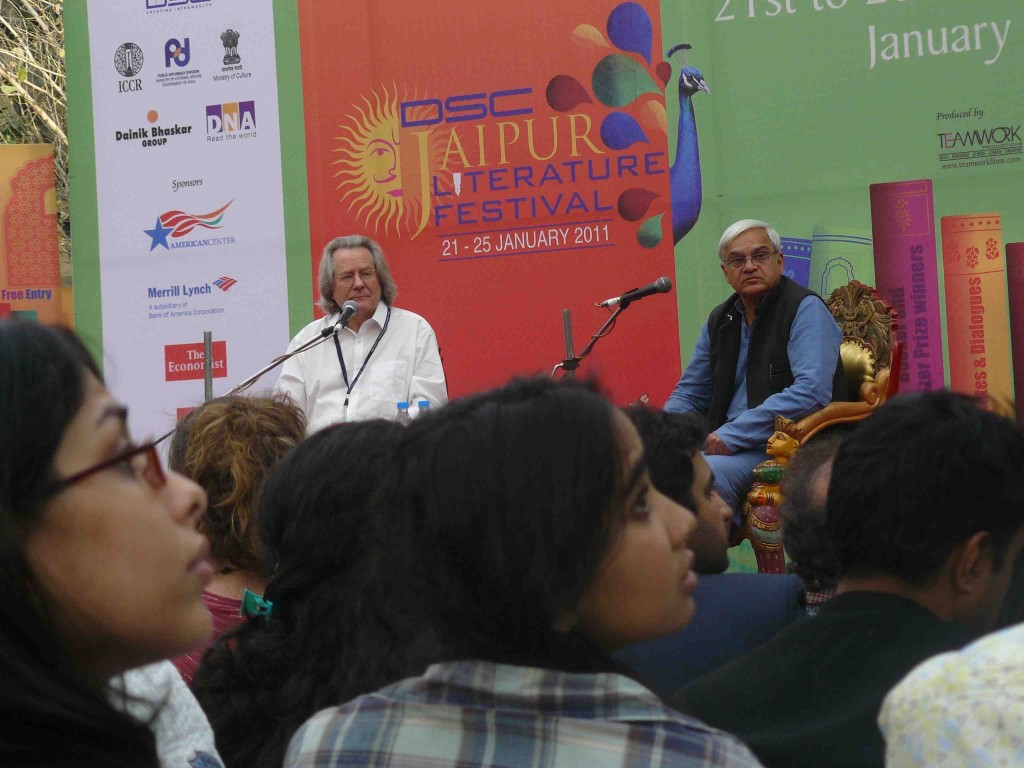
There’s a story Ruskin Bond tells the audience that is illustrative of just how things have changed in the world of publishing, currently spearheaded in the subcontinent by the likes of his interlocutor this morning, Ravi Singh of Penguin India.
He tells us of how he goes to a bookstore, and just like any young author might, looks for his books. He finds a copy of one, alas, tucked into the bottom of a pile of books. Sneakily, he slips it out and places it on the top of the pile. But the owner of the store has seen him. Not recognising Bond, he takes the book and pushes it back under, remarking, “Yeh nahi chalta.” (This doesn’t sell). “To teach him a lesson,” says Bond, “I bought the book myself.” And how much did said book cost? Three rupees.
In those days before literature festivals and publicity tours, if we are to take Ruskin Bond at his word, the author didn’t really write for an audience. You just sat in a room and wrote. Of course, writers are no longer faceless individuals. Perhaps this is why JM Coetzee, who gives the impression of someone who only wishes to express himself through his work, was so eagerly anticipated at the festival.
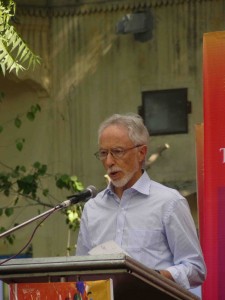
Coetzee, a spare, upright, white haired white man of 70, could not have appeared more different from last year’s Nobel Laureate Wole Soyinka, an expansive, big haired, grandfatherly black man whose booming baritone mesmerised a similar audience. But for forty-five minutes, reading from ‘Elizabeth Costello’ in his precise, measured tones, Coetzee achieved the same effect on the Front Lawns of the festival venue (where even standing space was at a premium).
The chapter read out by Coetzee tells of a professor visiting his elderly mother, a writer, in a remote village in Spain. Here she lives with numerous feral cats, and the ‘village idiot’ Pablo, both of which she stubbornly dedicates herself to. The son tries to understand, somewhat fumblingly, what his mother means by this. They speak of faces (do cats have them?), souls (if a cat has a soul, does it have qualities?), the concept of choice, and whether life was a birthright as much as for Pablo as for the cats who multiply incessantly. Layers upon layers, in unblinking, limpid prose: you could not ask for more of a novelist.
And what of philosophy, beloved and daunting? Following Coetzee’s meditative reading, AC Grayling’s ‘secular sermon’ sought to dispel the fear of seeking answers to ‘what is’ and ‘what matters’. This quest, for Grayling, is a responsibility if we are to live better lives, and make use of the third of the 1000-odd months that are available to us for serious living, learning, and loving. Further, if we are to be able to have “the degree of latitude with which to seek the ethical”, we need individual autonomy and freedom of expression. Authoritarians across the world well fear the Graylings of our age, because the sword has no chance against pens wielded with such passionate, articulate intelligence.