
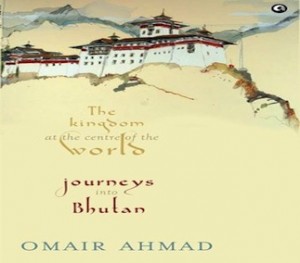
 The Kingdom at the Centre of the World: Journeys in Bhutan, by Omair Ahmad, Aleph Book Company, 2013
We have come to expect production values from Aleph Book Company, and The Kingdom at the Centre of the World: Journeys in Bhutan does not disappoint with its delicately rendered cover of a dzong suspended, as it were, in time and space. Nonetheless, it is the stated mission of author Omair Ahmad to tether the mystery of Bhutan to the mainstream of the wider world, and he begins by name-checking milestones on the road to Thimpu – the introduction of Buddhism by Padmasambhava in the 8th century, the state’s consolidation in the 17th century, its fraught relations with Tibet, China and British India, the refugee crisis of the 1990s, and the latter-day curiosities of Gross National Happiness and guided democracy.
But Ahmad is not dealing in serious history here. He opts instead for a more palatable hodgepodge of folklore, journalism and travelogue, divvied up into sections too brief to do their subjects justice. He devotes two early chapters to assorted saints who put Bhutan on the map; it’s frustrating that a book that means to enlighten us on Bhutan finds it necessary to subsist on a mash-up of mythology and recorded history. Ahmad’s easy, anecdotal style has its advantages, but it leads him to such lazy paragraphs as that summing up the 11th-century mystic Milarepa: ‘The idea of a man at peace with himself in the wilderness, subsisting on wild roots and attuned to Buddhist principles must have held great appeal to the Buddhists of Bhutan, enclosed as they were by jungles and mountains. It is little surprise that the Drukpa school of Buddhism soon began to dominate the country. Milarepa’s songs are considered amongst the greatest repositories of Buddhist knowledge ever produced.’ There is no real examination of why the Drukpa school dominated in Bhutan or why Milarepa’s songs are so profound, so one is forced to conclude that Ahmad is projecting his own pastoral longings onto mediaeval Himalayan peoples.
However, the simplicity with which Ahmad outlines Bhutan’s religious and secular evolution serves some purpose, and the reader begins to grasp the difficulties the tiny kingdom has faced throughout its miraculous survival in a rough neighbourhood. Ahmad also, by recounting the invention of the suspension bridge in Bhutan and the tea-fuelled Duar Wars with the British, manages to posit the country as less isolated, if not quite the centre of the world. Perhaps he is too enthusiastic: he is very keen to portray Bhutanese protagonists as heroes, and his disapproval of British colonial Ashley Eden, for instance, is undisguised and petty.
If unbiased historical analysis is not Ahmad’s forte, however, we have a right to expect real insights into Bhutan’s character, earned through hard miles off the beaten track. Instead we are served up with vignettes of a few tourist sites, supplemented with weak anecdotes culled from previous visitors. Is the writer being disingenuous when he claims that as a political advisor in New Delhi in 2005, he found ‘almost no concrete information about the country’? Bhutan may have been an enigma to many, but scores of tomes dissecting its history were published prior to Ahmad’s discovery of the country that ‘sounded too good to be true’. Perhaps he is trying to convince us that information was scarcer than it was, so as to present his own travels as more adventurous than they actually are?