 |
The government has declared 2012 as Nepal Investment Year, but if the experience of Hartmut Bauder is anything to go by, there won't be too many foreigners wishing to invest in Nepal.
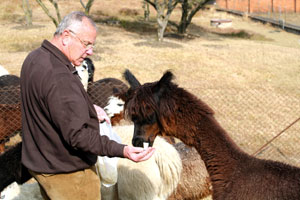
Bauder (pictured, above) was working for the German multinational, BASF in India where he married a Nepali and moved here in 1985. He retired to the country that captured his heart and set up Himalaya Plantations to propagate olive oil, which he felt is an ideal agro-industry for Nepal.
Many thought Bauder was crazy, and told him so. Still, he set up his plantation in Chitlang of Makwanpur and nurtured every sapling in his orchard until it reached maturity.
"This was kind of a wild idea, that we grow olives in Nepal," Bauder explained this week, sitting at his home in Thaiba. "There was no know how what so ever and we learnt the hard way that it's a very difficult business."
Bauder has met obstacles every step of the way but he has proven that Nepal is an ideal place to grow olives and produce high quality olive oil, the standard of which is praised even in Italy.
"Because the soil in Nepal is so poor, washed out and acidic there is a lot of land where olives could grow," he says. While olive oil consumption has increased in Nepal, Himalaya Plantations continues to be the only producer of Nepali olive oil, a fact which leaves Bauder dismayed.
"My intention was to show that it works, not knowing if I would ever get my money back," he says, "I was willing to run that risk. But if it worked I had hoped the government would say thank you and promote it among Nepali farmers. But nothing really happened."
Bauder's investment in Nepal's agriculture isn't restricted to olive oil. He introduced South American alpacas to show that Nepali livestock farmers could have additional income. Alpacas are well suited to Nepal's topography and terrain and they produce high quality wool known for its warmth. In Europe an alpaca coat can cost up to 1,000 Euros.
"It was another idea; like olives, we wanted to bring something positive to the country," says Bauder, "we thought Nepal is also high altitude, there is fantastic wool, it should work." But in the absence of an official push, alpaca farming has been slow to catch on.