
Eight months ago in this space, I argued that Nepal's crisis is better explained by homegrown institutional decay than by ‘foreign hands’. And here we go again: the India question is back at the centre of our politics.
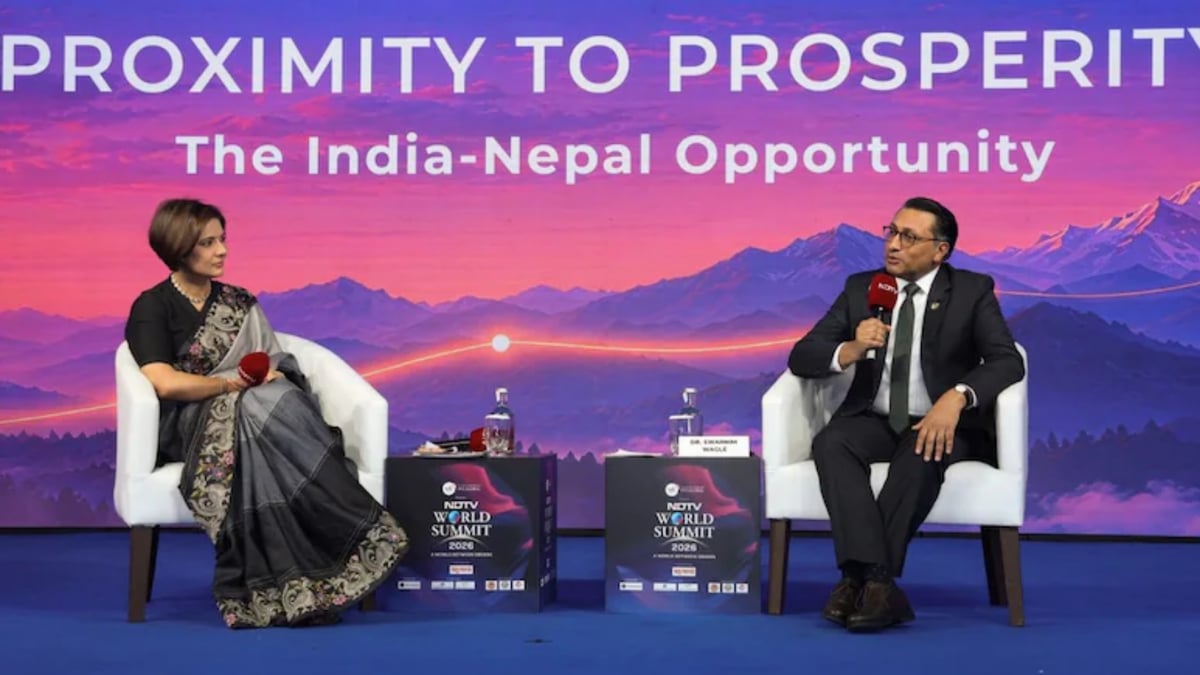
Not through a foreign plot this time, but through a minister's words in Delhi. At the NDTV World Summit last week, Finance Minister Swarnim Wagle, who is also vice-chair of the RSP, said: "Our generation is different. We have seen the world, and our aspirations are economic. We want good jobs, good governance and good relations with our neighbours. So I can say with great happiness that the era of associating Nepali nationalism with anti-Indianism is now over."
Picture the scene. A globetrotting, highly capable Nepali economist and finance minister takes the limelight with External Affairs Minister S Jaishankar. He hit all the right chords, with a confidence rarely seen in Nepali dignitaries. So what could go wrong?
Well, for all the good intentions, a single word threw a spoke in an otherwise smoothly turning wheel. That word was "anti-Indianism" Back home, the reaction was swift. Critics asked why such a claim had to be made on a foreign platform.
Nepal needs a constructive and confident relationship with India, built on trade, energy, tourism, connectivity, IT parks and mutual respect. In an op-ed in Nepali Times back in 2010 titled ‘Win-win-win’, I proposed a trilateral connectivity and economic-cooperation summit among China, Nepal and India.
Nepal political culture labels people ‘pro-China’ and ‘pro-India’ against each other while opportunities next door is wasted. In that light, Wagle was trying to project a reset that his party had already articulated: Nepal as a ‘vibrant bridge’.
With a little less bravado, he could have achieved the same goal without the slippage. How can a government announce a change in foreign policy without turning it into another partisan wedge issue back home.
Read generously, his message was a generational one. Wagle’s implication seemed to be that his party's sweeping electoral support was proof that voters had rejected that old party-machine culture altogether.
Last September’s uprising and the sweeping mandate given to the RSP were largely a rejection of the moral decay, governance failures and extractive politics of the past, not a referendum on Nepal's relations with India or China.
Still, a new party with such a mandate naturally wants a fresh start with our southern neighbour, drawing on shared history and geography for mutual benefit, and to stand apart from the old pro-India and anti-India camps altogether. That is a worthy ambition.
But there is a boundary democracies have long tried to respect, and much of the criticism of Wagle's Delhi flap can be understood in that light.
In 2020, after the map dispute with India, the Nepali Congress' Minendra Rijal defended Nepal's position on Indian television. Though one of Prime Minister KP Sharma Oli's fiercest critics at home, he made clear that his opposition stopped at Nepal's borders.
Wagle did not attack his rivals by name, and his purpose was clearly to reinforce the idea of development diplomacy. But a minister abroad speaks for the country, not just his party, as others have noted. In going the extra mile to make his point, he used a word that may have blurred the line between a national message and a partisan one, perhaps unintentionally.
Here is the irony: to declare Nepal free of the old labels, many saw him as reaching for one of them. ‘Anti-Indianism’ is not a neutral description of the past. In our politics it is an accusation, and it is often aimed at someone.
Had Wagle simply said that Nepal is moving from the ‘politics of grievance’ to ‘development diplomacy’, his message would have come through clearly. ‘Anti-Indianism’ turned it into a quarrel over domestic dispute played out on foreign soil.
For decades, the far left and the far right branded the NC as ‘pro-India’, and it turn the party cast its rivals as ‘anti-India’. Each label serves the same purpose: to paint the other side as less patriotic.
When that vocabulary travels to a neighbour's capital, it sends a mixed signal about whom the neighbour should be dealing with: the party or the state. Foreign Minister Shisir Khanal's recent engagement with Delhi went through the proper channels, and one hopes that is the message India takes away: Nepal's partner is the state, not a party or its personalities.
None of this means anti-India sentiment was simply invented. The 2015 bBlockade was real, and its hardship is remembered in every Nepali kitchen. Unresolved issues remain: the border, unilateral embankments that flood the Tarai, barriers to our electricity, stalemate on air corridors. Raising them is not hostility. It is the duty of any government.
Former Indian ambassador Ranjit Rae, in his memoir Kathmandu Dilemma, gives his account of Nepali politicians seeking India House's views even on appointments such as the police chief. The north is no different. During the Communist split of 2020–21, China's ambassador was lobbying openly to hold the party together. Political factions have often courted one neighbour while accusing rivals of serving the other. It is our political culture.
When our institutions are weak, foreign governments find it easier to deal with individual leaders and party networks than with the state itself. Our politicians, in turn, have been accused of seeking outside relationships to strengthen their hand at home.
Critics back home saw a Nepal minister trying to win favour abroad by casting others as an anti-India faction. Whether intended or not, such political messaging risks turning relations with a neighbour into a tool of domestic party competition. Over time, this can weaken Nepal's bargaining position and give outside powers greater leverage over our internal politics.
The RSP's manifesto promises to turn Nepal from a buffer state into a ‘vibrant bridge’ between India and China. Wagle's message was trying to achieve just that: collaboration, growth and opportunity. I welcome that. But a bridge must be trusted by both banks of a river, and any shift in relations with India should be seen as Nepal's national policy, not just the RSP's party position.
To be fair to Wagle, every new government wants to show how it differs from the past. And sometimes that means pointing out what went wrong before. But foreign policy must go beyond party politics. Governments may change, but Nepal's national interests remain. The challenge is to improve relations with India without making it seem like one party speaks for Nepal more than others.
Democracies need not speak with one voice. Debate and opposition are healthy, especially at home. But looking outward, Nepal needs a foreign policy that continues from one government to the next.
Perhaps the most hopeful part of Wagle's message was not about India at all. It was about Nepal's younger generation: the demands for jobs, opportunity and accountable government. Whether this also marks a retreat from the old pro-India and anti-India labels remains to be seen. But it offers an opportunity to focus on economic ties with both neighbours that benefit ordinary Nepalis.
That is a message worth carrying abroad to both capitals. A statement this bold was made in Delhi, a similar one belongs in Beijing: Nepal's patriotism should not be measured by how close or distant it is from either neighbor, it should be a national message.
Our neighbours, too, should deal with Nepal through its institutions rather than through favoured parties or leaders. And our politicians should stop turning legitimate national concerns into tests of partisan patriotism.
Can Nepal change its foreign-policy direction without making every change of government a new declaration of who is patriotic and who is not? The younger generation may be opening that door. Whether our political institutions can follow remains the harder question.
For better or worse, the end of anti-India nationalism will not be declared in Delhi. It will be earned at home: in power plants, factories, export markets, and institutions strong enough to outlast any party.
Alok K. Bohara, PhD, is Emeritus Professor of Economics at the University of New Mexico, and writes his newsletter Nepal Unplugged.