
A simple change in traditional irrigation methods could cut methane emission, save water, and create a new source of carbon credits for rural economies in Nepal. But making it work will require coordination, monitoring and fair distribution of the revenue.
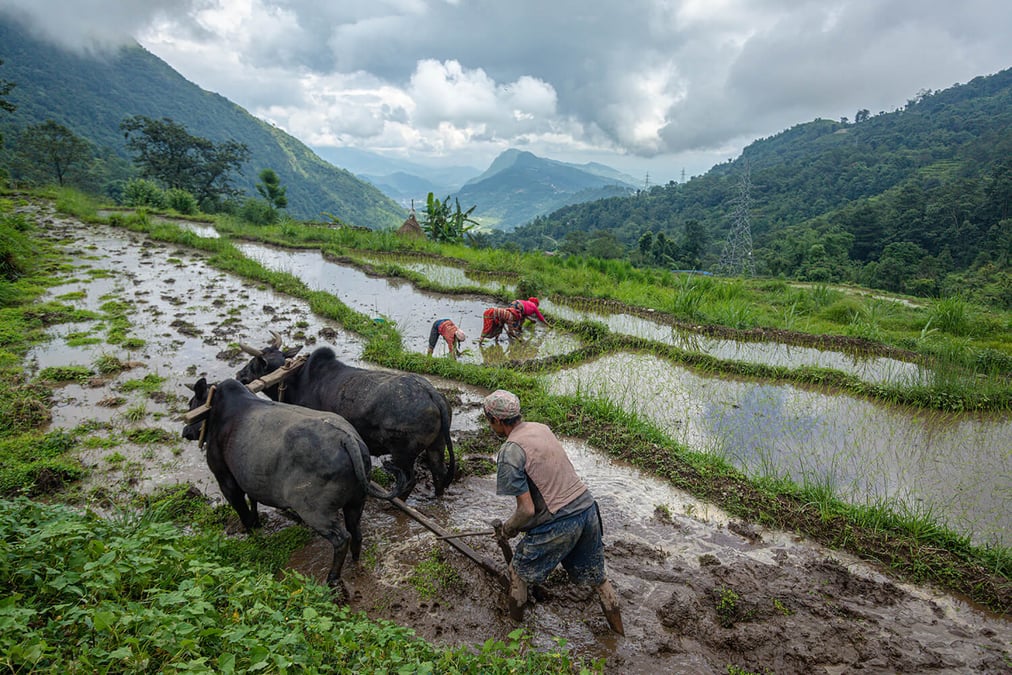
Flooded rice fields are a familiar sight across Nepal. Keeping the paddy plant underwater controls weeds, but in the absence of oxygen, methane-producing microbes thrive in the soil. Methane is an even more potent greenhouse gas than carbon dioxide and makes up a significant source of Nepal’s agricultural carbon emissions.
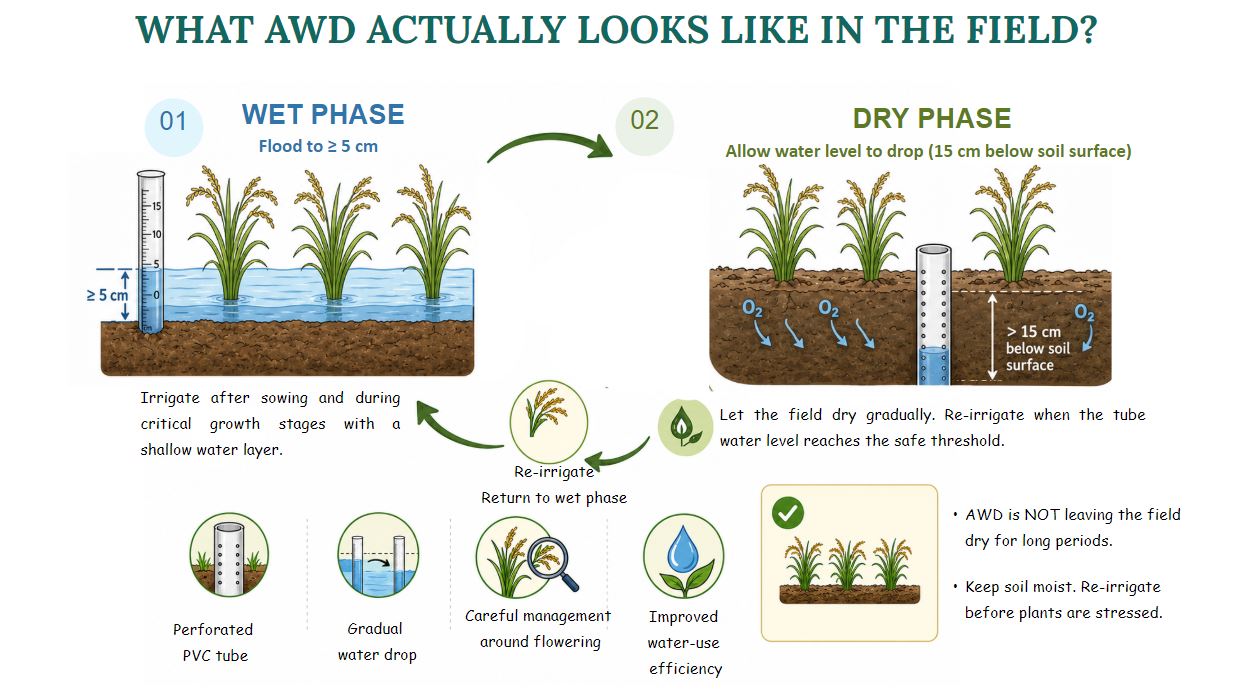
A simple modification of farming practice could help change this. Alternate wetting and drying (AWD) allows rice fields to dry briefly instead of remaining continuously flooded. Farmers then re-irrigate when the paddy needs water.
A perforated plastic tube inserted into the soil can show how far the water level has fallen. When it reaches a safe depth, the farmer irrigates again. Special care is taken during flowering, when rice is particularly sensitive to water shortage.
AWD does not mean allowing rice fields to be completely dry but using water more carefully.
Nepal has about 1.45 million hectares under paddy cultivation. Much of this lies in the Tarai, where flat land, warm weather and well-established irrigation systems make rice central to rural livelihoods.
Tarai paddy farms are best suited for the AWD method, especially where farmers control irrigation and drainage. But rainfed farms, and deep-water rice areas may be unsuitable.
Farmers in many places also share canals and pumps, meaning that one household cannot change its water schedule alone. This makes AWD more than an individual farming practice. Water User Associations, cooperatives, municipalities and irrigation offices will need to coordinate when water is released, how long fields remain without standing water, and how disputes are resolved.
SCALING UP
The science behind AWD is well established, but scaling the practice up is harder than demonstrating it on a few plots. Nepal’s rice farms are small and fragmented. Farmers worry that reducing standing water will affect yields.
Irrigation schedules are often uncertain, while agricultural extension services have limited staff and resources. Overall, the perceived risks of adopting AWD currently outweigh its benefits for farmers.
A carbon project could shift that balance. Building on the recent introduction of Carbon Trading Regulation 2082, which established a legal framework for carbon trading, a carbon project could enable farmers and municipalities to generate revenue by implementing AWD and reducing methane emissions.
That revenue could pay for farmer training, field demonstrations, water-level tubes, irrigation planning, monitoring and technical support. It could also provide incentives to farmers who follow the required water-management practices.
Lower emissions do not automatically become carbon credits. A project must first establish how fields were managed before AWD began. In this case, the baseline would be continuous or extended flooding. The project must then demonstrate that farmers changed their irrigation practices, methane emissions fell and rice yields were not negatively impacted. An independent auditor would review the evidence before credits could be issued.
One attractive structure for an AWD carbon project is certification under Gold Standard, an international carbon-crediting program that provides a pathway from project planning to the issuance of credits.
In Nepal, AWD is still at the feasibility stage and has not yet been registered as a project or issued carbon credits. However, an AWD project in Pakistan recently received the first rice methane reduction credits issued by Gold Standard. The final number of credits would depend on the area that is eligible, previous flooding practices, crop duration, farm inputs and the methodology accepted when the project is registered.
$36M in carbon credits
AWD can reduce methane emissions by an average of 2.5 tonnes per hectare each year. Nepal could theoretically avoid 3.62 million tonnes of greenhouse gas emissions annually to generate gross annual value of about $36 million at $10 per credit.
But this would depend on local flooding practices, crop duration, soil conditions and farm management. And even partial adoption could make a meaningful contribution to Nepal’s climate targets and benefit farmers.
This would not all go directly to farmers: project development, training, monitoring and verification costs would first have to be covered. Still, with fair and transparent benefit sharing, carbon revenue could fund farmer incentives, irrigation improvements and the wider adoption of AWD.
A carbon project could support direct payments to individual farmers, but it could also finance shared benefits such as irrigation improvements, field equipment, extension services and training.
Improved coordination between farmers as a result of the project could strengthen local irrigation systems and reduce disputes over scarce water. Farmers may also benefit from fewer irrigation cycles, lower diesel or electricity costs and better access to water during dry periods.
Tenant farmers, women farmers and households with small plots should not be excluded simply because agreements are easier to sign with larger landowners. A credible benefit-sharing system will matter as much as the per-credit price.
Nepal should not begin by promising millions of credits from its entire paddy area. The first step should be a pilot in a well-managed irrigation area where continuous flooding can be verified, drainage is possible and farmers are willing to participate.
The pilot should run through at least one full rice season. It should measure water use, farmer costs, crop yields, compliance and the practical cost of monitoring each hectare. Only then can the project estimate how many credits it could realistically generate and how much income could reach farmers.
The theoretical numbers are attractive, but success will not be decided by national calculations alone. It will depend on whether farmers can control irrigation, whether yields are protected, whether emission reductions are credibly verified and whether carbon revenue is shared fairly.
If those conditions are met, Nepal’s rice fields could produce more than grain. They could also save water, support the country's climate goals, and supplement rural economies.
Urja Shrestha is with Windpower Nepal.