
|
|
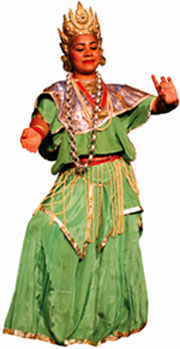
Below the stoic, humbling mountains that ring Kathmandu Valley, the chaos of life and the lively people who create it have a palpable rhythm. In the tradition and culture here is movement. As a dancer from America recently arrived in Nepal, I wanted to explore the movement of Nepal, magnify it and understand more about the country's traditional dances in order to learn more about the pace of life here.
Of the numerous dances attributed to various cultural groups and social movements, my main interest was the Newari Dance, in part because I'm based in Kathmandu and it makes sense to explore the culture with its deepest roots here. All I knew to start with was that Newari dance was festive, and included traditional costumes and masks. But when I started exploring, I came up against a curious challenge: finding places to learn the Newari Dance and see it being performed is more difficult than you think. Despite Kathmandu and Bhaktapur's abundant Newari population, the ritualistic and celebratory dances are sadly not often taught in dance studios, and the dance is mostly performed in a few tourist venues or at festivals.
"People don't have time anymore to pass on such traditions, " said Raju Hyaumikha, 38, the director of the Kathmandu University-based Newari Music and Dance Centre in Bhaktapur. "Now people have different occupations than when I was young, so they don't have time to think about this older culture."
Most traditional dance and music schools agree that teaching Newari Dance in order to preserve the culture is extremely important. The dance movement tells stories of the deities and reflects various religious and philosophical aspects of Newari culture. These schools often carry on traditional Newari music classes, but in the months between festivals, dance classes are scarce. "Students are studying hard," Hyaumikha explained, "the classes will start up again next term."
Similarly, The Sadhana Kala Kendra dance school does not presently give Newari Dance classes unless a solo class is specifically requested. "The centre was founded to preserve Nepali Dance and music. Nepali people play instruments poorly, so we are here to form stronger musicians," the school's director Tikendra Rai explained. As far as dance goes, though, the school teaches what is in demand from its students. Rai said that classical and Nepali folk dances are more commercial dances that are taught year round. He claimed that the most popular classes at his school are Hindi and modern dances. "Nepali people demand these dances," Rai said. "Newari dance is not in high demand unless there is a festival."
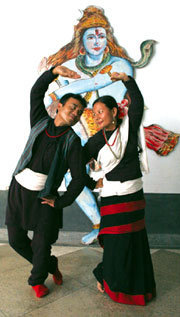 Suresh Nepali, 36, has been a dance student for 18 years and performs various dances with his wife from time to time. "I started with modern dance, moved to Nepali folk and then I learned Newari," Nepali said. "Now, people want variety," he explained. Newari Dance embodies only one culture and dance students want to branch out. "Newari Dance," he said, "is also the most difficult to learn. There is a specific language, and when studying Newari Dance, one must also study the music." Nepali, once a private teacher of Newari and Nepali folk dances, also believes that he and others simply don't have enough time to dedicate to this art.