
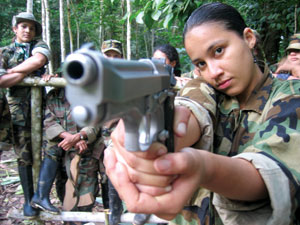
 FRANK PIASECKI POULSEN HIGH NUMBERS: During the civil war in Nepal women had an active participation in the guerrilla and the story repeats in Colombia. Around one third of FARC fighters are women. |
The war in Colombia is one of the longest-running armed conflicts in the world. It began (or intensified) when Jorge Eliécer Gaitán, a popular social activist who advocated fiscal and land reform, was murdered by the oligarchy in 1948.
Today, in a continent that is overwhelmingly at peace, Colombia's 65-year-old conflict is like a vestige of another era. After many fits and starts, the peace process this time seems to be serious.
President Juan Manuel Santos publicly announced in early September that the government and the insurgents would be starting peace talks, first in Oslo and then in Havana, with the governments of Norway and Cuba as guarantors and Venezuela and Chile as observers.
But why has Santos, an implacable opponent of the guerrillas as Defence Minister under former President Álvaro Uribe, chosen the path of negotiation? Because this time, he says, "the stars are aligned to end the conflict." In other words, the national and international conditions are propitious.
Firstly, the Revolutionary Armed Forces of Colombia (FARC) are no longer what they used to be. They remain the most formidable guerrilla force in Latin America, with 20,000 combatants, and the only one that has not been defeated by force of arms. But satellite tracking and massive use of drones now allow their communications and movements to be tracked.
The killings of the FARC's top commanders have made it more difficult for the guerrillas to regroup. And FARC's use of kidnapping, summary execution of prisoners and indiscriminate attacks on civilians, have made the group unpopular.
The FARC are far from defeated, and could probably continue the conflict for years, but they are certainly not going to win. Peace talks, if they lead to a dignified agreement, would let them leave the field walking tall, to join political life.
But Santos did not decide to talk because the FARC was weakened militarily. It was also because the oligarchy opposed to land reform are no longer the dominant power in politics. A new urban ruling class has emerged in the last decade, with far more power than the rural elites.