
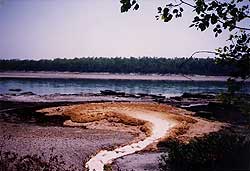
 Economic growth and ecological conservation are often on a collision course, and nowhere is this more apparent than at the point where the Narayani River enters the Royal Chitwan National Park.
Nepal's third largest river is the source of fresh water for the western reaches of the park, sustaining its aquatic life, attracting indigenous and migratory birds, and replenishing its wetlands. However, the population growth in Chitwan valley, the use of agro-chemicals, and the location directly upstream of polluting paper mills, breweries, distilleries and other factories now seriously threaten Nepal's best-known nature sanctuary.
Luckily, being a big, snow-fed river system, the Narayani has a built-in capacity to flush itself, especially during the monsoon. But in the dry season, concentrated pollution on the Narayani is killing fish, which in turn is wiping out birdlife, reptiles and other fauna.
Studies have shown that downstream from Narayanghat, the Narayani's once-abundant fish stock has dwindled. The population of Brahminy ducks has declined sharply. The rare Gangetic fresh-water dolphin, already depleted by the Gandak Barrage on the Indian border, have all but disappeared. There used to be 18-20 sightings per year of dolphins in the Narayani till 1996, last year there were only three.
No systematic census has been done on the estimated 400 gharials which have been released into the Narayani River from the Kasara breeding farm since 1978, but an IUCN study showed that even eight years ago only seven percent of the released gharials survived in the wild. On Monday, Crown Prince Paras and assembled dignitaries released another five gharials into the Narayani at Amaltari, 15 km downstream from Gaidakot.
"The effect of pollution on gharials is cumulative," says conservation researcher Prahlad Yonzon of Resources Himalaya. "The pollution kills the fish, and the gharials have nothing to eat."
When the government decided to set up the Chinese-aided Bhrikuti Paper Mill in Gaidakot in 1984, environmental concerns were not very high on the national agenda. After it was privatised, the paper mill increased its capacity to 70 tons of paper per day and is planning to up it again to 128 tons with new modern equipment. 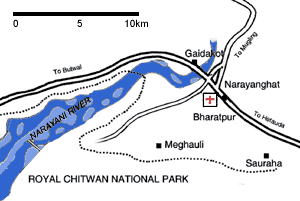 The mill's pollution record is so bad that environment groups and ecologists have been trying to get it to treat its effluent for more than a decade. In 2000, the legal group, Pro-Public even filed a public interest litigation in the Supreme Court, which ordered the plant in December 2001 to clean up its act. But the foam still floats down the Narayani.
Over the years, Bhrikuti's discharge has been analysed and tested by the Royal Nepal Academy of Science and Technology, various government ministries, the Nepal Forum of Environmental Journalists (NEFEJ) and the Environmental and Public Health Organisation (ENPHO).
One toxicity analysis of samples of Narayani water by independent researchers last year showed just how serious the problem is. One indicator of pollution is Chemical Oxygen Demand (COD), and according to Nepali law, COD content in industrial discharge cannot exceed 250 mg/l. A sample of Bhrikuti's effluent showed a whopping 979.6 mg/l. Even 1 km below the mill, the river had COD of 58.14 mg/l, whereas the international threshold for drinking water is in the 5-10 mg/l range.
Another indicator of pollution is Biological Oxygen Demand (BOD) which measures the amount of biologically usable oxygen in the water. A low BOD value implies a lot of micro-organisms present in the water (which is a healthy sign). Bhrikuti's effluent water had a BOD count of 74 mgO2/l, and 1 km downstream it was 6.4 mg O2/l. Narayani water above the mill was measured at only 3.6 mg O2/l.