
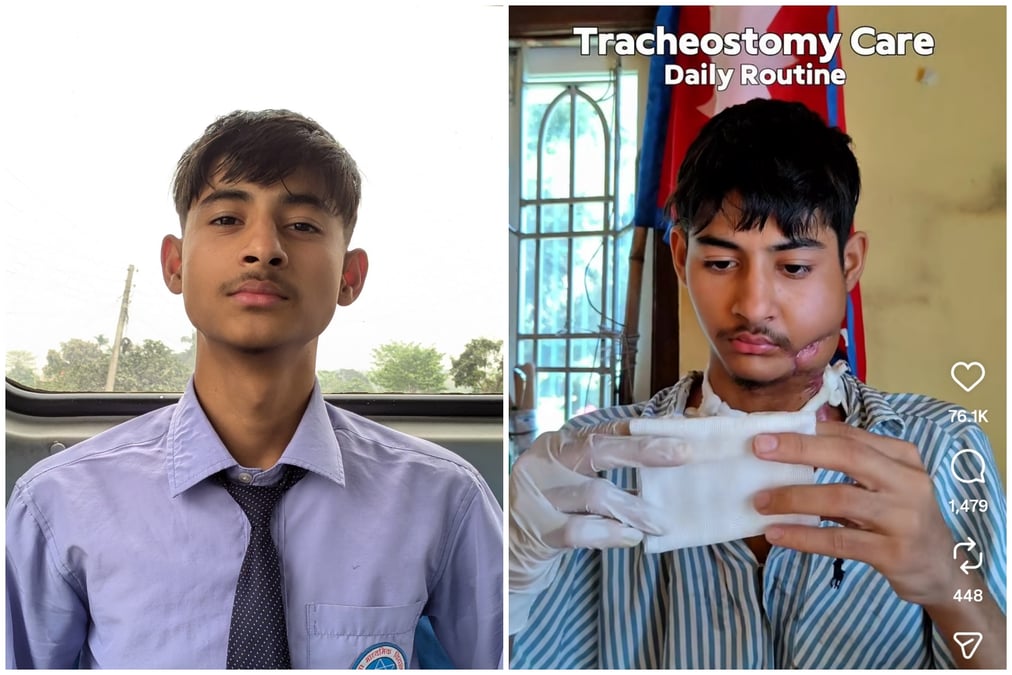
Shantanu Dhakal wakes up to a cold misty dawn, dons his college uniform and fastens his tie, tightening it carefully so as not to dislodge the tracheostomy tube protruding from his throat.
Gingerly, he brushes his teeth, mindful not to hurt the wound on his left cheek, where a bullet tore through during the GenZ protests on 8 September in the highway town of Itahari in eastern Nepal.
Dhakal, 18, came home from college that day three months ago and then took the bus to Itahari to join some friends who were protesting in front of the sub-metropolitan city office. It was mid-afternoon, and the crowd was chanting anti-corruption slogans and holding up placards.
Like most young Nepalis, Dhakal and his friends had been angered by videos on social media of the offspring of Nepal’s rich and powerful flaunting their lavish lifestyles.
"That was the trigger for me to join the protest, it opened my eyes to just how widespread nepotism and corruption was," Dhakal told Nepali Times.
The police arrested a few students, angering the crowd even more. They massed at the gate of a nearby police station to demand their friends be released.
Dhakal was standing across the street from the police station when the first shots rang out. The crowd scattered. As he ran for cover, there was a searing pain in his left jaw. Blood was streaming and it took some time for him to realise he had been shot.
“I was bleeding profusely and couldn’t speak. My vision blurred, there was a ringing in my ears,” Dhakal recalls. “I collected myself and continued to run, fearing that I would be shot a second time.”
Dhakal collapsed some distance away, and a fellow protestor took him to a nearby hospital, where doctors bandaged his jaw. He was referred to Birat Medical Teaching Hospital, where surgeons immediately performed an emergency operation.
The bullet had torn through his left jaw, shattering the bone, teeth, and soft tissue. Blood had rushed into his throat, obstructing the airway so doctors first performed a tracheostomy, installing a tube in his throat to help him keep breathing. A week later, the doctors reconstructed his jaw with metallic plates, grafting skin from his chest and transplanting it to the lower left side of his face.
Dhakal spent three weeks in hospital before being discharged. But the relief of being home was marred by disturbing thoughts. He says, “Just sitting there doing nothing began to take a toll on my mental health.”
Since he was always interested in content creation and producing short documentaries, he decided to document online his near-death experience and post-protest life.