
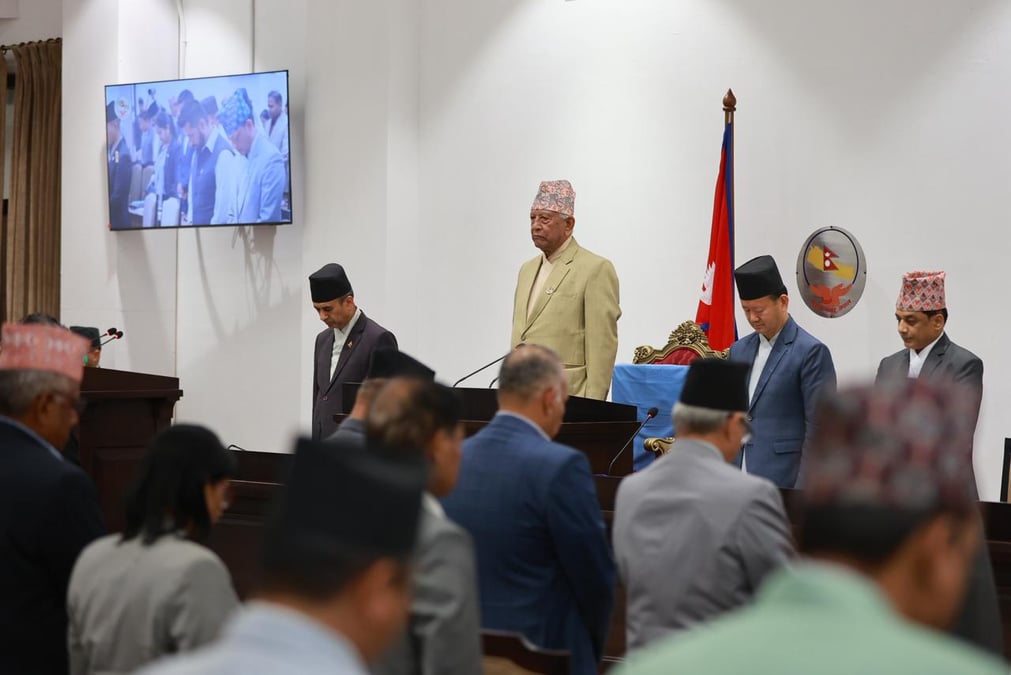
Barely a month after the March election, newly elected lawmakers convened for the first session of Parliament on Thursday (picured above).
But the RSP had already hit the ground running in its first week in office. Prime Minister Balendra Shah and his trusted Home Minister Sudan Gurung conducted a slew of high profile arrests.
The former prime minister, home minister and Kathmandu CDO, among others, were detained in connection with the 8 September massacre outside Parliament.
The Cabinet unveiled its 100-point roadmap outlining sweeping institutional, economic and social reforms to ensure better service delivery, and setting deadlines for itself for the first 100 days in office.
Key priorities include strengthening digital governance, removing redundancy across the civil service, investigating assets of high-ranking political and government figures, depoliticising the bureaucracy and universities, as well as broader legal and constitutional reforms.
“The move to hold former leaders accountable sends a powerful signal that impunity is no longer politically untouchable,” says Pukar Malla of Governance Lab at Daayitwa Abhiyan. “On the reform agenda, the direction is right but the timeline is too compressed, 100 days is not enough to transform the system. It is only enough to establish the discipline of transformation.”
The RSP’s decisions have mostly been greeted with enthusiasm by the electorate which gave the party an almost two-thirds majority in Parliament. Nepalis are for the first time in decades genuinely hopeful about the country’s leadership.
“The enthusiasm is real because the pain is real. But people are not just asking for symptoms to be treated. They want the patterns underneath the symptoms to change,” says Malla. "That is where the leadership journey becomes much harder, because structural change is slower, more conflictual, and far less theatrical than headline decisions.”
The RSP’s prompt proactiveness signals a can-do approach designed to placate voters impatient to see immediate change, and also to warn influential figures of the past three decades that anyone can be dragged to jail or put on the immigration no-fly list. The message is also to the bureaucracy to pull its weight, and clean up its act.
But in public discourse, there is also a sense that anyone critical of the government’s decisions can be targeted and trolled. Enthusiasm about the new government seems to outweigh critical and nuanced reasoning about whether ‘Balen Sarkar’ can achieve targets it has given itself within the self-imposed timeframe.
Any concerns about the RSP’s perceived high-handedness or criticism of state overreach tends to be dismissed, branded as noisemaking by mouthpieces of old parties.
Critics say the arrest of Oli, Lekhak others did not follow due process, and displays the very partisanship and vendetta tactics of the legacy parties that the RSP vowed to dismantle.
“The detentions and the plans this government has made for the next 100 days might be necessary, but they seem to be optimised for public spectacle and rather than being deliberative steps for sustained reforms,” says researcher Dovan Rai of Body and Data.
She adds: “K P Oli failed because he put himself above the system, and it seems as though that power has just transferred from one personality to another. What we need is strong institutions, not strongmen that play the role of hero or villain.”
The RSP’s strategy to overhaul the state apparatus is high-stakes, aspirational and at times unquantifiable. The new leaders and the public must recognise that Nepal’s problems cannot be solved in 100 days.
The near two-thirds dominance in Parliament offers the RSP a chance to show results, but it is also an unforgiving majority. Failure is not an option.
Adds Pukar Malla: Political leadership may drive change from above, but civil society and citizen networks have to partner from below.”
The NC and the UML are licking their wounds, and again proved their obsolescence this week by trying to rehabilitate and reinstate old leaders. The UML is on warpath, and missed another opportunity to turn a new leaf by rejecting 36-year-old Suhang Nembang as parliamentary party leader.
People who did not vote for RSP must give the party a chance to deliver on promises. But the party's most effective opposition may have to be its own voters, who must play the check and balance role by insisting on results, and preventing fawning support for populist leaders resulting in authoritarian creep.
“The public now plays a critical role in holding the leadership accountable, it must go beyond small wins,” says Dovan Rai. “Support must not come from opportunism, and criticism must not be based on prejudice.”