
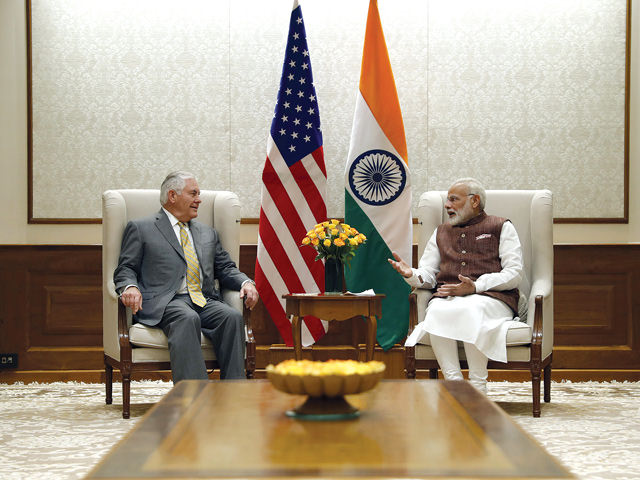
NEW DELHI -- India and the US are increasingly finding points of convergence on strategic partnership on security and development in the Indo-Pacific region, but will this be able to contain China’s rise they hope it will?
During his India visit to New Delhi this week, United States Secretary of State Rex Tillerson suggested that the world’s two largest democracies should partner to build road connectivity in the Indo-Pacific region, as a kind of an alternative to the Chinese One Belt, One Road (OBOR).
Such an initiative will invariably include Japan and Australia as well, which are also wary of China’s rising power in Asia and globally. Tillerson is learnt to have pushed for road connectivity also with Bangladesh and Afghanistan, so that even Pakistan could be persuaded to join in.
In addition, the US has already acknowledged India’s role in reconstruction of war-torn Afghanistan and is very critical of Pakistan for its perceived reluctance to combat terrorism. The US has repeatedly offered to help enhance India’s military capacity through sale of military hardware.
There is expected to be deepening Indo-US collaboration in military, terrorism and trade, but balancing China seems to be the real objective of the Trump administration’s new South Asia Policy.
OBOR is China’s ambitious project to build a ‘New Silk Road’ of ports, railways and roads linking Asia, Africa and Europe. India is opposed to it mainly because one of the components of OBOR runs through a disputed part of Kashmir. The US threw its weight behind India’s opposition to that $60 billion China-Pakistan Economic Corridor (CPEC), and earlier this year skipped China’s the Belt and Road Forum summit due to its sovereignty concerns over CPEC.
The US believes that OBOR is China’s way of securing control over Asia in an eventual hope of dominating Eurasia and exploiting natural resources -- directly against the US policy and interests. Any effort by China and Pakistan to come closer will therefore be resisted by the Americans. Of late, the US has put increasing pressure on Pakistan, even threatening cut military assistance if it fails to crack down on terrorist havens inside its territory.