Arthur Apr 30, 2011
Eighty per cent of the population are still becoming even more poor, but Nepali Times thinks it the onus is on the Maoists to "convince everyone"!
"... to prevent a dangerous political vacuum by midnight of the 27th. By then, the three main parties should have agreed to extend the CA's term, extend the deadline to write the constitution and start demobilising ex-fighters in the camps."
Actually what is required is agreement on integration of the PLA and NA, not "demobilising", and on the basic content of a constitution that guarantees the rights of the 80%, not an extension of time for the minority to keep blocking it.
If you had an argument against that, you would write it. Since you have none, all you can do is try to pretend to yourselves that you are not stuck with this simple reality.
Nepali Times has no influence on the 80%. What is the point of trying to convince yourselves that integration of the two armies is not required, when the Nepal Army itself has already accepted it? What is the point of trying to convince yourself that agreement on an actual constitution is required, not just agreement on further delay, when everybody is loudly saying the opposite?
Such efforts to convince yourselves only highlight how completely pointless your support for obstruction over the past year has been and how completely stuck you are now.
If you were not already completely isolated you would be presenting arguments to try and convince others, instead of trying to convince yourselves that you live in a different reality in which the the things you are now required to accept like integration of the two armies and a progressive federal constitution have simply disappeared.
Soni Apr 30, 2011
"Fortunately for us in Nepal, there seems to be an emerging consensus at the top level of the triumvirate that lords over us that there is no alternative to a national government during the constitution-drafting process. They are now putting the necessary legal provisions into place to postpone the statute deadline till 28 November, and hopefully within a month we will have a new all-inclusive government."
The quote is not from this Editorial, it is from this issue.
There really is no difference between the two, the message is the same and I understand that this editorial is informed by the same understanding as the quote from Publiser's Note, "democracy requires patience".
However, in my extremist, rightist, royalist and truly humble view, you are mistaking an oligarchy for democracy, and in doing that sabotaging the very idea that you advocate.
To examine the possible reason for your misplaced faith in the same old trick delivering a solution would be futile.
Since you believe that you are a democratic moderate, and a modern liberal, you have shut your mind completely to the views of us extremists. Instead, I am going to tell you exactly why you are wrong in the next box.
Soni Apr 30, 2011
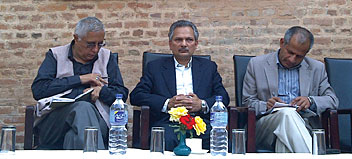
"The audience was left wondering: why don't we hand the government over to these three gentlemen instead of their bosses in each of the parties?"
The audience must have been made up of forward looking invertebrates.
The consensus mantra has been going on for, shall we say, umm, all eternity? Meanwhile, a national consensus government was to be made ever since 2006, wasn't it?
"All three spoke logically and cogently about what needs to be done next to avert a crisis on 28 May:
� Forge a consensus government that includes both the Maoists and the NC that is based on mutual trust and a spirit of compromise
� Agree on a basic draft of a broad-stroke constitution to be passed on 28 May
� Explain to the people why it couldn't be finished in time and say sorry
� Extend the CA term and commit to a strict deadline for completing the rest of the constitution"
There are too many inconsistencies in the quote above and makes one wonder if logic and cogently (persuasively?), mean the same thing as they are normally understood to mean.
I discounted that notion, knowing how liberal, democratic, open-minded, moderate intellectuals of Nepal live in a better, parallel universe, which does not contain narrow-minded, extremist, rightist, skeptical, low-life's such as this humble royalist.
So, I started wondering about the points.
Firstly, that you should set up a consensus national government is a beatifully articulated, and flashily expressed idea, very cogent and logical. But, how must one understand the difficulties in arriving at this consensus so far?
Furthermore, could a lack of trust in the Maoists be explained by their actions so far or could their utterings explain it? Meanwhile, while the spirit of compromise may be an easy genie to capture in a bottle of whisky at Balkhu and Paris Danda, in real worls, what must the parties compromise with the Maoists on?
Should NC say that half of the provinces may be built on ethnic basis while the Maoists agree that the other half should be on the basis of geography, while the rest is left for the UML to bicker over (since they can never stop bickering publicly).
Or, perhaps, property of only NC leaders would be returned by the Maoist party and then we could have a compromise on anything including selling the country through a joint auction organised by an all party committe?
As far as your second point is concerned, what difference is that going to make and what assurance can you (the three musketeers praised above) give that next year to an apology would not be made about the same thing with the same arguments and following the same line of reasoning?
But the extension was given and a robust timeline was indeed agreed upon last year too. You are the journalist, why don't you check that yourself?
Soni Apr 30, 2011
"If you look at the present situation, achievements like republicanism and secularism have not been institutionalized and aspirations for changes in social and economic structure especially with regard to land reforms have not been met. So theora(E)tically speaking, we cannot say that the relevance of people's revolt is over. But if we look at the political ground realities, they are not in our favor. The geo-political condition of Nepal is such that if we act against these conditions and risk our political integrity, the country might slide into another conflict and become a playground for foreign powers. So, in the present context, completing the peace process and drafting the constitution are the most practical options."
Let me also point out the other reason for my negative view on the editorial with reference to the quote above (from Dr Bhattarai's interview in Kantipur quoted elsewhere in this paper).
The achievements and aspirations that Baburamji highlights are actually phony. Neither the relevance of the achievements nor the true nature of social and structural changes been discussed widely and clearly enough. The moderate, liberal, non-and-anti-extremist, centrist, social democrats have deliberately kept the true character of their own aspirations well hidden.
This job would normally be done by a paper like this, i.e., evaluate the situation dispassionately, strip away the rhetoric that politicians engage in to hide their real intentions, and highlight the shortcomings in the present arrangement.
This situation must change and these "achievements" must be evaluated honestly by Nepal's intellectuals against the backdrop of the country's recent history. We must also be informed about the aspirations of not just the Maoists, but also of the NC and the UML.
I have full faith in Mr Dixt et al. I will wai for them to take the initiative for their own and this country's sake. They have a choice between being obscure and ambiguous through editorials such as this, or taking the leadership in leading the country out of this quagmire.
Re-evaluate the basis of your discourse, otherwise you will keep writing this every April.
"Fortunately for us in Nepal, there seems to be an emerging consensus at the top level of the triumvirate that lords over us that there is no alternative to a national government during the constitution-drafting process. They are now putting the necessary legal provisions into place to postpone the statute deadline till 28 November, and hopefully within a month we will have a new all-inclusive government." From Publisher's Note in issue 498.
who cares Apr 30, 2011
some fools flatter themselves of being hardcore rightist of nepal, but in fact they are nothing more than pets licking boots of some pampered, drunk, addict, murderer family.
while majority of nepalese concentrate on taking nepal forward- free, democratic, rule of law, prosperous .. but there are some who all care is to take nepal back where all nepalese has to sacrifice their blood, sweat to buy private jet to some guy, aka, gyn bahadur...
in reality, nepal has not move forward since gyn bahadur took over. then, they used to tell parties, public to cooperate, build consensus with gyn bahadur....... now, just faces have changed. but the same mentality remains.
can anyone tell me which one is the worst, shahs manipulating business environment or ethnic federalism? for me, both are same alcohol, of course, with different names whether you call it vodka, whiskey, beer, jad, or wine.
shahs manipulating business environment and destroyed economic activity, which was one of the main reason behind the war and ethnic federalism will start another form of war.
who cares Apr 30, 2011
what exactly are the beliefs of so called rightists in nepal?
*do they all support monarchy?
*regarding monarchy, what do they say: is it that only certain family has right to be monarchy or any ordinary nepalese can become the king or the ruling queen?
* can any child of the king become the king or has to be the elder son? and can first child/daughter become ruling queen?
what do the rightist females say about gyn bahadur rejecting the idea of making his daughter the ruling queen? or rightist females only believe in "female is just meant to serve male".
*are rightist females angry with democratic govt. for giving daughters right over half the family wealth, citizenship through mother and other right for woman?
Soni Apr 30, 2011
what exactly are the beliefs of so called rightists in nepal? Â
*do they all support monarchy?
Â
No. Only I support a constitutional monarchy under the 1990 constitution.
Â
*regarding monarchy, what do they say: is it that only certain family has right to be monarchy or any ordinary nepalese can become the king or the ruling queen?
Â
Yes. It is only a certain family, the royal family is not a certain family. It is the royal family and it is the traditions that they carry through lineage which make them important for continuity, stability, as a symbol of unity and as keepers of traditions which constitute the traditional life of a nation. Without such an identity and lacking such tradition Nepal would not be unique.
* can any child of the king become the king or has to be the elder son? and can first child/daughter become ruling queen?Â
Â
It is not necessary that the first child become the ruling monarch but it is the tradition. There have been plenty of non-first children becoming Kings. There are religious examples of that too. But a daughter does not become the ruling queen because in normal eastern tradition lineage is through male descent, just as in other marriages, and other Eastern civilisations such as in Japan and elsewhere.
what do the rightist females say about gyn bahadur rejecting the idea of making his daughter the ruling queen? or rightist females only believe in "female is just meant to serve male".
Â
I have not heard of such a suggestion and refer above. Rightists in Nepal do not believe that "female" is just meant to serve male", you do and you have said as much before, giving me advice.
Â
*are rightist females angry with democratic govt. for giving daughters right over half the family wealth, citizenship through mother and other right for woman?Â
Â
No, "female's" are not so dim that they would be pleased with mere crumbs thrown at them, it would be akin to saying that men should be pleased with the present oligarchy masquerading as "democratic" because they retain the right to inherit property.
Â
Two things, stop calling people "females", and abusing my King.
Â
I have not the foggiest idea why you ask me what rightists believe in, I don't know. I am a homemaker and since everybody calls people with my ideas as rightists, I call myself rightist feudal and everything else. Feel free to adress me with any abuse that pleases you.
Â
However, I believe that there should be democracy because through competition of ideas there would be better quality governance while the monarchy would be the keeper of traditions and a symbol of our nationhood, not through the mere person of the King, even if as resolute and strong willed as the last one, but by the mere power of the institution.
Â
This of course is not the entire set of my beliefs but may be taken as my view in a nutshell. People lacking the intellect to figure out the nature of an argument have destroyed this nation. I am simply going to be here, and measure them up.
Â
I do not have any expectations about the return of the Monarchy so I don't know why anybody would want to discuss that. There is also no chance for that because 90% of Nepal (or more) believes in what you believe in.
That belief alone does not make it right, it does not make what has happened right.
Â
Furthermore, I would not even want the King to come back. In my view, it is better that over time everybody forgets the King.
Rishav May 1, 2011
"• Forge a consensus government that includes both the Maoists and the NC that is based on mutual trust and a spirit of compromise• Agree on a basic draft of a broad-stroke constitution to be passed on 28 May• Explain to the people why it couldn't be finished in time and say sorry• Extend the CA term and commit to a strict deadline for completing the rest of the constitution"
I believe the editor is smoking something very strong going by the article.
Firstly the writing of a new constitution has never been the demand of the people in any of the Jana Andolans. There are more important things concerning our country such as streams of young men and women leaving the country for work and in many instances, having the daily occurence of their bodies returning in coffins from our airports. The poor law and order situation therefore affecting any environment of true freedom of expression, democratic and human rights. The lack of electricty and resources leaving our people suffering.
This is the mistake the Nepali Congress and all the 7 parties, in jumping into the bed with the Maoists without sorting out their PLA Militia, YCL and getting them to the very least denounce violence before stupidly going for elections. The 7 party and Maoist deal in Delhi was a mistake that the NC are probably realising now if they have any sense. Besides, the Maoists for 10 years of their insurgency was against multiparty democracy i.e. NC, UML etc How stupid must the 7 parties be in jumping into bed with the same people who have been trying to destroy them for the last 10 years so they can get back to power at all costs, even if that means losing your morality and the lives of your citizens.
The law & order situation, freedom of expression, peoples suffering has worsened since 2005. The NC, UML etc have really exposed themselves foolishly to the Maoists and are now next on the chopping board after the Monarchy.
K. K. Sharma May 1, 2011
Do not fault Pushpa Kamal Dahal for changing his opinion. Remember, he had met the Indian Foreign Minister, before he did so.
Not only PKD, but all the netas of the Nepalis seek guidance and orders from the masters in Delhi.
This is New Nepal: one cannot qualify to be a leader of the Nepalis, if one is not servile to Delhi.
who cares May 1, 2011
7:
it is fine for you to dishonor female in the name of tradition but it is a sin to speak honestly.
"Two things, stop calling people "females", and abusing my King."
then what would be the sweet word for female gender?
abusing your lord; it is not that simple, you should have kept them in your cupboard preventing them from roaming around freely using their hands, mouth and what not.
"since everybody calls people with my ideas as rightists"
those people are wrong, people with your ideas are not rightists rather a servant with slave mentality.
actually, am i also not fully aware about the definition of rightists but i think those who want to enslave people by misusing traditional values are rightist and those, other than rightist, neo-wanna be masters are leftist.
and you, you are just someone who all want is to see your master happy. nothing more than a loyal servant.
in the family, mostly males are involved in all kind of anti social activities, but its their family constitution that all the offspring should marry with the person their family chooses.
good thing for those males is that they can have open adultery (neither their family try to prevent, nor their in-laws) , but all wife can do is shopping, may be, she proudly calls it "homemaking".
"Rightists in Nepal do not believe that "female" is just meant to serve male", you do and you have said as much before, giving me advice."
why do you usually take the support of lies while arguing? when did i say such thing? i believe in freedom, equality not slavery.
it's your master's circle who believe in such. just analyze their actions and words. ........ o yeah, you are blinded by your obsession.
dont be sad, you are not the only one. even in developed world, people like you are there.
in UK, some media said their queen did not like the newly bride for her being commoner and still low lives, who are hated by their beloved queen for being
born as a commoner, still support her.
commoner and lack of dignity, seem like two sides of a coin.
Anil May 1, 2011
... we saw on the stage three leaders: Baburam Bhattarai of the Maoists, Shekhar Koirala of the NC and Pradeep Gyawali of the UML....The audience was left wondering: why don't we hand the government over to these three gentlemen instead of their bosses in each of the parties?This is a very simplistic way to look at very complicated problems facing the nation that all the problems have arisen because of individual leaders personalities.
This reflects a tendency among many media people and intellectuals to give greater emphasis to personalities of individual leaders rather than to their advocated policies and goals. Instead of asking the hard questions regarding policies, the focus then is more on bringing about a consensus between personalities.There is no thought given to the fact that such consensus if based on contradictory goals and policies is bound to unravel, and ultimately does not serve the long-term interest of the general public.
So there has been a lot written about how Baburam would be a better leader than Prachanda, forgetting the fact that Baburam himself says there is very little difference between the two in their policies and goals.
Like it or not, Prachanda was the only major leader to openly question Ambassador Sood's policy, when all the other prominent leaders(of all the parties) were being played around his thumb by him. His deputy Baburam was no exception with Ambassador Sood openly campaighning for him to be prime-minister (provoking Prachanda to accuse him of being India's yes- man). Baburam also being the Maoist ideologue has been instrumental in formulating the agradhikar principal trying to play off different ethnicities against each other in the mistaken belief that somehow he and his party would benefit as a result( which goes against the Maoists's own principle of class struggle).
The fact remains that Prachanda is thought to be more trustworthy by the Maoist rank and file; and as a result has the capability more than anybody else in the party to bring the Maoist rank and file and the PLA to a binding agreement if he so chooses. Baburam or any other Maoist leader cannot do that.
Being a wily leader trying to appease different factions in the party,no doubt he has taken advantage of the other parties gullibility and ineptness to gain advantage for his party and to keep different factions in his party satisfied. And who can argue that his party has not benefitted from this? Since 2006, the Maoist party has managed to outfox both UML and NC and the people of the civic society, and as a result has managed to preserve its own army(maintained by tax payers money), created YCL and its leaders and the party have become richer as well.
Prachanda is no fool and will keep on trying to squeeze the other parties and use their ineptness to gain the maximum benefit and will not compromise unless he sees there is no other way out. The lesson here for other parties is to do their homework first and be tough when negotiating, ask for concrete actions rather than promises, and stick to principles( and be ready to fight for them) rather than flowing with the tide of the moment or populist slogans. Hoping that just changing the Maoist leader will solve all their problems is just wistful thinking.
who cares May 1, 2011
if other two are given the position,
maoist will eat them alive.
Soni May 1, 2011
it is fine for you to dishonor female in the name of tradition but it is a sin to speak honestly.
"Two things, stop calling people "females", and abusing my King."
then what would be the sweet word for female gender?
1. Fairly simple, if you were addressing me, address me by name, or women is a nice and better way to replace female. There is a difference between addressing someone by their gender, and properly addressing them.
>>>>abusing your lord; it is not that simple, you should have kept them in your cupboard preventing them from roaming around freely using their hands, mouth and what not.
A. Why should I keep my constitutional monarch in a cupbpoard. They have as much right to speak as you do and still be treated with dignity. The King has done nor said anything objectionable. He was and remains the legitimate king of Nepal. I can only urge you to be polite in your disagreement.
"since everybody calls people with my ideas as rightists"
>>> those people are wrong, people with your ideas are not rightists rather a servant with slave mentality.
No, we are proud people, proud of our history with all its failings and hopeful of our future. We have the humility to know that we can't know everything and that lack of certainty about the future, and the knowledge that actions have unintended consequences, force us to advocate a more cautious stance.
Furthermore, our world view is predicated by love, both of our history and for our country. We also understand the power of feelings. If
you share my worldview you too would care more, and have greater emotional and logical understanding of how the world actually works. Sometimes it is entirely possible that you would not be able to express that in words, both because it would be foolish to speak of good in the company of pure evil, and sometimes because it really is not possible.
>>>>actually, am i also not fully aware about the definition of rightists but i think those who want to enslave people by misusing traditional values are rightist and those, other than rightist, neo-wanna be masters are leftist.
You seem to be contradicting yourself. Nobody is misusing traditional values to enslave people. But some people are indeed misinterpreting traditional values to hurt people and confuse the debate. There is no enslavement of people, not in my worldview because it is simply not possible. If you would be patient and engage in a bit of introspection you would understand things better. But I cannot help you.
For example, what did the SPAM alliance use the people for. Did they not lie to the "people"? They enslaved the "people" and bamboozled them for their own end because they have no love for the "people", they view people as a tool to access and occupy positions of power.
>>>>>and you, you are just someone who all want is to see your master happy. nothing more than a loyal servant.
A loyal subject yes, and that is because I know better. I want to see myself happy in the knowledge that our own values, our own history is respected. I know that I will be happy not under an Oligarchy which is devoid of any better value than lying and being hypocrites. I want to be happy seeing that there is a King who would be impartial, I would be happy when I see that the King would be the anchor in a world of uncertainty where a new wind every decade blows away our houses and our santiy. I don't know about others but I know that I myself would feel better and that won't be because of the reasons that you outline.
>>>>>>in the family, mostly males are involved in all kind of anti social activities, but its their family constitution that all the offspring should marry with the person their family chooses.
No, but I have heard about these anti-social activities, including about the latest incident to do with Tiger Tops incident.
>>>>>>>>>>good thing for those males is that they can have open adultery (neither their family try to prevent, nor their in-laws) , but all wife can do is shopping, may be, she proudly calls it "homemaking".
Again, conjecture. It is entirely plausible and the whiff of that alone was indeed sufficient to bring the Monarchy to its current state. I have also heard people talk about these things, and I have a feeling that I understand where these rumours come from.
But I have to concede that you do make a point about the reasons for the downfall, however, I have known about these allegations for a long time and as I say 90% of Nepal believes in that. I am not the 90%.
>>>>"Rightists in Nepal do not believe that "female" is just meant to serve male", you do and you have said as much before, giving me advice."
>>>why do you usually take the support of lies while arguing? when did i say such thing? i believe in freedom, equality not slavery.
I am the only one who never takes the support of lies in making my arguments and I have always backed my arguments with reason and evidence wherever possible. I don't need to lie about your attitude and you level of intelligence, I simply need to point out your comments.
Meanwhile, everybody believes in freedom and equality because it is popular and appears to be an unassailable stance, just like democracy. Nobody has yet outlined to me the difference between the slogan and its application. That is what matters, not the slogan you believe in but the reason that you see.
>>>>it's your master's circle who believe in such. just analyze their actions and words. ........ o yeah, you are blinded by your obsession.
I have analysed their actions and works and it is the fact that I have no obsession that I am able to take this stance. Reevaluate your own belief system and what induces you to it. Don't try to evaluate my "psychology".
>>>>dont be sad, you are not the only one. even in developed world, people like you are there.
in UK, some media said their queen did not like the newly bride for her being commoner and still low lives, who are hated by their beloved queen for being
born as a commoner, still support her. commoner and lack of dignity, seem like two sides of a coin.
No, absolutely not. That may be true in the west but it certainly is not true here. I am standing up for me, I really could not care any less about the UK.
Let me also make a point here, your world view is so fundametally different from mine that there simply cannot be any agreement whatsoever on this particular issue of Constitutional Monarchy.
I know I am right for my reason. But I also know that in case of Constitutional Monarchy a lot more than 90% of Nepal is against me. I really could not care less about that.
who cares May 1, 2011
i did not know female is a bad word. i try to remember to use "woman" if it makes you happy, or women happy.
"constitutional monarchy", i again repeat, there were and will never be possible for shahs (is not them the only family, for soni, who can rule over sonis) to tie themselves with constitution cause of their blood/gene thing. you know what i mean, right. or could explore my previous comments.
"The King has done nor said anything objectionable."
should i see this mere a joke?
if you are not trying to be funny then just think of how he always had been conducting his business (manipulating rules), protecting criminals, taking over power with the backing of royal army, (i wonder if he too had broken some bones or even killed someone during his youth cause its in their blood).... ..
i remember his take over speech; how he warned nepalese to follow discipline (the person who acted unconstitutional, who cant even take control his own son, who looted the wealth of nepal and his own family members as soon as he controlled royal army ............ simply did not suited him).
"No, we are proud people,"
ah, good for you and the fortunate ones.
"There is no enslavement of people, not in my worldview because it is simply not possible. "
then what is people paying tax to pay bills of some family, just because they were born there. what about people not let to freely express themselves, that about their family members committing crime on others and get away with that.
what do you thing slavery is? prisoner of war.
"For example, what did the SPAM al..............."
till date, all used nepalese, fooled nepalese, looted nepalese that is why i want to mover forward not backward. and why do you think i support them? i dont.
i want a system where right person gets the right job.
one major difference between you and me is, you support one evil and i support none.
"King who would be impartial, I would be happy when I see that the King would be the anchor in a world of uncertainty..."
again good for you. still living in fairytale.
you know what, i started hating so called royals cause of the same fairytale where "a poor girl does all the hard word to get out of her misery and at the end some fool prince in the horse enters the scene".
it was years(a decade and a half) later i realized that i am a republican. more i hear, see about so called royals (all over the world) bigger evil they turned out to be, the most incompetent of us all.
"what history?"
there is only one history: we were born and some day we all die (fact).
just because some got lucky, or fooled, or killed others and took control of the society with guns does not make it our tradition.
"I say 90% of Nepal believes in that. I am not the 90%."
dont forget, it took centuries for those 90% to believe it.
there was a time when they presented as if 100% believed in them.
nepal is the mother, shah is the father.
"Meanwhile, everybody believes in freedom and equality because it is popular and appears to be an unassailable stance,"
i am not every body and not even that 10%, I am I.
i never followed fashion or will ever.
i wonder if you too is a part of that family.
and dont say that all your kind is one big family and gyn bahadur is the father/guardian/care taker.
"I can only urge you to be polite in your disagreement."
normally i am polite with my disagreements, but in the cases where blood, evil etc are involved, it is not possible.
Devi-Prasad May 1, 2011
Draft must be available to public comments.CA assembly must be disolve after May 28. Six month should be allowed for hearing.care taker Government should collect the comment . Fresh Election should be carry out for house of representatives. any amendment in draft may be required should be amended by 2/3 majority. any matter not solve yet now will be put in new house for discussion and decision.Any more drama will harm the Nation.Still enough time is balance to announce the draft of constitution.
Soni May 1, 2011
i did not know female is a bad word. i try to remember to use "woman" if it makes you happy, or women happy. "constitutional monarchy", i again repeat, there were and will never be possible for shahs (is not them the only family, for soni, who can rule over sonis) to tie themselves with constitution cause of their blood/gene thing. you know what i mean, right. or could explore my previous comments.
The Monarch's of Nepal have always, very clearly , transparently demonstrated themselves to be tied by the constitution. All Monarchy's are predicated on the fact that it will be only one particular line that becomes the Monarch, particularly in our traditions. I do know what you mean, but really who cares about your meaning. It's not about the Shah's, it's about the Monarchy.
"The King has done nor said anything objectionable." should i see this mere a joke?
No, but I do see your comment as a joke.
(manipulating rules), protecting criminals, taking over power with the backing of royal army, (i wonder if he too had broken some bones or even killed someone during his youth cause its in their blood).... ..
No rules were manipulated. The current situation is about the misinterpretation of the provisions of the previous constitution. The Monarch took control of the situation because it was his constitutional duty to take control of the situation and protect the constitution of this country. That is precisely what he did and suffered the consequences.
i remember his take over speech; how he warned nepalese to follow discipline (the person who acted unconstitutional, who cant even take control his own son, who looted the wealth of nepal and his own family members as soon as he controlled royal army ............ simply did not suited him).
No you do not. He expressed his fears over the deterioration of the situation in Nepal. He outlined the need for the takeover. He failed to convince the people, and the rest is history.
"No, we are proud people,"ah, good for you and the fortunate ones.
I am not sorry to hear that you are probably ashamed of yourself. You should not be.
"There is no enslavement of people, not in my worldview because it is simply not possible. " then what is people paying tax to pay bills of some family, just because they were born there. what about people not let to freely express themselves, that about their family members committing crime on others and get away with that.
institution. As an institution with its own unique contribution there are provisions in the law for payment of certain amount for the upkeep of the Royal family, just as there are provisions for payment of the Prime Minister's and the President's bills. Just as there are provisions for the payment of bureaucrats bills in a socialist state. The Royal family committed no crime, and we all know that when the last crown prince did commit a crime what the consequences.
"what do you thing slavery is? prisoner of war."
No. Try and find out what it really is and then talk to me.
"For example, what did the SPAM al..............." till date, all used nepalese, fooled nepalese, looted nepalese that is why i want to mover forward not backward. and why do you think i support them? i dont.
No, you don't want to move forward, you appear to have no notion of forwards and backwards an you appear to be one of those classic Nepali's who are sharp with their tongues in finding fall in others but themselves would not want to stand anywhere because they are too much of a coward. You do not take a stance because you appear to me to be too much of a coward to take any.
"i want a system where right person gets the right job. one major difference between you and me is, you support one evil and i support none. "
The difference between you and me is that I support what I know to be right. You don't because you have no idea of what is the right point of reference for right and wrong. You don't want the right person for the right job, you want the job for yourself. The difference between you and me is that I know the most plausible way to fix things for everybody's benefit, while you are too arrogant, rude, pointless, selfish and egocentric to understand that.
"King who would be impartial, I would be happy when I see that the King would be the anchor in a world of uncertainty..."again good for you. still living in fairytale.
I am proud to be living in reality. This position is not easily arrived at, if you have not arrived at this position then I cannot help you do that. It is a personal journey and you must travel this road alone.
"you know what, i started hating so called royals cause of the same fairytale where "a poor girl does all the hard word to get out of her misery and at the end some fool prince in the horse enters the scene". it was years(a decade and a half) later i realized that i am a republican. more i hear, see about so called royals (all over the world) bigger evil they turned out to be, the most incompetent of us all.
Sorry about that. I have an inkling about the kind of person you are but I am not so judgemental that I would bother much on that front.
"what history?" there is only one history: we were born and some day we all die (fact). just because some got lucky, or fooled, or killed others and took control of the society with guns does not make it our tradition.
There is something you are missing. The interim called life. You appear to have formed your worldview with communists as your point of reference. You are most likely to end up continuing to complain about things all your life and knowing absolutely nothing.
"I say 90% of Nepal believes in that. I am not the 90%." dont forget, it took centuries for those 90% to believe it. there was a time when they presented as if 100% believed in them. nepal is the mother, shah is the father.
The way you read that and the way I read that are poles apart, there can and will never be a meeting point. You will continue to digress into pointless directions to keep the discussion of real issues as a sideshow. I will keep engaging till the end of eternity because all evil needs to be fought till the end of eternity.
"Meanwhile, everybody believes in freedom and equality because it is popular and appears to be an unassailable stance," i am not every body and not even that 10%, I am I. i never followed fashion or will ever.
That is a nice way to copy my view, but then it could be your own, I don't care either way.
i wonder if you too is a part of that family. and dont say that all your kind is one big family and gyn bahadur is the father/guardian/care taker. "I can only urge you to be polite in your disagreement." normally i am polite with my disagreements, but in the cases where blood, evil etc are involved, it is not possible.
No I am not, but yes we are all indeed a family with the King as the guardian of this nation.
No, you are lying, if you were impolite with evil then you would not be impolite with the King. You would support the king the way I do.
Soni May 1, 2011
माओवादी अध्यक्ष पुष्पकमल दाहालले मुलुक क्रान्ति प्रतिक्रान्ति र बर्वादीको दोबाटोमा उभिएको बताएका छन् ।
I can never stop being amazed by the hypocrisy and double speak of politicians. All of them have weaved such intricate and complex web of confusion that it will take several years to sort out the mess. Journalists are compounding that mess by engaging in pointless drivelese.
Babuwan Singh May 1, 2011
Soni (17)
Don't surprised for PKD he woke up from deep sleep ,he realized the value of peace and consensus.Perhaps he might has dream during unnecessary dispute added during last three years causes and fueling the present. further more the demised souls of innocent Nepali forcing him to speak " look the silent destruction in Nepal" Great leader of great party?
kamal kishor May 2, 2011
I am very much amused by the intellectual community's illusiveness and bankruptcies of ideas. It is so funny when these top intellectuals try to comment and be heard. Why we want to redefine intellectualism as total negativism? This is total degradation of intellectual class. I refuse to be part of it.
Hail the editor!!! No doubt it is a milestone Dahal and the Maoists crossed. It is not the same Nepalese politics now as was one week before. With this decision, Nepal has moved very close to a democratic and pluralistic republic.
Why do you want to cast a doubt on every positive move by the Maosists. Do I love them: No. Do I blame for the mess we are in today. 100%. But do I congratulate for this very positive decision: YYYYYES!!!!!.
The Editor missed one thing: it was Dr. Baburam who enabled and helped Dahal move to this direction. So why hesitate to congrat Dr. Baburam
John M. Kelleher May 2, 2011
Soni, I was preparing to leave one of my trademark irritable posts on this Editorial, but quite honestly I think you've hit every nail on the head already. Your posts are worth the price of admission - far more so than the recycled [if attractively presented] gruel which passes for topical commentary in the Nepali Times these days.
>> " "The audience was left wondering: why don't we hand the government over to these three gentlemen instead of their bosses in each of the parties?"
The audience must have been made up of forward looking invertebrates." Considering that the venue was a book-launch for a bio on the late GPK, I would call that a safe bet. I'm baffled as to how anyone, even only half-seriously, could propose that the balm for Nepal's political malaise is some triad including that blathering sociopath Baburam. Quite why this nauseating little gnome is so passionately lionized by certain misguided layers of Nepali society is something which has never been satisfactorily explained to me.
Soni May 4, 2011
My concerns run deeper than the immediate politics of the situation; in my view this is relevant particularly with reference to a second assault on a sitting CA member.
I cannot think of any reason why there should be any celebration of such extreme expressions of people's views.
This is what has hobbled the development of Nepal - sudden bursts of righteous indignation, unchecked by reason and simple decency and dignity, leading to actions which erode the foundation of social and national functioning.
Here are some of the points that I want to make without elaborating much on them. I oppose the events of the past few years, and what I have outlined above including the latest incident because they have, and will, result in;
A) Discredited leadership
B) Destroyed credibility of the state
C) Destruction of the basic faiths which forms the basis of a nation
D) Bad precedent
E) Destroyed momentum of economic growth
F) Lost intellectual capital
G) Muffled voices of reason against the overwhelming cacophony of populist intellectualism
H) Quality of political participation is limited to hoodlums now
I) The present system, and from the voices we hear, the coming system's inability to instinctively and reflexively adapt to change
J) The lunatic fringe being goaded into the limelight because of the weakness of the gatekeepers of sanity
K) Victimhood gaining currency as the symbol of new virtue and goodness, now there is a race to the bottom in claiming victim status by everybody
I cannot see anybody whose views will not resonate with these facts. It is with this in my mind that I have repeatedly urged Mr Dixit and the gang to take their job more seriously. If people like me do it, it would be partisan, dangerous, and (despite my best efforts) often incoherent.
This country is far too important and unique and beautiful to be lost to the madness of a few megalomaniacs, murderers and liars. I hope that at least this comment is clear and coherent.
jange May 4, 2011
21. Soni
and what I have outlined above including the latest incident because they have, and will, result in;
A) Discredited leadership
B) Destroyed credibility of the state
C) Destruction of the basic faiths which forms the basis of a nation
D) Bad precedent
E) Destroyed momentum of economic growth
F) Lost intellectual capital
G) Muffled voices of reason against the overwhelming cacophony of populist intellectualism
H) Quality of political participation is limited to hoodlums now
I) The present system, and from the voices we hear, the coming system's inability to instinctively and reflexively adapt to change
J) The lunatic fringe being goaded into the limelight because of the weakness of the gatekeepers of sanity
K) Victimhood gaining currency as the symbol of new virtue and goodness, now there is a race to the bottom in claiming victim status by everybody
This is exactly what the Maoists are aiming for. An they are succeeding quite well. too.
jange May 5, 2011
status by everybody
A) Discredited leadership
B) Destroyed credibility of the state
C) Destruction of the basic faiths which forms the basis of a nation
D) Bad precedent
E) Destroyed momentum of economic growth
F) Lost intellectual capital
G) Muffled voices of reason against the overwhelming cacophony of populist intellectualism
H) Quality of political participation is limited to hoodlums now
I) The present system, and from the voices we hear, the coming system's inability to instinctively and reflexively adapt to change
J) The lunatic fringe being goaded into the limelight because of the weakness of the gatekeepers of sanity
K) Victimhood gaining currency as the symbol of new virtue and goodness, now there is a race to the bottom in claiming victim status by everybody
Exactly the gameplan of the Moaists. And we are well on the way to achieving it- with a little help from the major political parties and of course, the NT.