
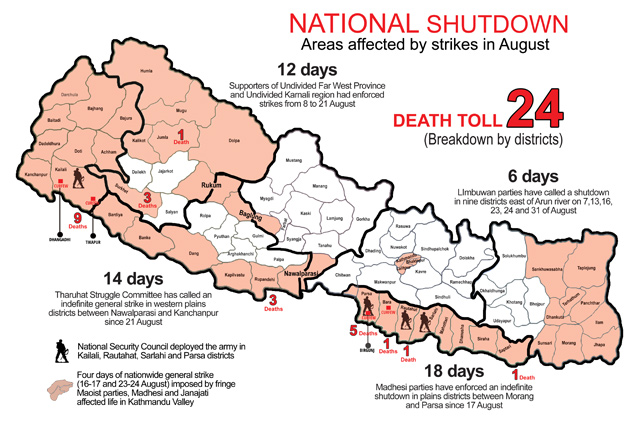
It is difficult to find a resolution to violent unrest if you don’t know what the demands of the protesters are. How do you address an agitation without a clear agenda? This appears to be what is happening with the violent protests that rent the Central Tarai this week.
The Tharus had genuine reasons to be angry at being left out by the power brokers in Kathmandu when the federalism model was changed from 6 to 7, and left their demands for autonomy unaddressed. Others of various Maoist persuasions just cashed in on the prevailing resentment and piggybacked a peaceful protest to butcher policemen on 24 August.
It is a different story in the eight districts of the central Tarai that make up Province 2. Madhesi leaders, many of whom lost the 2013 elections, have been trying to rebuild up their support base. Having been discredited for their lack of concern for the everyday needs of their constituents when they served in high government positions in Kathmandu, they have taken recourse in whipping up communal sentiments against ‘colonial’ rule in the Tarai.
After failing to ignite the Central Tarai last month, prominent Madhesi leaders from various parties forged an alliance with the Tharu Struggle Committee and addressed a gathering in Tikapur of Kailali district in the west urging locals to take up weapons and chase hill-dwellers out to where they came from. We believe it isn’t a coincidence that what was supposed to be a peaceful protest on 24 August ended up in the lynching and shooting of eight policemen and a baby.
Now, the violence has spread to the Central Tarai where disparate Madhesi parties including former Maoists like Matrika Yadav and Upendra Mahato are in the fray, competing to be more violent than each other in order to build up support in their constituencies. This is why some of the Tarai towns don’t seem to be in control of the more mainstream and relatively moderate Madhesi leaders anymore. More and more, it looks like the agitation is driven by those who want to stop the constitution going through at any cost: an unlikely cabal of the extreme left to the extreme right and everything else in between.
What doesn’t help at all is that there is a government in Kathmandu that appears to be in denial, exposing a real disconnect between the capital and what is happening outside. Leaders seem incapable of grasping just how dangerous the situation is turning out to be. When they do look at the Tarai it is only to gerrymander boundaries for added electoral advantage. When these leaders negotiate, they aren’t listening to the people and their leaders from the Tarai but talking to each other. Engaging in such cynical power games when there is an urgent need to douse the flames in the plains is a sign of serious political failure and lack of statesmanship at the level of the Prime Minister.