
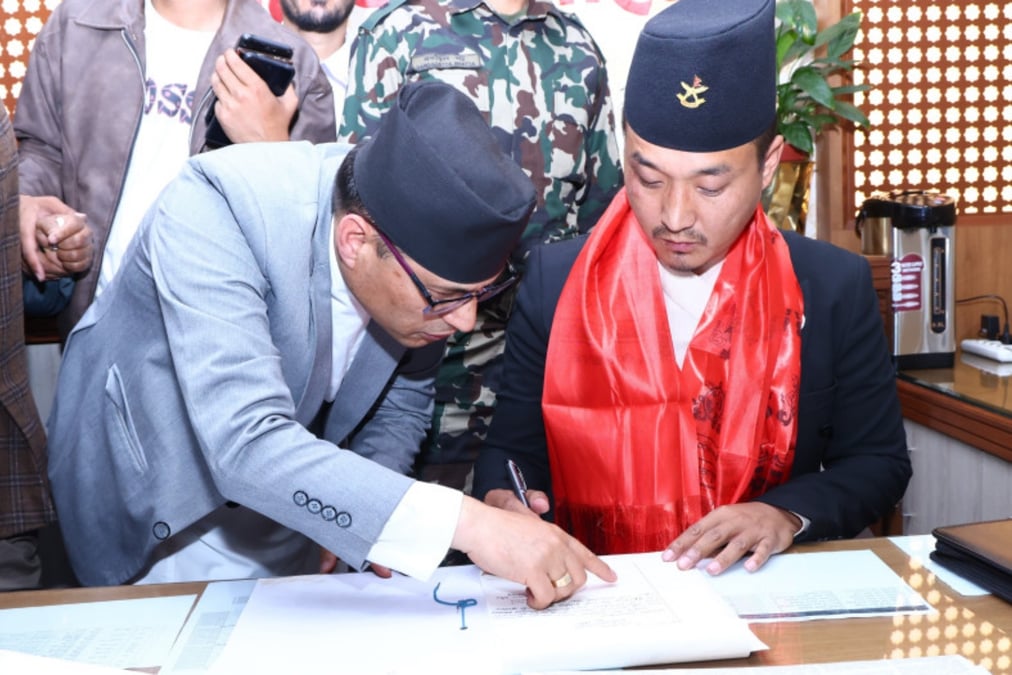
In a classic arc of political sociology, a revolutionary figure takes several decades to complete their cycle: mobilisation, institutionalisation, and finally governance.
However, the timeline of this trajectory has been telescoped in the case of Home Minister Sudan Gurung, who in 2025 described himself as a social activist and volunteer, has gone from the barricades of the GenZ protests to the mahogany desk of the Ministry of Home Affairs.
Gurung is a personal pick of Prime Minister Balendra Shah, and played a pivotal role in getting him to join the RSP by mediating with Rabi Lamichhane. His journey serves as a real test bed for the ‘Outsider-to-Insider Transition’, raising a fundamental question about someone who now leads the very apparatus that he once fought against: the police, intelligence service, and the bureaucracy.
Social capital can indeed be built during a crisis exacerbated by state failure, and that is where we first see Sudan Gurung — expediting relief delayed by systemic corruption and red tape. Gurung’s delivery aid through a social-media-driven volunteer network bypassed the government.
Whether or not he really rushed a dying child to hospital after the 2015 earthquake does not matter, it has become an urban legend.
His work evolved into the non-profit Hami Nepal in 2020, serving as a ‘parallel state’ mechanism that would later become central to his public identity. Later, his group sprang into action during the Covid crisis, organising oxygen cylinders and beds . He was there after flood disasters in Manang and Sidhupalchok, and even organised Rs15m worth of aid to Turkey after the 2023 earthquake.
Moral Legitimacy became his primary source of power, and he strategically positioned himself as an alternative emergency response system. But the real rupture happened on 8 September 2025 when years of frustration, corruption scandals, lack of transparency and state accountability culminated in a rally that the next day descended into anarchy.
There was no single leader. The movement was fully decentralised, but as elsewhere such upheavals produces a recognisable face. Among them was Sudan Gurung. Who despite being a millennial himself, became the most visible interlocutor of the GenZ movement.
He negotiated with the state’s key actors, including the president and the Chief of Army staff, during the period of uncertainty When the country was on the brink. This led to the dissolution of parliament and the formation of the interim government under Sushila Karki, paving the way for the election on 5 March.
Since then, Sudan Gurung’s role has become contradictory. Within days of touching Prime Minister Karki’s feet after her swearing in, he was at the gates of Baluwatar spearheading midnight demonstrations calling for her resignation. He accused her and Home Minister Om Prakash Aryal of not consulting the youth over Cabinet appointments and not arresting the previous government officials.
This oscillation became a hallmark of Gurung’s own version of the ‘Radical Flank Effect’ — erratic behaviour to force the establishment to make concessions.
On 18 January Gurung formally joined the RSP, and started campaigning from his home constituency of Gorkha-1. He won decisively and was appointed home minister by Balendra Shah. The transition was complete.
As minister his role spans core security areas: overseeing internal security through the Nepal Police, Armed Police Force and the intelligence bureau. The man who took part in anti-government rallies is now in charge of the riot police that aresupposed control anti-government protests.
His portfolio also handles state administration matters such as citizenship, immigration, and border security, coordinates with the judicial system on prisons, detention, and policies related to punishment and clemency. For example will be overseeing the fraud case against his own party’s chair, Lamichhane.
In his book Power in Movement, political scientist Sidney Tarrow observes that social movement leaders encounter ‘institutional capture’ upon entering government. In a sociological paradox, the man who previously denounced the police for killing youth protesters is now the person who issues directives to those same forces.
Preventive detention, surveillance, and the control of public festivals are the same instruments that the former old guard employed to stifle his movement. The activist who demanded transparency at the B P Koirala Institute now manages the state’s most secretive security apparatus.
In this arc, Gurung is not alone, there are parallels around the world for leaders emerging from the ashes of revolt. It is not so much a prediction, but for Gurung the challenge is even more acute because youth expectations are so high.
The bar for performance has been raised by citizens demanding change and quicker, more efficient service delivery. He is under constant public scrutiny, which is why he has to take YouTubers every time he goes on inspections of the airport, the BP Highway, police stations, picking trash on the sidewalks or meeting the Swiss ambassador to ask about repatriating the ill-gotten wealth of politicians.
Sudan Gurung is facing intense public glare. There have been calls to reveal the truth behind Hami Nepal’s finances, the alleged links to Free Tibet, and lately not paying five years of rent for an illegal lakefront property in Pokhara.
As minister, he will find that moral legitimacy alone is no longer sufficient, it must be reinforced by transparent and consistent institutional accountability. Sudan Gurung’s ascent is evidence that the public mostly trusts ‘outsiders’ during times of crisis. However, history also cautions us that the state only permits ‘insiders’ to operate.
Gurung will have to organise systemic reform to inject the transparency of his volunteer days to the Home Ministry’s traditionally secretive disbursements. If he fails, he runs the risk of validating Michels’ Iron Law of Oligarchy, which would serve as a warning about how revolutionary energy is dissipated by the very structures it was intended to overthrow.
Nepal is watching the man who said he once held a dying child in his arms after an earthquake. The volunteer has become the Warden.
Nischal Raj Gautam is a student of Media Studies and Mass Communication at St. Xavier's College, Maitighar. He is a member of the EU Delegation's Youth Sounding Board (YSB), and a journalist for TheirWorld's The Education Issue 2026.