
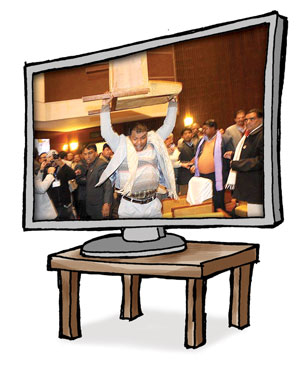
On many occasions, the UCPN (Maoist) leaders Pushpa Kamal Dahal and Baburam Bhattarai have accused their political opponents and media and civil society whom they deem as class enemies of indulging in “Goebbels-style” propaganda.
That’s a bit rich for comrades for whom facts have never stood in the way of an argument.
The latest lie is that the Maoist party had more than a two-thirds majority in the last Constituent Assembly, but did not press home that advantage because they wanted a constitution by consensus. If it wasn’t so serious, this deliberate truth-bending would be really funny.
Here is a breakdown of the strength in the last CA of those parties which were opposed to UCPN (M) and Madhesi Morcha’s idea of federal structure: NC–115, CPN-UML–108, CPN-ML–9, RPP–8, RJP–3, RPP-Nepal–4, Rastriya Jan Morcha–4. This comes to 251. Even if we concede that all the rest were in favour of the then ruling coalition’s idea of state restructuring, the number does not cross 350.
UCPN (M) Chairman Dahal claimed that he had the support of nearly 420 CA members in the last assembly. That is 70 more than the actual number. He and others claim that the Janajati and Madhesi CA members from NC and the UML had lent their support to the Maoist party on their idea of federalism.
Stalin was used to airbrushing history and removing inconvenient facts and people from history. What can you expect of his disciples in Nepal?
Let’s recap. After the kind of discussions we witnessed inside and outside the CA in the last few months before it was dissolved in 2012, it was clear that federalism was going to be the most prominent issue for elections a year later.
The UCPN (M) and their Madhes-based allies were so sure of getting their idea of federalism endorsed by the majority of the people that they mentioned in their election manifestos that they would adopt the democratic process of voting to decide the constitution matters if the parties failed to strike a consensus. That promise has been conveniently forgotten.
If the parties are to decide everything outside the assembly, why hold another election for the assembly to draft the constitution? If the idea was to get it endorsed by an elected assembly, the parties could have reached an agreement on contentious issues, hold the election and then get it passed by an overwhelming majority. The idea was to have the constitution by an assembly representative of the people of Nepal.