
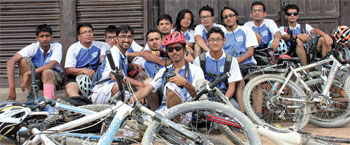
Kathmandu Kora, which takes its name from the clockwise circumambulation done by Buddhists around religious structures, was initiated in 2011 by British teenager Maxim Jones.
Before leaving for a volunteering trip to Nepal, he wanted to raise funds for his missions at the SAMATA School in Boudha and the OCCED Orphanage in Naxal.
Jones contacted the Nepali tour operator Socialtours, who suggested that he conduct a fundraising cycling challenge around Kathmandu. With the help of another teen, Shishang Lama, Jones began to organise the challenge in January 2011.
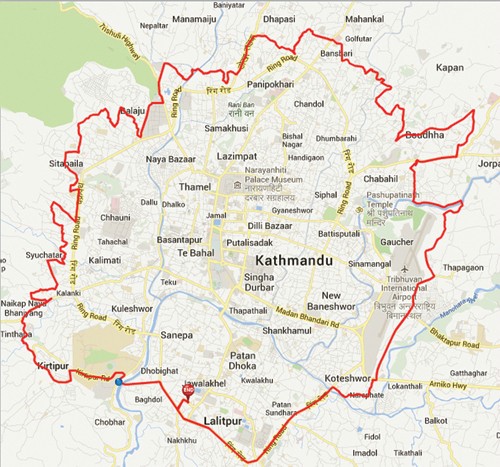
Six months later, in July 2011, thirty-five other cyclists joined the two teenagers and cycled 60 km around Kathmandu. The event raised Rs 450,000 which was shared between SAMATA school and OCCED orphanage.
After the success of the first cycling challenge, Socialtours expanded the fundraising campaign and created Karma Foundation, a non-profit to run Kathmandu Kora. Each year, the INGO Save the Children identifies a new cause for the funds raised by the cycling challenge, which usually include development projects in rural areas of Nepal. “We implement projects in zones where the government cannot operate”, explained Binita Pandey, chairperson of Karma Foundation.
In 2012, Kathmandu Kora raised Rs 950,000 for the renovation of a birthing facility in Samritu, Rukum. The following year, 800 riders amassed Rs 1.7 million to build a birthing centre in Sharmali, Baitadi. This year, Karma Foundation hopes to raise Rs 2 million for the construction of a birthing facility in Pyutar, South Lalitpur.
“Women here give birth in the post office”, said Bipin Maharjan, manager of Socialtours. “Seeing these horrible conditions, we chose to help a village nearer to Kathmandu this time”.
In addition to raising money for unprivileged rural areas, Karma Foundation and Socialtours hope to increase awareness among the cyclists, and their entourage, to the organisation’s cause of the year.
The organisation asks the riders to raise Rs 100 per kilometer by soliciting friends, family and companies to pledge for the cause. But this is a voluntary act and riders are not bound to collect that exact amount of money. Although Karma Foundation receives support from agents in Australia, U.K, Norway and U.S.A, Maharjan wants Nepal to be less dependent on foreign aid.
“We are used to receiving money from other countries,” he said. “But if we are united, we don’t have to rely only on foreign funding”.
To show participants the difference their contributions can make, Karma Foundation took ten riders to witness the implementation of the project in Sharmali last year.
“It’s important for the cyclist to witness the difference they’re enabling”, said Pandey. “We want people to understand that one individual can make a big difference.”
Kathmandu Kora 2014
19 July, 7am
Patan Darbar Square
Read also: