
|
|
When I read in a Birganj newspaper that the 'A People War' photo exhibition tour was being put up at the Birganj Chamber of Commerce and Industry I wasn't really that interested.I had seen exhibitions here before, and they all lacked the
professional touch. I was also blas? because similar exhibitions of photographs of conflict in Kashmir and the Indian northeast I had found disappointingly selective.
Human rights groups highlighted atrocities committed by the state, and those put up by state functionaries displayed images of militant atrocities. Photo exhibitions, therefore, seemed to serve a propaganda purpose rather than to tell the stories of human tragedy.
But my reluctant visit to 'A People War' sprang a few surprises. First of all, I was struck by the long queue of people patiently lining up outside the venue. It took me ten minutes to get in, and there was total silence inside the hall which was filled to capacity.
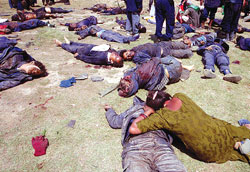
Nepa~laya had done a good job in selecting the photographs from the book, A People War. Each told the story of how ten years of violent conflict in Nepal had brutalised society. The exhibition was carefully balanced, and left no scope for recrimination or revenge. The emphasis was on how conflict affects civilians the most, and it depicted images of sorrow but also resilience and the inner strength of people caught up in war.
Everyone was reading every caption and lingering over the pictures. As we inched along, I was instantly struck by a photograph that showed three dead goats and an elderly farmer, their bodies torn apart by a bomb dropped from a helicopter. The picture forced us to ponder and compare the value of human life and the lives of animals.
Further on, there was a photograph of a woman caressing the body of her policeman husband who lay among many dead scattered on a blood-soaked field. My inner self asked a silent but difficult question: was she unlucky to be there, or lucky to be able to say a final farewell? I took refuge in a presumptuous thought and silently comforted myself by supposing that they did not have children.