
 MIN RATNA BAJRACHARYA |
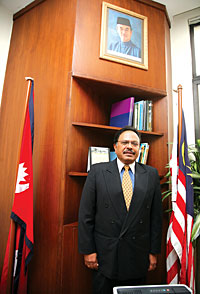
Nepali Times: What is the Malaysian government's assessment of the situation in Nepal?
Ambassador Ilankovan Kolandavelu: We are pleased to note that the peace and democratisation process in Nepal is forging ahead, although there are some hiccups along the way. Malaysia made its contribution to the election monitoring process in April by sending a delegation consisting of the deputy chairman of the election commission and two election commissioners. They have reported that the conduct of the election has sufficiently met acceptable international standards.
Now that the new government has been formed, we hope that lasting peace and political stability will be established to enable the government to focus on nurturing economic development and prosperity. Though Malaysia is not in the category of donor nations, we have been contributing to the development of human resources and capacity-building in Nepal for more than 20 years through the Malaysia Technical Cooperation Program. Nepali workers in Malaysia remit about US$400 million to Nepal every year. For Nepal, Malaysia is the biggest recipient country of Nepali workers, while Nepal is the third biggest source country for Malaysia (until 2007 Nepal was second biggest source country of foreign workers).
Would you say the Malaysian model of economic development has some lessons for Nepal?
The World Bank and IMF are fond of referring to Malaysia's growth model and prosperity as 'Asia's Miracle'. The former prime minister once responded that he did not believe in miracles and that Malaysia's growth and prosperity were brought about by?in his words? "shedding our sweat, tears and blood". Malaysia, on its independence from British colonial rule in 1957, was grouped in the category of least developed nations. As we celebrate our 51st anniversary, Malaysians can take pride in the progress and development that their country has achieved. Through hard work, tolerance and consensus, our multi-ethnic, multi-cultural and multi-religious population has turned diversity into an asset that brings stability and prosperity to the country.
Certain aspects of our experience in nation-building could offer some lessons to Nepal, particularly our ability to successfully forge a multi-party coalition government. Our economic policies relating to diversification of the economy and exploitation of domestic natural resources could be of value to Nepal. Of course some modifications have to be made to adapt to local conditions.
What would the new government need to do to entice Malaysian businesses to invest in Nepal?
First and foremost, sustained political stability and peace need to be established to realise the peace dividend. Some Malaysian businessmen have shown an interest in exploring investment opportunities in the country,
particularly in hydropower, infrastructure and tourism-related projects. However, the government has to create an enabling environment that would reduce the risk of investing and doing business in Nepal. As businessmen,
they are prepared to take a calculated risk, but Nepal needs to introduce business-friendly economic and financial polices to entice the Malaysian business community to invest in the country.