Till now, the most interesting archaeological finds in Upper Mustang were sky caves containing human remains 1,500 years old, and scriptures and textiles suggesting the region’s links to the ancient Silk Road.
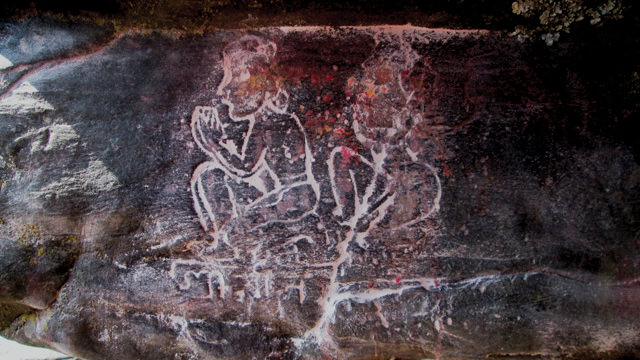
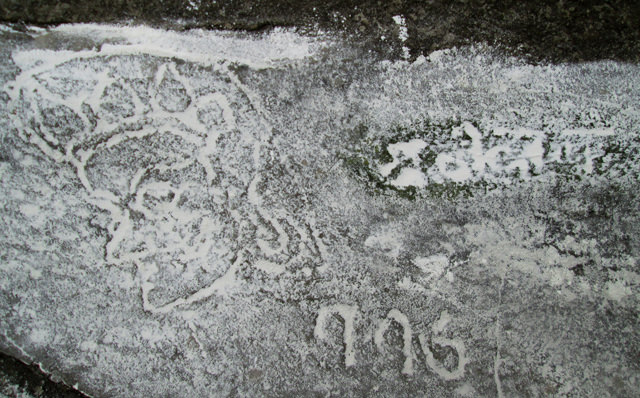
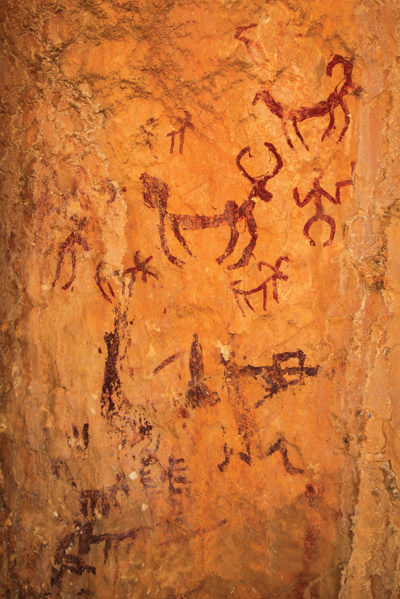
But recently, Fidel Devkota, an anthropologist has discovered 90 rock paintings made of red and yellow ochre that he says could rewrite the history of the people of this part of Nepal that juts into the Tibetan Plateau. The paintings of wild yaks, horses and other animals, with depictions of the crescent moon and human figures, were found on rock faces in the Kya and Ludak Valleys in the eastern part of Mustang.
“The paintings and inscriptions are different in style, execution, composition and placement, suggesting that they are from various historical periods,” says Devkota, who had been documenting the impact of climate change in Mustang for the past 10 years when he came across the rock art which are in such a remote location, even local herders didn’t know of them.
At the Kya Valley site, the paintings were found on a cliff facing southeast towards Bhrikuti Himal, and although the Ludak rock art site is exposed it was only found three years ago.
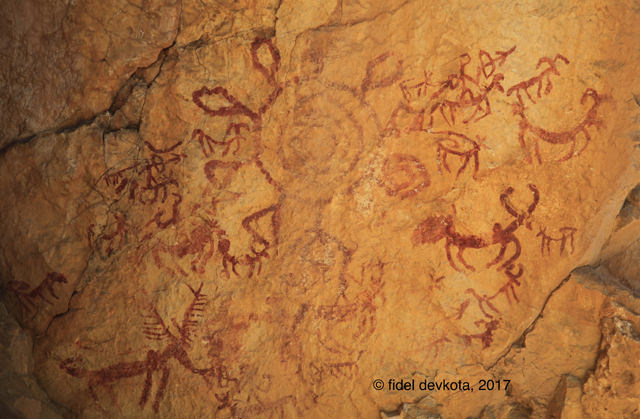
Devkota collaborated with John Vincent Bellezza, an archaeologist and cultural historian specialising on Tibet, and the two have jointly published a paper, ‘Obscured for Centuries: The Lost Rock Art of Lo Mustang’, documenting the discovery.
As carbon dating has not yet been done, Belleza compared the rock art and inscriptions, based on Devkota’s photographs, with the rock art in western Tibet, Sipti and Ladakh. He dates some of the paintings as far back as pre-7th century CE.
“The first phase of paintings is prehistoric but the later phases are clearly motivated by Buddhism and Yungdrung Bon religious practices,” writes Devkota in the paper. The rock art depicts hunting and other wild animal-human interaction, birth giving, anthropomorphic portraits, tiered shrines and other sacred symbols. Belleza writes that the rock art in Kya and Ludak focuses on the beliefs, values and activities of the painters, although pinpointing their specific traditions is difficult. It is also difficult to discern whether the artists were pastoralists or agriculturists or both.