
 BIKRAM RAI |
Kathmandu Valley's population has now surpassed 3 million, and it is probably the only major city in the world that has virtually no water supply utility worth its name.
Together with the huge electricity shortfall, the crisis of urban water supply represent proof of spectacular state failure. Successive governments have demonstrated that they have little political will or management capability to run modern utilities like power, water, or garbage disposal.
The only reason water riots haven't broken out is because traditional water spouts built by the Malla kings 400 years ago are still working, and some of the Rana-era water mains laid down 80 years ago still function.
Modern urban water supply needs political, social, economic and administrative systems to be in place, and Kathmandu's present water crisis is caused by decades of failure in all these areas. While current demand has surpassed 200 million litres per day, the government supply is only 45 million litres in the dry season and 120 million litres in the wet season. Water supply is rationed to one hour every third day if you live in one of the lucky neighbourhoods.
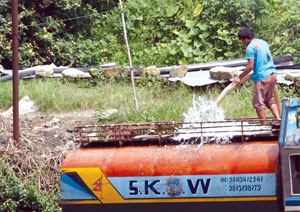
Just controlling leakage would partly cover the shortfall in supply since as much as 75 million litres a day are lost to rusty and leaky underground water pipes. By most international norms, Kathmandu Valley should be considered uninhabitable by now. More than half the city's water supply is being met by a booming water tanker business that either pipes water in from streams on the Valley rim, or pumps it up from drilled wells.
Every day there are hundreds of water tankers lining up to fill up near the scenic and historic Taudaha Pond on the Valley's southern outskirts. But there is no uniform rate, no documentation of revenue to the VDC, and no one pays VAT. There is no attempt to conserve the area from where water is pumped out, in fact it has become a garbage disposal site.
No one here knows or seems to care who is pumping water out and who is being paid for it. It is clear that the trade is in the hands of local toughies who enjoy political protection. No one seems particularly worried that this unsustainable water mining is lowering the groundwater table.