
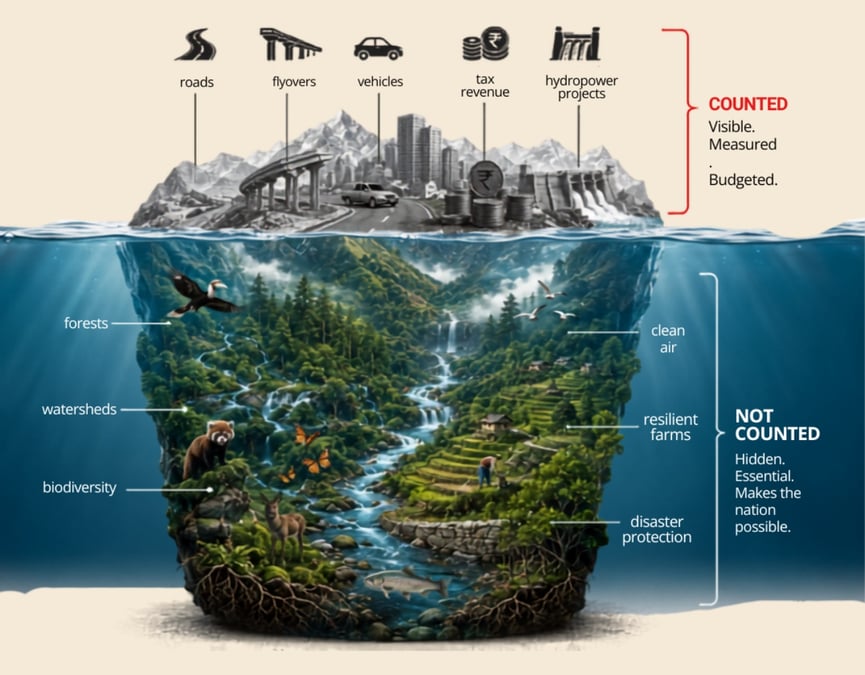
From the perspective of a green economy, this is not a balanced budget. It does not try to address the importance of preserving Nepal’s natural capital.
Forests are biological supermarkets– they cover 46.08% of Nepal’s area and provide numerous ecological goods and services every year that cannot be accounted for in terms of water regulation, carbon sequestration, biodiversity protection, wellness tourism.
Nepal is well-known across the world for the success of its community-based forest management model. We have been managing the resource for 50 years, but it is also time to start thinking about its sustainable management. The private sector can be involved in landscape level enterprise development.
However, forestry, environment, and climate change have seen only a small allocation in the budget. It seems as if forestry and the environment are not considered productive sectors at all, but as expenditure items.
Road building, construction of physical infrastructure and other such expenditures are considered investments while natural capital is not. This is a narrow economy approach rather than a green economy one.
According to green economy principles, natural capital is a productive resource that delivers economic benefits, job opportunities, climate change resilience, and social well-being. However, compared to previous years, there is no significant shift toward transformative green growth.
The budget largely maintains existing programs rather than investing in new economic opportunities in the green economy such as forest-based enterprises, ecosystem restoration industries, carbon markets, green jobs, bio-economy development, and nature-based ecotourism.
A green development paradigm should not be an afterthought, but be integrated into all plans, established on a nexus approach between water, food and energy systems. The budget allocation does not reflect the scale of investment needed for Nepal’s transition towards a green economy.
Although the budget acknowledges climate breakdown as a problem, there is no strong framework to address adaptation or mitigation efforts. There is a visible disparity between the policy agenda and budget agenda.
A climate-resilient budget needs to be explicit on adaptation priorities, financing arrangements, achievable targets, institutional mandate, and monitoring systems. Unfortunately, a lot of climate policy promises are general statements without any clear actions.
The budget does not offer an action plan to realise the goals set by Nepal’s Nationally Determined Contributions 3 (NCD3). On the contrary, it is an economic plan that relates to agricultural production, energy, infrastructure, tourism, health, and the economy overall, even though the climate crisis affects all the problems faced by these sectors.
Climate change financing has not been diversified from the environment to other sectors where it should play a role. For a green economist, climate change budgeting has to be incorporated in policies and plans for infrastructure, agriculture, urban development, corporate social responsibility, and industries.
All activities undertaken by international organisations at the global level have to be financed and countries at the national level need to design and implement policies and guidelines aimed at mitigating or adapting to climate change. Local communities need financing mechanisms to become carbon neutral.
SUSTAINABLE GROWTH
The budget appears to prioritise economic growth through infrastructure expansion, less importance is given to the natural base on which sustainable economic growth is based.
Nepal has abundant natural resources like forests and water, and many economic activities are based on them: hydropower, tourism, biodiversity, etc. In addition, Nepal follows the traditional approach of national accounting, which should be replaced with economic and environmental accounting.
This approach gives ecosystems value so that the closing and opening stock of natural resources would be calculated each year and future plans can be laid out. It is evident that unplanned road construction, dredging of riverbeds, expansion of urban areas, and construction of infrastructure have led to unsustainable development, caused disasters, fragmentation of forests, biodiversity loss, and degradation of watersheds.
All this has been ignored in economic calculations, resulting in environmental and disaster costs of such development being neglected. This budget is still based on the traditional approach to development in which environmental considerations are viewed as matters of compliance rather than a criterion for investment.
A green economy perspective focuses on green growth and calls for mandatory climate risk assessment, evaluation of ecosystems and natural capital accounting prior to any major infrastructure projects. The real challenge now is whether Nepal can afford to invest in infrastructure which damages the ecological balance needed for water availability, agricultural productivity, hydroelectric power generation, and disaster preparedness.
Therefore, this is not a green budget but rather an ordinary development budget with environmental elements in it. A green budget must give the primary consideration to natural capital in any process of economic planning.
Forests, watersheds, biodiversity, soil resources, and ecosystem services must be seen as productive natural capital assets contributing to economic growth and national wealth with focusing on:
· A national program on forest landscape management to also create green jobs.
· Promotion of recycling.
· Funding for businesses based on forests, non-timber forest products, eco-tourism, bio-economy sectors, and value-added forest products.
· Payment for ecosystem services to reward communities for conserving forests, watersheds, and biodiversity.
· Special policy provision for national priorities projects that support low carbon emissions.
· Carbon financing and carbon market readiness programs.
· Climate-resilient agriculture and agroforestry to reduce rural vulnerability.
· Green fiscal policies for investments in renewable energy, circular economy firms, and environment-friendly investments.
· Establishment of natural capital accounting mechanisms for national economic planning and public investment.
Sony Baral Gauli, PhD, is Director, School of Forestry and Natural Resource Management and Associate Professor at Institute of Forestry, Tribhuvan University.