
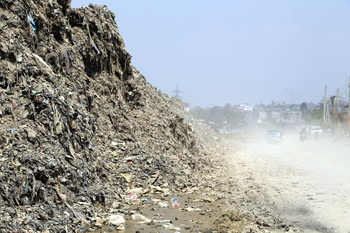
Although Kathmandu’s world heritage sites are well known, few may be aware of a new archeological dig that stretches for several kilometers along the Bagmati River. Deep trenches have been dug out, creating 20ft-high hills made of dirt held together with striations of blue, pink and black polypropylene that tell the 30-year local history of the plastic bag: Nepal’s most ubiquitous landmark.
In the Kathmandu Valley, garbage is the gift that keeps on giving. It is everywhere, stuffed in plastic bags and dropped in drainage ditches or piled high in empty lots, on the roadside or on the edges of the city’s rivers. It is thrown out of bus windows, off roof tops into neighbor’s yards. As long as their house and yard is swept clean, the vast majority of valley-dwellers don’t seem to care. When it gets too high, the garbage is burned in open areas, the toxic fumes blanketing nearby houses. The plastic bags clog the rivers and choke drainage pipes, creating flooding and spreading fetid, disease-carrying refuse. The health impacts are felt at all levels.
Rapid unplanned urbanisation has brought traffic jams and choking pollution, but politicians in Nepal’s new government have, with few exceptions, shown little political commitment to solving the problem of garbage. In 2011, the government passed the Solid Waste Management Act that set rules, regulations and fines for transgressors but enforcement is weak and detailed responsibilities are unclear.
The Valley needs clean water but the sole operating waste water treatment plant is handicapped by more than 12 hours of power cuts a day and needs to be overhauled. Sewage flows untreated into the rivers. There are no proper slaughter houses in any municipalities and no rules for disposing of the city’s dead cows and dogs. They end up in shallow graves near river banks, leaching into the water supply. Hospitals are responsible for disposing their own hazardous waste such as needles, tissues, organs and other body parts, but the government has not provided a dumping site. Some hospitals burn in the open, and others use incinerators that releases dioxin and furan, two highly carcinogenic pollutants.
An exception is the government-run Bir Hospital that has even built a bio-gas plant on its premises. Sumitra Amatya, executive director of the Ministry of Urban Development’s solid waste management technical support center, says sanitation in the Valley is in a state of crisis management. Serving Kathmandu and Lalitpur, the Valley’s only working landfill, Sisdole, 24 km from the capital, is almost full and during the monsoons is frequently cut off from the city by floods and landslides. The government has bought the land for another site but needs billions of rupees and at least four years to make it operational, Amatya says.