

In March 2014 the World Health Organization (WHO) released new estimates attributing 7 million deaths per year – one eighth of all deaths – to air pollution, including 2.6 million due to outdoor air pollution and 3.3 million due to indoor pollution in the Asia-Pacific alone.
Many air pollutants are also ‘short-lived climate pollutants’ (SLCPs) that have significant impacts on local and regional climate. These include black carbon particles emitted by diesel engines, brick kilns, cook stoves and open fires, as well as the gases ozone and methane. Unlike the greenhouse gas carbon dioxide (CO2), which, once emitted, stays in the atmosphere for centuries impacting global climate, SLCPs have atmospheric lifetimes of days to months.
The good news is that shutting down their sources reduces their climate impact within days to months. It also means that they do not have time to mix uniformly around the world, and have the greatest impact in the region near their sources.
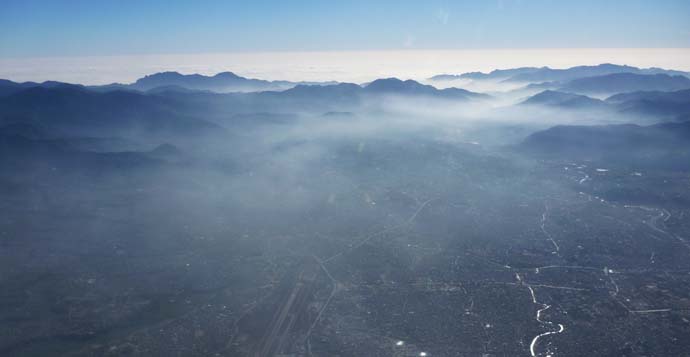
The bad news for us is that Nepal is in a region that is a major hotspot for black carbon emissions. While globally black carbon has the second biggest impact on climate after CO2, in northern South Asia its impact is much bigger. Black carbon contributes to the melting of Himalayan glaciers and snowfields, warms the atmosphere at higher elevations and cools it at lower elevations. It also reduces visibility, and contributes to changes in monsoon rainfall patterns.
Outdoor air pollution has grown steadily in recent decades. During the dry season, plumes of smoke from hundreds of millions of cooking fires, millions of diesel vehicles, generators and pump sets, as well as tens of thousands of brick kilns merge into one thick brown haze layer that extends from Pakistan to Bangladesh, penetrating deep into Himalayan valleys. In winter, pollution contributes to the increasing persistent fog that covers large areas of the Indo-Gangetic plains for weeks on end.
Air pollution is worse in large cities like Dhaka, Delhi, and Kathmandu. In the Kathmandu Valley it is much worse in winter than in summer, and worse in the morning and evening than in the afternoon or late at night. Air pollution increases when brick kilns start operating in December, and is worse in the eastern part of the valley where the brick kilns are concentrated as well as near roads and other pollution sources. Field studies during the first half of 2013 found concentrations of air pollutants several times above WHO’s and Nepal’s own air quality standards for extended periods of time, not just in Kathmandu but also in places like Lumbini.