
Nepal revives the purity and popularity of paubha
The sacred artform has been passed down to a younger generation of Nepali painters
More than 1,300 years ago a unique devotional art form evolved in Kathmandu Valley’s unique Hindu-Buddhist civilisation.
Called paubha, the scrolls were painted with natural pigments on white cloth, with intricate portrayals of Hindu and Buddhist deities, rendered with precise iconometry as recorded in traditional texts. When Princess Bhrikuti was married to Tibet’s King Songtsen Gampo, she is said to have taken along paubha scrolls, and the thangka style evolved from them into purely Buddhist scrolls.
Even while tourism has prompted galleries across the Himalaya to mass produce thangka, there is a movement in Kathmandu to preserve the paubha’s original motifs and styles so its sacred aspects are not corrupted.
.jpg)
Foremost among those practicing paubha in its traditional form is Nepal’s most celebrated artist Lok Chitrakar. He explains, “Kathmandu Valley’s paubha takes a more syncretic approach by depicting both Buddhist and Hindu iconography, while thangka mostly portray Buddhist deities and are traditionally painted by monks.”
Paubha art holds a sacred purpose for the artist who paints it. The action itself is a form of devotion, where the artist attains a meditative state. Artists like Chitrakar infuse culture, knowledge, worship, and dharma in every stroke of the brush for months, sometimes even years, it takes to complete a single piece.
While each artist uniquely paints deities and the stories behind them based on personal interpretations and experiences, they all share the understanding that the paubha is not simply a portrait of the divine, but rather a form of worship and prayer.
“Paubha is a reflection of inner karuna (compassion),” says Chitrakar while applying meticulous brush strokes to a paubha he has been working on for more than a decade. “The art itself is a form of prayer.”
.jpg)
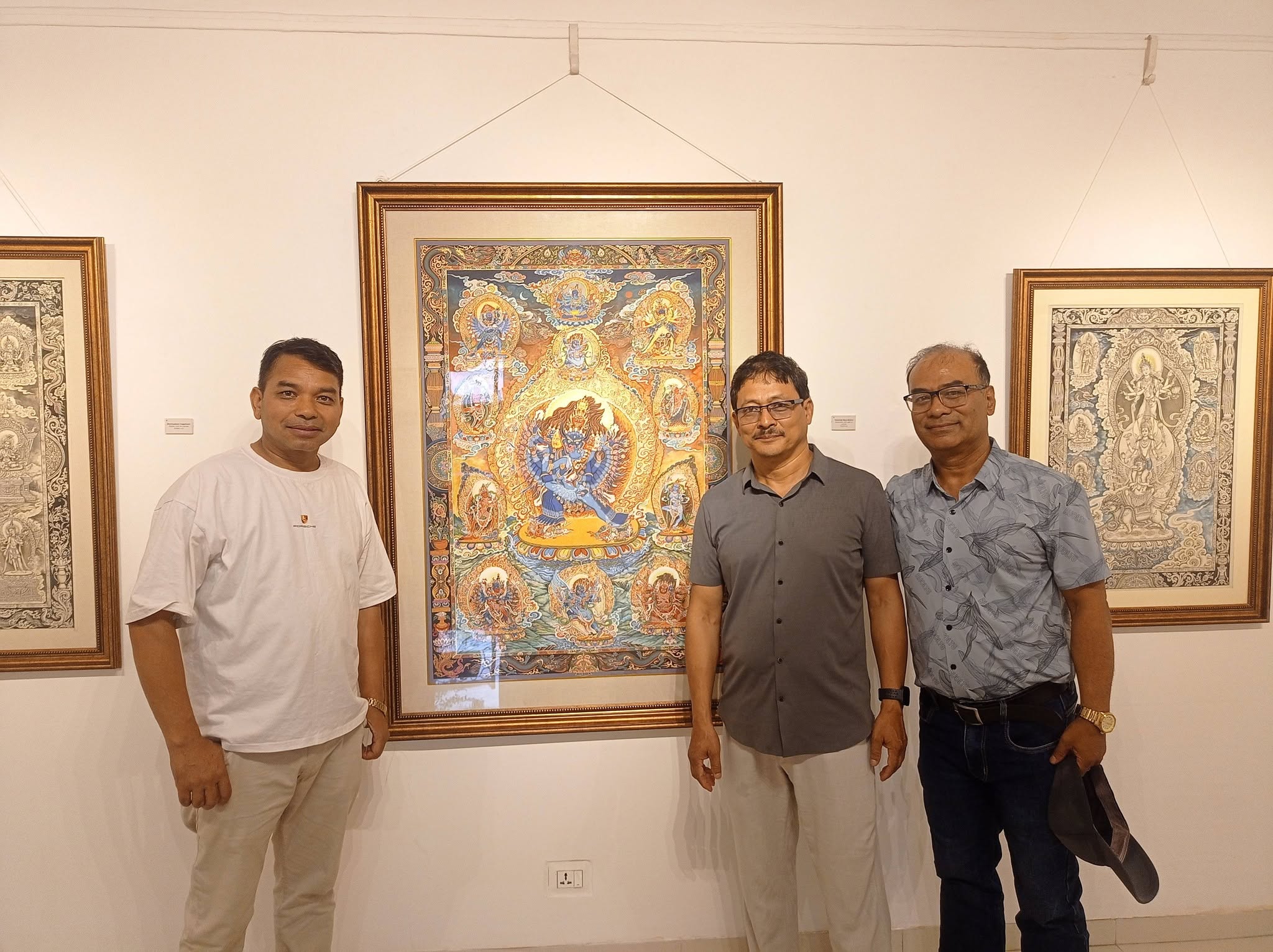
Across town at the Siddhartha Art Gallery, there is an ongoing exhibition of paubha scrolls by Shankha Narayan Shrestha and Shankar Kumar Joshi, who tell traditional tales of goddesses and gods in a visual style that must have been much powerful centuries ago when there was no mass media and the Internet.
“Paubha can be regarded as both art and a religious art form. Over centuries, it has continued to enrich the local art scene in Kathmandu,” says Sangita Thapa who curated the exhibition at Siddhartha Art Gallery.
The exhibition titled ‘Traditional Paubha Paintings’ will run till mid-August, and the gallery at Baber Mahal Revisited is no ordinary show, the paubha give in an ambience of a shrine where visitors become pilgrims.
Skillfully crafted images of the divine imbue viewers with a powerful feeling that transcends artistic appreciation and becomes spiritual inspiration.
The paubha titled Simha Sartha Bahu recounts a popular Newa folktale in bright colours, the fierce goddess Ugratara claims victory in striking vermilion, and Ganesh’s aura is decorated with intricate red and orange spirals, a trademark Nepali style. The deities portrayed also indicate the unique harmony between the Hindu and Buddhist faiths in Kathmandu Valley.
PAUBHA AS MEDITATION
“It’s like meditation. We lose track of time while working on them,” says one of the artists, Shankha Narayan Shrestha, 51. Shankar Kumar Joshi, 58, puts it even more precisely: “The brain, eyes, hands, and heart all need to be in the same place. Unity of mind and body is essential to paubha paintings.”
The process can be exacting. Artists first choose a theme, or deity, for the painting and then conduct research on it through primary texts in Sanskrit so nothing is lost in translation. After preparing the canvas, artists draw the symbols, attributes, and objects each deity holds. Lok Chitrakar says that the iconography is the atma, or soul, of the paubha.
Colours are made naturally from crushed stones, plant dyes, and powdered metal, a method Chitrakar hopes will not be replaced by syntheic material. Every line and curve of the painting is governed by iconometric rules recorded in traditional texts. While there are subtle characteristics of the artwork which are unique to each artist, they do not deviate from the basic rules. Doing so risks misrepresenting the deity and the teachings, and the painting loses the essence which makes it a genuine paubha.
Sundar Sikhwal, a paubha teacher, remembers a time when learning the paubha craft was vastly different from today: “It was much more difficult because we could hardly get any references … it is much easier now because of all the online resources.”
While earlier generations of paubha students relied on their guru and a handful of scrolls, today’s paubha painters can just scroll the net on their phones. But access alone does not guarantee cultural preservation. Sinkhwal has noticed a shift in the temperament of today’s youth who are attracted to paubha more out of fleeting curiosity than pure passion.
“People don’t have as much patience these days,” he says. Chitrakar echoes this concern, noting that interest in preserving the genre in its purest form may be threatened by shorter attention spans and instant gratification among digital natives immersed in pop culture and the online universe.
Although worrying, Sinkhwal also sees hope. Students at the gallery this week at Sinkhwal’s paubha lessons included a modern artist, an architect, a surgeon – all professionals and not idle hobbyists. They all choose to spend their free time learning a rigorous and demanding spiritual discipline, because it connects them to their culture, their country.
“Art keeps looking for new avenues,” Chitrakar notes. “The topic needs to be understood, but Nepali people have also started collecting and learning more about their culture.”
As Nepalis rediscover cultural and artistic heritage, and collectors invest in traditional works, the significance of paubha is enhanced and its preservation is on firmer ground.
For Shankar Kumar Joshi working on a paubha shrinks time, and does not feel the hours tick by. In an era demanding speediness, and abundance over authenticity, paubha offers a chance to rediscover a slower pace of life.
Uncertainty that comes with globalisation hits smaller countries harder, but as the revival of the purity and popularity of paubha paintings prove, the historic artform has been passed down to younger generation of Nepali artists.
.jpg)
Traditional Paubha Paintings
Siddhartha Art Gallery
Baber Mahal Revisited
11am-5pm, 12-5pm (Saturdays)
Till 15 August