

|
|
| IT'S DEVELOPMENT: Maoist senior, CP Gajurel, at a panel discussion on post-election development delivery with Kathmandu-based donors and academics last week. |
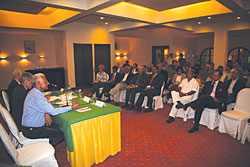
At an interaction last week organised by this paper, Maoist foreign minister-in-waiting C P Gajurel, like many past politicians in Nepal, turned to donors present for help in rebuilding the country.
He said his party would make sure aid goes directly to the people and without leakage and corruption along the way. There was a strong sense of d?j? vu hearing all this. It was reminiscent of the euphoria after 1990. Leaders then, as now, promised corruption-free good governance.
It didn't take long for the hope to evaporate. Given the role of money in competitive politics, most politicos were soon up to their necks in the quagmire of corruption.
Gajurel was asked how his party would meet the aspirations of thousands of his cadre. He said there had to be massive job creation for Maoist youth, and he asked for donor help. It left many wondering whether the Maoists would now use ministries as recruitment centres as the UML and NC did post-1990.
Gajurel's reliance on donors also shows that the Maoists may fall into the same old dependency trap. Nepal has been receiving ODA for more than 50 years and part of the goal has been poverty alleviation through job creation. Despite this, unemployment (13 percent) and under employment (47 percent) are at all-time highs. In fact, this was a factor that enabled Maoist recruitment.
In order to do things differently and effectively, the Maoists must realise that employment creation as well as other development undertakings have never been a function of money alone, but building people's institutions. Only then can local development also generate employment opportunities in the process.
Unfortunately, while the donors are good at doling out money, their record is tardy at best in building institutions resulting usually in the wastage of scarce resources. Take the Ministry of Local Development (with its interesting acronym, MOLD) which has spent a budgeted sum of Rs 38 billion in its nearly 30 years of existence. This does not include the vast sums spent by donors directly to micro-manage projects that they fund.