
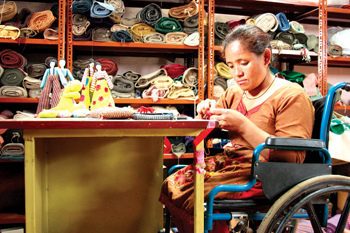
After hearing about the organisation from her relatives, Purja came to WSDO office in Pokhara and began learning to sew and make handicrafts. Today, the 39-year-old trains other poor women like herself and helps them overcome personal and social obstacles. “WSDO helped me become financially independent. I am happy to have the skills to support myself and not rely on anyone else,” she says. In 2011, Purja travelled to Kenya as part of a two women team from Nepal to participate in WEIGO’s (Women in Informal Employment: Globalising and Organising) meeting.
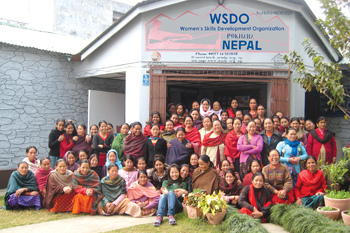
WSDO was started in 1975 by the government to train poor, illiterate women in vital life skills so that they could earn an income. When the change in government in 1989 forced the organisation to shut down due to a lack of funding, many employees lost their only source of earning and were pushed back into poverty. Devastated by the loss, Ramkali Khadka, a former employee and currently the executive director, got together three friends, collected Rs 10,000, and put the company back on its feet.
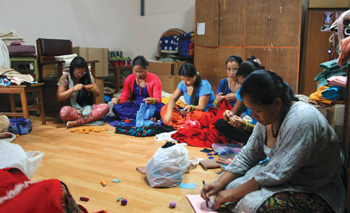
WSDO is self- sustaining through income generated from sales of handicraft products like bags, dolls, laptop and camera covers, backpacks etc. As a member of Fair Trade Organisation, the company uses only local raw materials and eco-friendly dyes. While it has a retail shop in Pokhara, in Kathmandu WSDO products are sold at Sana Hasthakala, Dhukuti, and Maha Guthi and even exported as far as Europe and Australia.
Apart from training, the company also provides its employees with free health check-up, clothing allowance, and 60 day paid maternity leave and conducts social and environment awareness programs. It also has its own saving and credit program where members get loans at nominal interest. “WSDO is like a family and I want to work here for as long as I can,” says Purja.