

|
|
| DOING THE ROUNDS: UML candidate for Kathmandu-8 Astha Laxmi Shakya goes door-to-door in Sitapaila last week. |
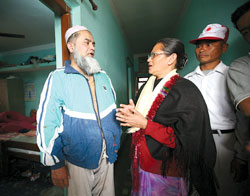
Laxmi Bista was preparing breakfast in Sitapila when the election campaigners arrived at her doorstep. She has met several candidates who have come house to house here on Kathmandu's outskirts to ask for votes, and she has now made up her mind.
"I will vote for a woman candidate," she says resolutely, and looks on as UML candidate Astha Laxmi Shakya's entourage passes by. Laxmi is encouraged by the number of women contesting in this election, and believes more women in the parliament means a pro-women constitution.
Still, out of 3,947 candidates in this election, only 367 are women. When the constituent assembly sits 200 (33 percent) of the 601 MPs will have to be women. The proportional representation ballot (PR) guarantees 168 seats for women. In the first-past-the-post ballot (FPTP), the parties have selected 10 percent women candidates for 240 seats.
But it is clear that only a few women will win in the FPTP ballot, and this will mean the proposed 33 percent ratio for women in the assembly is unlikely to be reached.
Hisila Yami, Maoist candidate for Kathmandu-7, is confident that more women MPs will make a difference. "We have never been this inclusive in terms of ethnicity or gender," she told Nepali Times.
But politicians from other parties are not convinced. "It is a ploy to deprive women of our rights," says Uma Adhikari of Inter-Party Women's Alliance, who is concerned women have not been given the recommended number of tickets. "It is not that the parties don't have capable women, but deep-rooted patriarchy screens out women who are proactive, capable, and smart," she says.