
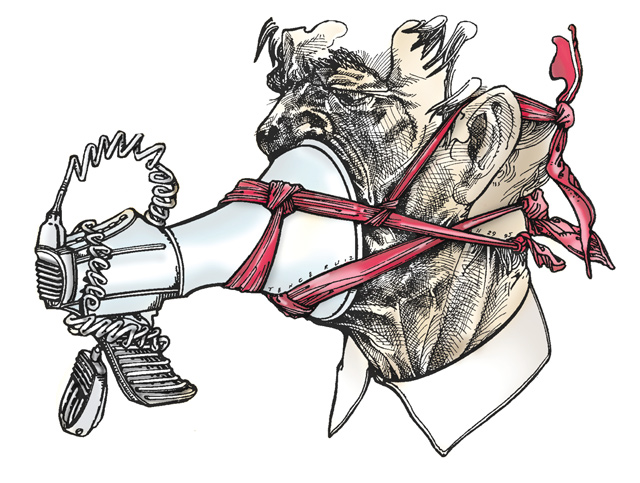
“There is an elephant in the room which everyone feels and sees, but no one dares touch.”
- Khagendra Sangroula
Of all the forms of action, silence is the most dangerous — it is the most political act of all. Those who take their beliefs to the street or make themselves heard through the press or other forms of physical and intellectual activism collectively push our society to think hard about the challenges we face.
Whether we stand up for or against a cause, person, institution or idea, it is an expression of the openness of our society. The very ability to have debate and public rebuttals is how our democracy is realised in everyday life. It is one thing to disagree or even dislike opinions and thought processes, but the very fact that we are able to do so openly is what keeps society from becoming closed.
The minute opinion stops being produced, and debate and discussion die — that is when the real threat to open society surfaces. The life of an idea, whether political or otherwise, is determined by the strength of the voices both in support and against it. That is what is meant when we say ‘all publicity is good publicity’. So long as there is a dialogue around a particular topic, for and against, the spirit of the cause is kept alive. When there is silence, the spirit of the cause is killed and we move towards a closed and less democratic space.
This ‘culture’ of silence manifests both as a result of direct intimidation and the utilisation of a politics of fear, such that individuals are silenced even in the absence of an immediately real threat. Instead, individuals are silenced out of trepidation of what is to come, a ghost-like terror of social ostracisation, political persecution or character assassination. A collective and consuming fear of persecution is normalised and as such, silence breeds further silence.
When the pillars of open society — among the media, parliament, civil society and public intellectuals, and sometimes even the judiciary — fall prey to silence, a real crisis is born.
Over coffee recently, writer Khagendra Sangroula mused: “Listen, there is an elephant in the room which everyone feels and sees but no one dares touch, except those one-off pagals (crazies). But the truth is that in every society and throughout history, change has always been led by the pagals.”