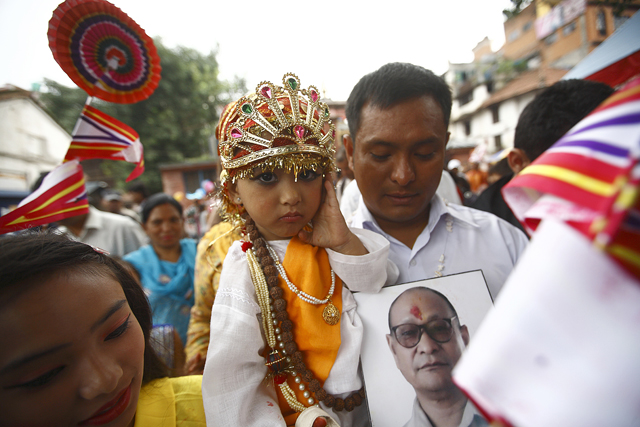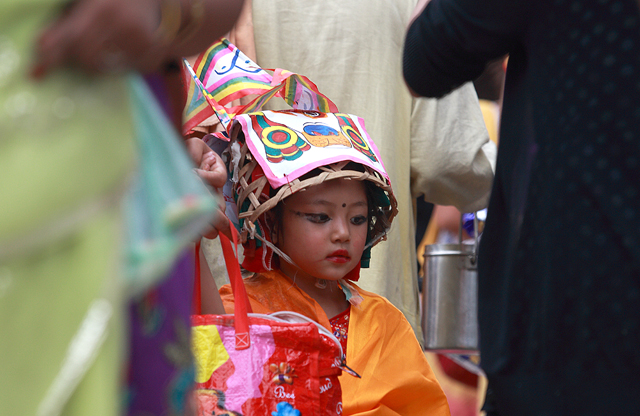
Pratap Malla’s prosperous reign as the king of Kathmandu in the mid-17th century was when most of the monuments of the Hanuman Dhoka Palace were built. One day Pratap Malla’s young son died, and the grief-stricken queen was inconsolable.
To show her that she wasn’t the only person to have lost a loved one, the king ordered everyone in the kingdom who had lost a relative that year to bring out a huge procession.
The king also asked them to try to make the queen laugh through skits that poked fun at Kathmandu's rulers. Tears gave way to laughter, and thus began Saparu, the unique Newari festival of satire, death and rebirth.
The festival is also known as Gai Jatra in Nepali because the procession includes young boys dressed as cows. This year, the festival falls on Sunday, 30 August and will be accompanied by feasts, music, dancing and merriment. Saparu carries special significance this year because the earthquake caused almost 2,000 fatalities in Kathmandu Valley. Of the 8,844 people killed, 20 per cent were Newars.
“Death is a reality of life and we have to accept it,” says Bhuyu Maharjan, 88 who survived the 1934 earthquake, “and Saparu gives us the strength to deal with death in the family and move on.” Maharjan still remembers the Saparu festival after the 1934 earthquake as a chance for his community to come to terms with their collective grief. For a festival that commemorates death, Saparu is mostly filled with laughter, music and feasting and is a part of Kathmandu Valley’s exclusive cultural heritage. The focus this year will be on rebuilding lives and reconstruction of fallen shrines and monuments.
“The number of people taking part in procession will be higher but the route will be shorter because of the supporting beams blocking some streets,” says Maharjan.
There are variations in the way Saparu is celebrated in Kathmandu, Patan or Bhaktapur. In Patan, there is an additional procession in memory of those who died during the previous year and the worship of the god of death, Yama, also known as Matya.
“It is a festival that helps families cope with death, and this year it will help the healing process and show world that we are getting back on our feet again,” says Sudhan Subedi of the Nepal Tourism Board which is promoting Nepal’s festivals.