
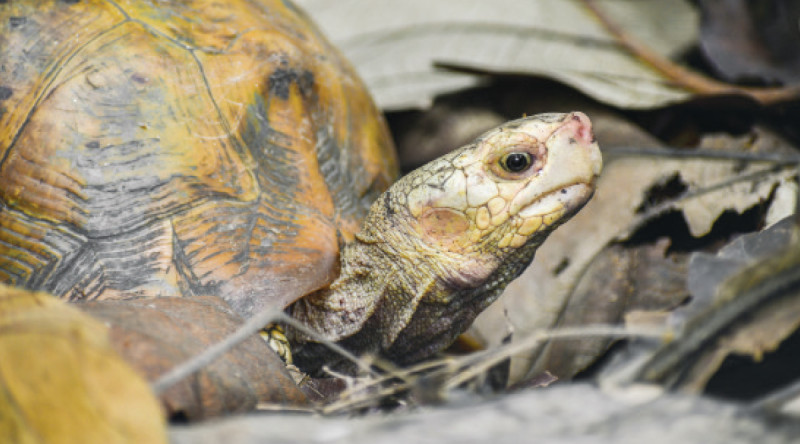
The critically endangered Elongated Tortoise (Indotestudo elongata) is one of the 17 species of turtles found in Nepal. Native to South and Southeast Asia, it is also known as the Yellow-Headed Tortoise, Ground Tortoise, Golden Tortoise and ठोटरी.
Its habitat is spread across Nepal and the reptile spends most of its life hiding under dry leaves in sal forests, bushes or bamboo groves. It feeds primarily on flowers and fruits, mushroom, and smaller organisms like earthworms, snails and slugs.
Turtles are some of the most threatened creatures with half of the 356 species found worldwide listed as threatened.
While in Nepali they are all called कछुवा, the distinction is made between whether the animal is aquatic (turtle) or terrestrial (tortoise). Morphologically, turtles have webbed feet for swimming and they come to land only to lay eggs, while tortoises have club-like forelegs and 'elephantine' hind legs, are heavier and cannot swim. In Nepal, Indotestudo elongata is the only entirely terrestrial tortoise.
According to the IUCN, several species of the Testudine order of reptiles, which includes tortoises and turtles, are more endangered than tigers, snow leopards, elephants or rhinos.
However, as governments, organisations and researchers prioritise the study and conservation of larger charismatic mammals, turtles and tortoises are largely overshadowed.
Popular for its meat and eggs, the shy Elongated Tortoise is also reared in homes as it is considered lucky and auspicious, an incarnation of Vishnu and bearer of wealth, and is often left in monasteries. Its meat is also believed to have medicinal properties, but the curative and religious benefits are scientifically inconclusive.
Adding to the challenge is the mass harvesting of the remaining wild populations for the growing food markets in China and East Asia, where it is incorrectly believed that a mixture, made by grinding up the tortoise's shell, serves as an aphrodisiac.
IUCN notes that the Indotestudo elongata has declined across its range by at least 80% in the last 90 years as a result of habitat loss alone, and has additionally been extensively and intensively exploited for consumption and export trade.
Read Also: Planet of the pangolins, Maheshwar Acharya
The Convention on International Trade in Endangered Species of Wild Fauna and Flora (CITES) states that Elongated Tortoise’s transport and trade without a permit is punishable by 2-10 years of imprisonment or a fine of Rs100,000–500,000, or both.