Between the 1980s and 2000s, over 5,000 Nepali children were adopted abroad, primarily to the United States, France, and Spain. While international adoption was intended to provide vulnerable children with better opportunities, child trafficking and irregular practices prompted Nepal to suspend adoptions in 2007, and overhaul its policies.
By 2010, stricter regulations aligned with the Hague Adoption Convention drastically reduced adoption numbers. Today, many of these children, now adults, are returning to Nepal in search of their roots, only to encounter a society that no longer recognises them, legally or socially.
Behind the statistics lie the deeply personal and emotional journey of adoptees returning to reconnect with their past, seek family, and rediscover a sense of belonging. These stories reflect a broader struggle for identity and the complexities of bridging two worlds.
Maya
Adopted at 9 by a family in Barcelona, Maya carried fragmented memories of her early life in Nepal including the painful recollection of the day her mother and sister vanished, leaving her and her younger siblings behind. She had faint images of her mother, elder sister, and the village where she once lived.
In June 2017, Maya came to Nepal accompanied by Chandra Kala and two friends, Jay and Vikram. With only a few photographs of her mother Tulsi, her elder sister Pargati, and her brother-in-law Kamal, along with a street name, Maya arrived in Birendranagar after a 20-hour bus ride from Kathmandu.
“Now that we’re close, I feel like I can’t face them,” she confessed to Chandra Kala, wrestling with anxiety about what she might uncover. “I’m nervous. I don’t know if I’ll recognise them or if they’ll recognise me. I don’t know how they’ll react or what they’ll say. And then there’s him [Kamal]. I have such bad memories of him. I don’t know if I can handle this.”
Chandra Kala reassured her, reminding her of her courage and the importance of this moment. Maya and her companions asked around the town with little success until a shopkeeper recognised Kamal and directed them to a nearby village. Jay went to confirm and returned excitedly, shouting, “It’s her! It’s your sister!”
Maya froze, paralysed by fear and anticipation but she pushed ahead. At the village, Maya’s sister Pargati initially struggled to recognise her. Jay introduced Maya: “Do you recognise her? This is your younger sister. She’s come all the way from Spain to find you.”
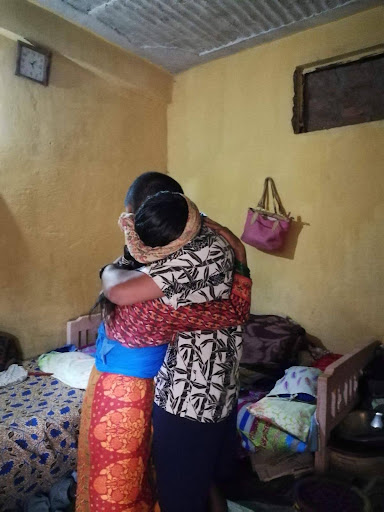
Slowly, realisation dawned, and the two women embraced, bridging the decades of separation with tears and disbelief. The next day, Maya met her mother Tulsi in an emotionally overwhelming reunion. Tulsi rushed into the room and embraced Maya tightly, sobbing uncontrollably: “Mero chhora-chhori, gaye, gaye… my children they went, they went …”
Once the tears subsided, Tulsi and Pargati began recounting the heartbreaking circumstances of their separation. After the death of her husband, Tulsi faced relentless judgment in their village when Kamal stayed with the family before his marriage to Pargati. The villagers accused Tulsi of impropriety, calling her पापी (sinful) and demanded that the family leave.
“We didn’t want to leave, but the village didn’t want us here,” explained Pargati. “We left intending to bring you and your siblings later. But when we returned, you were gone.”
Tulsi recalled how she had entrusted Maya and her siblings to relatives, hoping they would be cared for temporarily. However, when she returned, the children had been sent away without her knowledge.
“I only trusted them because I had no other choice,” Tulsi said through tears. “I didn’t know they would send my children away. What kind of mother does that make me? They called me a bad mother, but what else could I have done?”
The reunion brought healing and answers but it also exposed the societal pressures that had fractured Maya’s family. Despite the challenges, Maya spent the rest of her visit bonding with her sister, nieces, and younger half-sister, Sunita, slowly bridging the gaps created by time and distance.
Maya’s journey was a testament to the courage required to confront the past, the pain of uncovering difficult truths, and the hope of rebuilding connections once lost. Her story highlights the enduring emotional complexity faced by adoptees navigating their history and identity.
Ashmita
Unlike some adoptees whose main focus is reuniting with their biological family, 26-year-old Ashmita’s priority has been to uncover the institutional details surrounding her adoption. She wanted to understand what the orphanage and the government knew about her background and why so much information seemed concealed.
“I just want to know where I come from,” she said. “Even if I never find my biological family, having a better sense of the places and people connected to my story would mean so much.”
For many adoptees, returning to Nepal is not just about reconnecting emotionally, it is about seeking formal recognition as members of the Nepali community. However, the legal framework in Nepal often fails to acknowledge their unique status.
In Nepali law, adoptees are left in limbo: their birth parents are not considered legal parents, and their ties to the country are effectively erased upon adoption. This lack of recognition creates significant hurdles, particularly in two key areas: accessing pre-adoption records and obtaining Non-Resident Nepali (NRN) status.
Despite international norms like the Convention on the Rights of the Child, which guarantees the right to know one’s origins, institutions often refuse to cooperate. Orphanages and non-profits in Nepal, which hold critical pre-adoption records such as birth certificates and citizenship documents, frequently withhold this information, reflecting the systemic reluctance to provide transparency.
In numerous cases, records that should include family names, addresses, or relinquishment agreements were either incomplete or falsified. These practices not only prevent adoptees from reclaiming their histories but also perpetuate their disconnection from their heritage.
Ashmita’s initial requests for information from her adoption agency were met with delays and incomplete responses. When she turned to the orphanage where she spent her early years, she encountered even greater resistance. At one point, the director of the orphanage issued veiled threats.
Nevertheless, Ashmita persisted and managed to find the name of the individual who had brought her to the orphanage. However, the person had disappeared, leaving yet another gap in her story.
A breakthrough came when Ashmita accessed a police report that suggested she might have been born in a different municipality than the one in her adoption records, prompting her to seek help from local authorities. The police took an interest in her case and began investigating possible connections to her birth family. While progress was slow, they meticulously followed leads to help her trace her origins.