
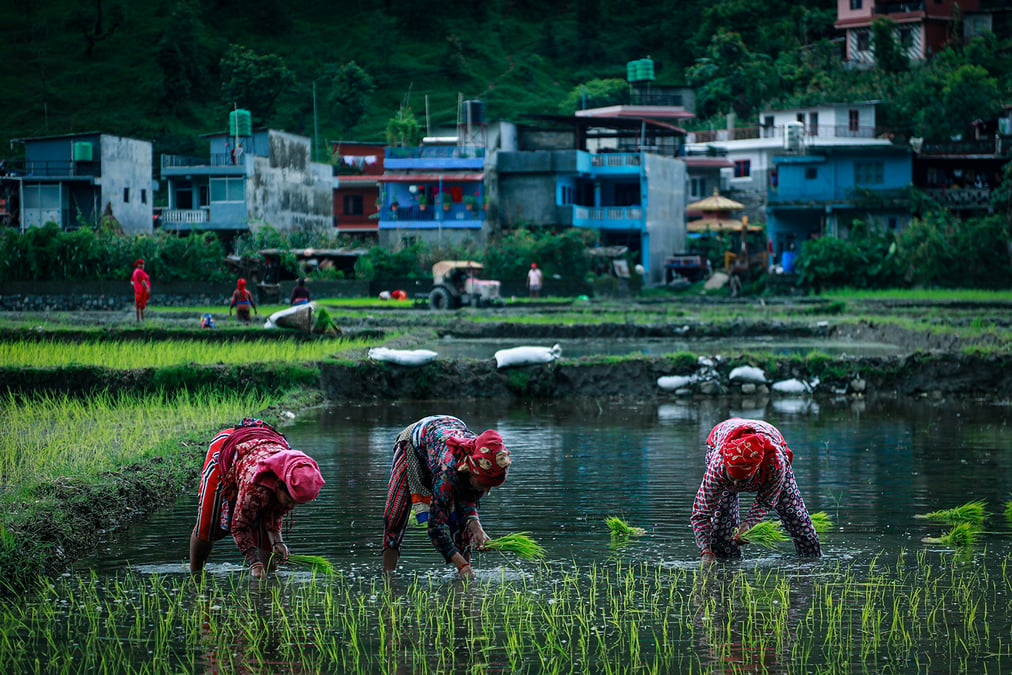
Nepal faces a recurring and worsening fertiliser crisis that has shifted from a seasonal inconvenience into a deep structural malady.
Timely and affordable fertiliser is not just an agricultural input; it is a national commodity tied to economic stability, rural livelihoods, food sovereignty, and government accountability. Yet millions of farmers continue to face shortages at the most critical time of the planting season.
The fertiliser problem cannot be treated as a routine administrative matter because agriculture remains central to Nepal’s economy even as services and remittances grow.
Despite billions spent on fertiliser subsidies annually, government policy has so far failed to ensure timely supply during the critical planting season. The gap between rising budget commitment and persistent on-the-ground shortages point to something more fundamental than a funding problem. The crisis is rooted in institutional dysfunction and structural failures in procurement and distribution.
Data from a nationwide survey by Kathmandu University School of Art, Inter Disciplinary Analysts (IDA), and The Asia Foundation reveals a rapidly worsening picture. In 2022, only 1.1% of respondents identified the lack of timely availability of fertiliser and seeds as a major concern. But that figure jumped to 19% in 2025.
This sharp increase reflects growing public frustration with the government’s agricultural support system. Fertiliser shortages are no longer isolated and confined to remote areas — they have become a widespread national concern.
The consequences of delayed fertiliser distribution are severe and consequential. Crops like paddy, wheat, and maize need fertiliser applied at specific growth stages. Even a delay of a few weeks can sharply reduce productivity. When fertiliser does not arrive on time, farmers must either delay planting or grow crops with insufficient nutrients.
Decreased domestic agricultural production makes Nepal more reliant on imported food, putting extra pressure on foreign currency reserves. The country already imports large amounts of cereals, vegetables, edible oils, and livestock products. Fertiliser shortages can lead to widening trade deficits and inflation. In a country that heavily relies on imports, disruptions in agricultural productivity can weaken overall economic stability.
STRUCTURAL IMBALANCES
One major cause of the crisis is its heavy reliance on imported chemical fertilisers. Nepal imports almost all its urea, diammonium phosphate (DAP), and potash fertilisers, mainly from India and other suppliers. Over 483,000 metric tons of fertiliser were imported in the last fiscal year. But demand exceeds 1 million metric tons annually.
Heavy reliance on imports exposes Nepal to various external risks. Global fertiliser prices are sensitive to energy markets, geopolitical conflicts, and international supply chain disruptions.
Since ammonia and urea production relies on natural gas, shifts in global energy prices directly impact fertiliser costs. The Russia-Ukraine conflict and the West Asia war have disrupted global fertiliser supply, and this could severely affect Nepal’s food security.
When the United States and Israel struck Iran on 28 February, Nepal’s paddy fields became an unintended casualty. The blockade of the Strait of Hormuz through which one-third of the world’s seaborne fertiliser passes sent global urea and DAP prices up 30-40%, compounding an 18% rise already recorded in 2025.
Nepal produces no chemical fertiliser domestically, and needs around 350,000 metric tons of urea and DAP for the paddy season beginning this week, but only 183,000 tons are likely to be available. The government sells subsidised urea to farmers at Rs18 per kg while the open market price has reached Rs160 — a gap that now costs close to Rs80 billion to maintain, a burden the agriculture ministry itself admits is unsustainable.
In response, Kathmandu has turned to New Delhi for an emergency 80,000-tonne procurement, though the five-year G2G agreement underpinning that arrangement expired in March 2026 and its renewal remains unconfirmed.
With rice providing over half of Nepal’s daily calorie intake and smallholder farmers making up 60% of the agricultural workforce, a fertiliser shortfall this season means lower yields, higher food prices, and squeezed farm incomes — consequences that will be felt long after the guns fall silent in the Strait.
Beyond international vulnerabilities, Nepal faces significant domestic governance issues in fertiliser distribution. Delays in procurement, bureaucratic inefficiencies, poor coordination between federal and provincial agencies, inadequate storage facilities, and political interference often disrupt supply chains.
There are also reports of black-market activities and smuggling, further worsening the situation. Additionally, border areas have seen increasing inflows of low-quality and smuggled fertilisers from India.
Given these ongoing crises, policymakers and experts emphasise the need to treat fertiliser as a strategic national sector, not just an agricultural commodity.
Ensuring long-term fertiliser security requires integrated planning across agriculture, energy, industry, infrastructure, trade, and environmental policies.
This shift is increasingly important as Nepal aims to strengthen food sovereignty and lessen its reliance on imports. The most promising long-term solution is domestic fertiliser production through environmentally sustainable technologies.
Traditional chemical fertiliser manufacturing has relied heavily on fossil fuels — making it carbon-intensive and vulnerable to global fuel price swings. Recent advancements, however, now make it possible to produce ‘green fertiliser’ using renewable energy sources, opening a viable path that aligns with Nepal’s growing hydropower and solar capacity.
Green fertiliser production uses hydrogen through water electrolysis powered by renewable electricity from sources like hydropower or solar energy. This hydrogen is then combined with nitrogen from the atmosphere to create ammonia, the main component of urea fertiliser. This process significantly reduces greenhouse gas emissions compared to traditional fossil fuel-based production.
Nepal has considerable advantages in this area. The country has vast hydropower potential, much of which is still untapped. National energy policies and investment plans indicate that Nepal has been expanding hydropower generation and is beginning to see seasonal electricity surpluses during the monsoon.
Solar photovoltaic investments are also increasing, contributing to a more diverse renewable energy mix. These developments create chances to channel surplus renewable electricity into productive sectors like fertiliser manufacturing.
The proposal for a domestic fertiliser plant is gaining political attention. In 2025, Government of Nepal reportedly instructed government agencies to create a roadmap for studying fertiliser factories and enhancing supply systems. Such directives reflect a growing acknowledgment that long-term fertiliser security cannot depend solely on imports and subsidies.
However, building a fertiliser manufacturing industry in Nepal faces significant technical and economic challenges. Fertiliser production is energy-intensive and requires a steady electricity supply, modern infrastructure, water availability, transportation systems, and significant capital investment.
Unlike many industries, fertiliser plants need continuous power operations to maintain efficiency and safety. Thus, strategic industrial planning and grid stability are crucial prerequisites.
Despite these challenges, Nepal’s growing renewable energy capacity offers a unique opportunity. Combining hydropower with solar energy and better grid management could ensure a steady electricity supply for green fertiliser plants. Additionally, producing fertiliser domestically could drive industrial growth, create jobs, reduce reliance on imports, and improve energy efficiency.
Another emerging idea for Nepal is the circular carbon economy. Traditional industries often release carbon dioxide as waste, which contributes to climate change. However, integrated industrial systems can capture CO₂ emissions from areas like cement production and reuse them in fertiliser production, especially for urea. This approach can enhance resource efficiency while lowering environmental pollution.
Fertiliser subsidy on which the government spends billions each year, is vital to Nepal’s agricultural support system. This aims to lower production costs and make fertilisers more accessible for smallholder households. Subsidies are crucial in Nepal, where most farmers have small plots and limited buying power.
However, subsidy systems have their drawbacks. High subsidy costs can strain government finances, especially when international fertiliser prices soar. More importantly, subsidies won’t fix shortages if procurement systems are inefficient and distribution channels are weak. Delays in tender processes, transportation issues, and leaks in supply chains still hinder the effectiveness of subsidy programs.
Concerns also exist about inefficient and poorly matched fertiliser use. Nepal’s soils vary enormously — from acidic hill soils to alkaline Tarai and mixed compositions in between — meaning that effective fertilisation requires localised assessment of what nutrients each soil type actually needs. A blanket application of chemical fertilisers without accounting for this diversity can degrade soil quality over time, reducing long-term productivity.
Experts are increasingly pushing for integrated nutrient management practices that combine organic fertilisers, composting, bio-fertilisers, biochar, and balanced, soil-specific chemical application. Government discussions have also highlighted the need to promote organic fertiliser production alongside broader reforms in chemical fertiliser management.
Demand dynamics are evolving quickly. Population growth, urbanisation, commercialisation of agriculture, and changing food consumption patterns are putting pressure on agricultural productivity. Farmers are becoming more aware of the need for balanced nutrient application and expect better access to agricultural inputs. At the same time, climate change is affecting rainfall patterns, increasing drought risks, and impacting planting schedules, complicating fertiliser demand forecasting and distribution planning.
If fertiliser systems continue to fail, the consequences would be severe. Shortages often lead to panic buying, black-market activities, price hikes, and social unrest. Farmers may reduce their cultivated areas, switch to less input-intensive crops, or give up farming altogether. This decline in agricultural output can then drive-up food prices and further increase reliance on imports.
The recent rise in public dissatisfaction over fertiliser availability should be seen as a warning sign. Survey results showing growing concern about late fertiliser supply reflect wider worries about food security, governance, and economic stability. Addressing these issues requires proactive and systemic reforms instead of just temporary fixes.
PATH FORWARD
Investing in domestic fertiliser production is not just an industrial move, it is a strategic national priority. A well-organised fertiliser industry powered by renewable energy could significantly boost supply security, stabilise prices, reduce currency outflows, and support agricultural modernisation.
However, success relies on careful planning, phased implementation, and strong governance. Initial pilot projects could help build technical skills, assess commercial potential, and gradually expand production based on real demand and available infrastructure. Partnerships between the public and private sectors, international technology collaboration, and transparent governance will also be vital.
Nepal’s fertiliser sector sits at the heart of a complex nexus linking agriculture, energy, industry, trade, and environmental sustainability. The nexus framework recognises that these domains actively shape and constrain one another: energy availability determines fertiliser production, fertiliser access drives agricultural output, agricultural productivity affects trade balances, and trade exposure feeds back into food and energy security.
The recurring crises of recent years are best understood through this lens. The combination of rising public demand, growth in renewable energy, and technological advances gives Nepal a historic opportunity to reorient this nexus — turning fertiliser from a persistent national vulnerability into a driver of resilience and self-sufficiency.
This demands a clear shift in both policy thinking and practice. On the demand side, Nepal must move beyond blanket subsidies toward smarter, soil-specific distribution systems that reflect the country’s diverse agro-ecological conditions. On the supply side, the priority must be phased investment in domestic green fertiliser production — leveraging surplus hydropower and solar energy to reduce import dependence and stabilise prices.
Governing this transition requires dismantling the bureaucratic bottlenecks, procurement delays, and distribution leakages that have repeatedly undermined even well-funded programs.
Above all, Nepal must adopt the nexus framework — treating fertiliser not as a standalone agricultural input but as a strategic node connecting energy policy, industrial development, trade, and environmental sustainability. The decisions made in the next few years will determine whether fertiliser remains a recurring crisis or becomes a foundation for national resilience.
Chandra Bahadur K C is Data Manager and Sudhindra Sharma is the Executive Director of Inter Disciplinary Analysts in Kathmandu.