
 We are on a Yeti Airways flight, just taken off from Kathmandu. In front of me sits a large old man in a woollen cardigan, his hair grey and tousled, his face as craggy as the mountains below. He is deep in thought.
Perhaps he's remembered that today is the anniversary of the saddest day of his life. The day his wife and youngest daughter took off from the very same airport and minutes later died. Or perhaps he's thinking of Everest. It has come into view now. A giant black pyramid above the clouds.
How strange that the planet's highest peak is almost exactly the right height: custom built by the gods just high enough to test human beings to their limit. At twice the height it would be impossible, at half the height inconsequential.
Fifty years ago, no one knew if it was possible to climb it. Many had tried, many had died. But in the early morning of 29 May 1953, two brave men worked their way along its virgin knife-edged summit ridge. On their backs were oxygen cylinders so heavy their weight almost cancelled out their advantage. On their minds, the scientist's warnings that if their oxygen cylinders stopped working, they would probably die.
One of these legendary heros, Tenzing Norgay, is long dead. The other sits in front of me, Edmund Hillary. Everest, that great event in his life, has faded from view now, and his face warms as the plane banks to reveal the terraced Sherpa villages. The ground rushes to meet us and we are bumping along a grassy airstrip well known to Hillary, he built it.
A huge crowd surges forward as Hillary pauses at the doorway of the plane to take in a lungful of thin air. But what the atmosphere lacks in oxygen it makes up for in affection. There is love in everyones eyes, welcome scarves and flowers. Soon Hillary is amongst them, embracing a doctor from a hospital he has built, a nurse from a health clinic he has built, a pupil from one of 30 schools he has built, and other players in his 40 years of secret service to the people of Everest. The man who climbed their highest mountain has gone on climbing higher into their hearts. 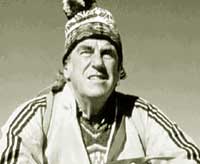 How he would have laughed if you'd told him his life would be like this. I have an image of him back in 1931 in his own rural setting, a bee farm out of Auckland. He is 12, short and scrawny, uncomfortable in his own body, uncomfortable amongst others. At school he prefers the company of the ants in the playground to his fellow pupils, and in the physical education class he has been placed in the hopeless squad.
The mountain people are leading him up a hill now, one of his oldest Sherpa friends supporting him by the arm, others poised to help should Hillary's 80-year-old body falter. For over 40 years they have watched him come to them, in the early years trekking for weeks from Kathmandu with hundreds of porters carrying building supplies. Now he comes by air and less often. But each visit is treasured. And each visit they know may be his last.
He is here to work. He and his team. One of his team is walking beside him, a bearded man with a twinkle in his eye, also about 80. He is George Lowe, the other New Zealander on that successful British Everest Expedition of 1953. If they'd had their way they would have climbed to the summit together but fate, or rather expedition politics, decreed otherwise. Not only did the leader John Hunt not countenance a colonial summit team upstaging the English team members. Hunt had even dropped them from the expedition some months prior to departure, but reinstated them after being persuaded quite prophetically by the English team members that Hillary and Lowe's alpine skills could well mean the difference between success and failure.
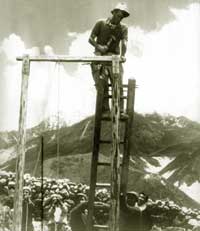
Some years after the successful climb, some Sherpa friends were sharing the fire with Hillary and Lowe when Hillary asked his head sherpa, "Urkein, if there was just one thing we could do for our Sherpa friends what would they want it to be?" The reply was immediate. "Sir, we would like a school for our children." Next year, Hillary and his team built a simple school in the Sherpa village of Khumjung and soon the first batch of eager barefoot Sherpa children, faces brightly polished for the occasion, stepped into their wooden benched classroom and began a journey that would take some to incredible heights.
When word spread through other villages and other valleys, Hillary was avalanched with petitions. At Thami village the monks and elders composed a petition that was presented to Hillary by a 10-year-old boy. They had written: " Our children have eyes but still they are blind. Please build a school in our village too." So next year Thami village, where Tenzing Norgay had grown up, had a school of its own. 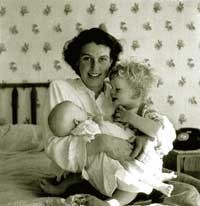 Hillary and his teams have now built thirty schools, as well as two hospitals, two airstrips, many bridges and many health clinics. A forty year labour of love, fashioning rocks he used to climb into school and hospital walls, working with Sherpa and Western building teams, including his brother Rex who worked as building foreman on these projects for twenty five consecutive years.
Hillary is among friends. Ang Rita was in the first batch of children from Khumjung and went on to top the SLC. Now he is Hillary's right-hand man, the full time administrator of the Himalayan Trust. Hillary's son Peter is taking pictures, shuffling a little painfully having only recently returned from hauling a heavy sled uphill for 84 days to the South Pole.
Nothing's been too easy in life for Peter. As the son of the most famous New Zealander it's been hard for Peter to blossom as his own person in the giant shadow of his father. But he's stepped well out of that shadow now , followed his father's footsteps up Everest in 1990 and has recently followed his own footsteps to the summit of Everest again.
Peter was the first child born to Hillary and his wife Louise, whom Hillary had courted in Sydney where she was studying music. Two other children soon followed, daughters Sarah and Belinda. By then Hillary's building activities in Nepal were in full swing and it wasn't long before three little Hillary children were carrying rocks along with Sherpa children, each doing what they could. These family trips to Nepal, living and working with the Sherpa people, were the happiest times in Hillary's life, and 1975 was meant to be the happiest time of all.
That year Hillary, Louise and their now teenage children had decided to spend the entire year in Nepal. Hillary had gone on ahead to supervise the building of his second hospital and his family would join him in stages. His wife Louise and youngest daughter Belinda, 16, would be first in and on 31 March 1975 they set off with the family dog and some Sherpa friends to Kathmandu airport to fly in to join him. Louise had always been fearful of light planes and wanted to walk in, but Hillary had persuaded her to fly.
A young New Zealand pilot met them at the airport and soon they were taxiing for takeoff. Perhaps in the excitement of transporting half the Hillary family, the pilot had omitted one pre-flight check. He had forgotten to remove the pins that unlock the tail flaps. The plane took off, the tail flaps still locked in stall position. It came crashing down into a field killing all on board.
Hillary, standing on the mountain airstrip on which they should by now have landed, had a premonition that something terrible had happened, and a friend soon arrived by helicopter to break the dreadful news. Hillary helicoptered back to Kathmandu and felt compelled to land at the crash site. He would have nightmares for years to come. 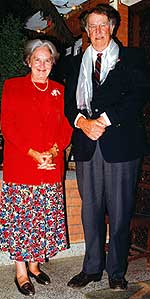 That night Hillary cremated the two people he loved most in the world, his wife and youngest daughter. And his only wish that night was to join them. For days he struggled with inconsolable grief made worse by his belief that it was all his fault, that he'd made them fly rather than walk. His two remaining children, Peter and Sarah on arrival in Kathmandu were warned by their grandmother, "Your father will never be the same again. He's heavily drugged, curled up in a ball, sobbing."
It was the hardest thing that tough man ever did, clawing himself back from the brink of suicide. He would stay alive, he decided, for what was left of his family. He would stay alive because of his responsibilities to the Sherpa people. He would return to the hills and his half completed hospital, and work and weep with his Sherpa friends.
Hospital completed, Hillary returned to Auckland. The family house felt like an empty shell and he felt the same. As part of his self-healing he would throw himself into the organisation of an expedition he and his late wife had often talked of doing together, journeying by jetboat along the entire length of India's River Ganges.
It would prove an extraordinary expedition, in Hillary's opinion his most memorable ever. No expedition in history had ever been done in such public gaze. You could hardly see the Ganges banks for people, hundreds deep, here to catch a glimpse of these magic boats and the hero of Everest.
Hillary and his late wife Louise had had as closest friends Peter Mulgrew and his wife June. Peter had been on expeditions with Hillary in Antarctica and the Himalayas and they and their wives had been an inseparable foursome. But in 1979, four years after Louise's death, Peter Mulgrew died, also in an air crash. At the last moment he had taken Hillary's place as guest commentator on an Air New Zealand flight to Antarctica which crashed into Mount Erebus, killing all on board.
 After the summit team of Tom Bourdillon and Charles Evans gave up at the South Summit on 26 May, it was Hillary and Tenzing's turn. They had a three man team to help them establish a higher camp: Ang Nyima, Alf Gregory and George Lowe. It was Lowe who cut the steps to the highest camp, carrying the most, and putting up Hillary and Tenzing's tent. They discuss whether Lowe should stay with them for tomorrow's summit push, for a three man team may be valuable if the route proves very technical. But there is insufficient oxygen for three. Lowe wishes them well and walks downhill into obscurity.