
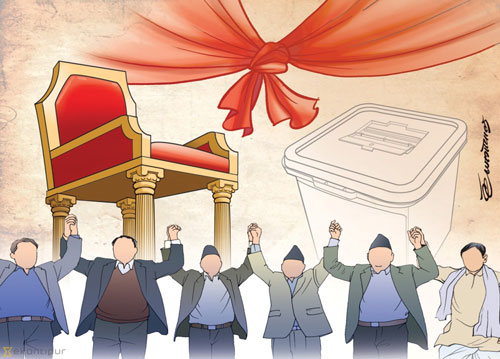
Two of the biggest Communist parties, UML and the Maoist Centre, have forged an unexpected electoral alliance, leading to ultimate party unity. The New Force Party has also joined the alliance. Talk of left parties uniting is not new. But the expectation was that the Maoists and the Nepali Congress partners in the ruling coalition would be the ones to make an alliance for the November parliamentary and federal elections. The Maoists have assured the NC that they will not break up the coalition before elections, however their continued participation in the government is now up in the air.
Electoral alliances and parties merging are part of the democratic process, especially if their vision and ideology coincide. Since the root cause of chronic political instability is seen as the plethora of parties, the unity of parties should be seen as a positive move. The fact that proportional representation in forthcoming elections will mean that there will be no party with a clear majority must have prompted this alliance – reinforced by results from the recently concluded local elections.
Although they share a Communist ideology, the UML and the Maoists are far apart. One of them waged an armed struggle for 10 years and has been in parliamentary politics for only 11 years since the ceasefire. The UML has 26 years of experience of parliamentary democracy. Even Baburam Bhattarai, who declared that he had abandoned Communism to set up New Force, is now part of the alliance.
A big test of the alliance and a future united party will be how flexible they show each other to be during the elections: we have seen before that factionalism can impact on national politics. Some have raised fears about the future of democracy after the unification of the two big Communist parties. The UML and the Maoists should dispel these fears, and reassure us that even if they unite they will implement the Constitution to bolster the federal democratic republic.
The UML-Maoist alliance has understandably put pressure on the NC to try to forge its own alliance. In fact, this can be an opportunity for the NC to reform and restructure itself. Having strong political parties will strengthen the nation, it will reduce foreign intervention and will ensure greater stability. Ultimately, having parties that can command a majority and establish sustainable alliances can allow the country to leap forward in terms of economic prosperity.
However, it is incongruous that the Maoists, as members of the ruling coalition, should be forging an alliance with the main opposition UML. It is therefore incumbent on the Maoists to prove that the alliance is just for elections and it will not break up the coalition. The main national priority now is provincial and parliamentary elections. We should not have a situation where an election government has to be changed.