
|
|
|
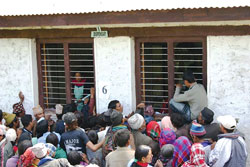
WHERE IS MY MEDICINE? Humla people throng a health post that was distributing free medicines during a health camp. |
Medical charities in remote parts of Nepal are trying to fill the vacuum left by the government, but this has brought a host of other problems.
Because the government has neglected health for so long, providing care is like buying political support: it brings the NGOs working on health in direct confrontation with the Maoists.
There are now about 130 NGOs based in Humla working for the development of Nepal's most remote district. Some work on health and it didn't take long before Maoists closed the first health post. Doctors, mainly western, used to fly into health camps by helicopter to distribute free medicines, like candies to begging kids.
David Citrin, who is working on a doctorate, is not impressed: "Due to a lack of research on what people really need, not enough awareness on how to use medicines and a complete lack of follow up, the camps are more like a medical circus."
People came on the second day, saying they didn't feel any better after swallowing all their medicines, meant to last for two weeks. Instead of treating 8,000 people, the same 2,000 people show up four times on average to stock up on as much free medicine as they can get. Villagers are disappointed when referred to an Indian doctor.
Shanti, a woman in Simkot, told us at least three people died last year, shortly after one of the health camps ended. Citrin says he saw children playing with used needles and later learned of people dying due to infections. "The concept of a bidesi doctor flying in by helicopter to give free medicine is just so powerful in an area where the government hardly bothers to do anything," he told Nepali Times. "Health camps obscure the real political and economic origins of sickness, they're a band-aid on a festering wound."
The government has promised free health services and free medicine for the poor from February. This sounds promising because 75 percent of the health care expenses of Nepalis are met by out-of-pocket payments, the highest percentage in Asia. As with everything else, the problem will be in making sure it works. When 97 villagers in rural Myagdi were asked recently what they really needed, the majority simply said: "An honest doctor who's here with us."