
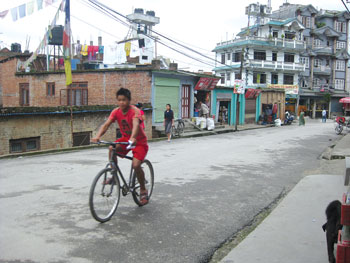
The street here is concrete, there is no hint of refuge at all within the vicinity, no dark sludge piling in the gutters, no chip bags blowing in the wind. It is as if the entire area is vacuum-sealed. Houses lining the road pop in vibrant colours, alluding to Ramhiti’s complex heritage and demographic diversity. Businesses are thriving. One of the cleanest and relatively prosperous neighbourhoods in Kathmandu, however, is an illegal squatter settlement whose residents face the threat of eviction and demolition of their homes every day.
Located between Kapan and Mahankal, Ramhiti is considered one of the oldest squatter settlements in the Kathmandu Valley. Established in 1981, the community has undergone 30 years of development and locally-led initiatives aimed at raising the quality of life of inhabitants while making it more welcoming to visitors. This combination adds to both the long-term happiness of its residents and makes the neighbourhood attractive to public officials.
“We feel the need to prove to the government that we’re a positive influence on society,” explains Lapka Lama, community organiser and resident of Ramhiti. “By keeping the area clean and implementing self-sufficient projects, we hope to show the authorities that we deserve to stay.”
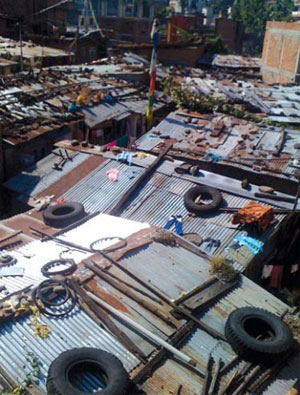
With financial assistance from Lumanti, residents built a new school that was later transitioned into a state-supported educational facility. Since the community has been taking care of its own needs, Ramhiti has the implicit blessing of the government. In 2007, the community upgraded the road that jets through the settlement, making it accessible to vehicles and promoting further foot traffic on the popular tourist route that extends from Boudhanath to Kapan Monastery.
Projects like these have increased business flow in the area and also drastically improved its aesthetics. Today, the 2,000 plus inhabitants of Ramhiti make a ubiquitous effort to keep the settlement as pristine as possible. Says Lama, “The cleaner we make it, the less likely that they will kick us out.”
As children parade the street with their kites, residents take a break from their mid-afternoon conversations to revel in the small paradise they helped create. Hopefully, future generations of Ramhiti will build upon the community’s prosperity and uphold its strong ties.
A roof of one’s own
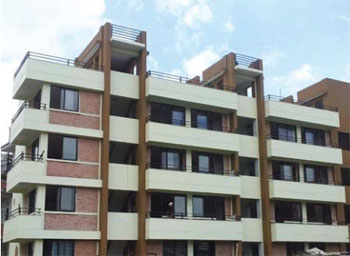
Last July, Lumanti oversaw the construction of the Valley’s first-ever rental-housing unit in Dhobighat that will provide shelter to 24 low-income families. Years of political instability have disintegrated any relevant housing aid provided by government agencies, while private developers have almost exclusively focused on luxury apartments and high rises for the wealthy.
Lumanti fills a role left vacant by both a state too irresponsible to fund public housing and private construction companies too greedy to consider anyone besides the wealthy. With poverty levels within Kathmandu at 30 per cent and housing prices sky rocketing, the project couldn’t have come at a more crucial time.
By building the first apartment complex for the poor, the organisation hopes to bring the public and private sector together to not just provide a temporary fix , but a long-term solution to housing those most in need. “If the government is ready to provide land, Lumanti is ready to start a housing program,” says director Lajana Manandhar. “But the participation of the private sector is also crucial.”
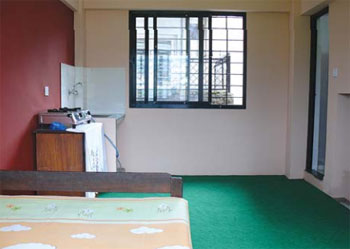
Currently, the Department of Urban Development and Building Construction (DUDBC) is also on the brink of beginning a project aimed at creating six blocks of low-cost rental housing in Ichangu. Such a venture would be unprecedented and provide hundreds of needy families with adequate shelter. Like Manandhar, Shambhu KC, acting director of the DUDBC, stresses the need for a collaborative effort between different organisations for the housing projects to succeed.
Lumanti’s work, however, is much more than an innovative housing scheme. By operating low-income housings in all varieties of neighborhoods throughout the Valley, these units have a better chance of being successful while integrating otherwise segregated demographic groups. And the Lumanti model is also awake up call for the private and public sectors and NGOs to pull resources, expertise, and ideas from one another so that the poor can have safe, dignified homes.