

This issue of Nepali Times focuses on growing inequality in Nepal. The income and wealth gap has been widening around the world, and Nepal is no exception.
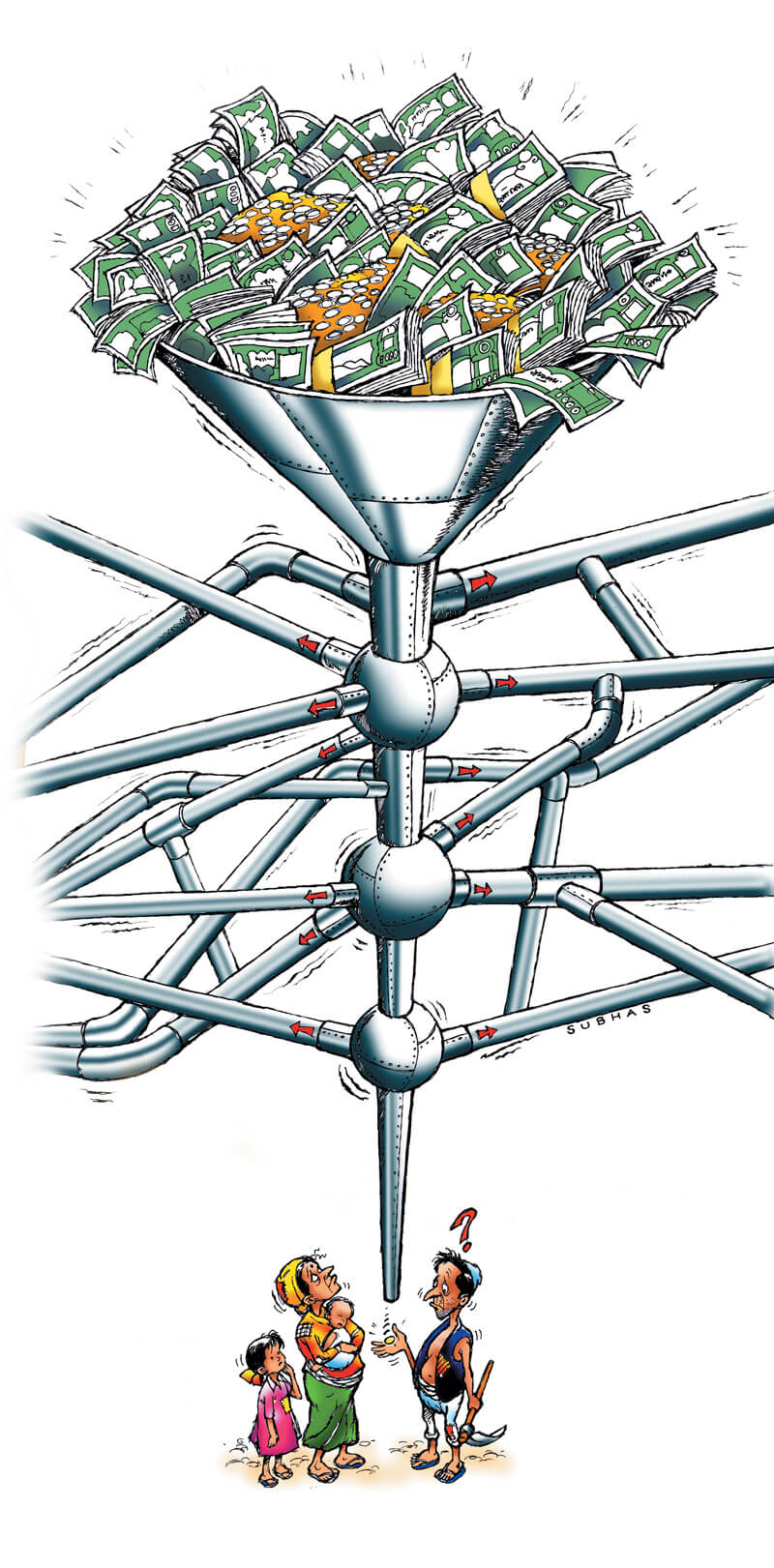
A few people on top of the wealth pyramid have a lot more than the numerous at the bottom. Governments and INGOs use the data to get aid which helps, in a strange way, to create a new category of people called the ‘Lords of Poverty’. Without too much generalisation, it is safe to say that poverty has become an industry in itself. Those who go to work every day to end poverty would be unemployed and poor if they were successful.
Read also:
Mind the Gap, Editorial
Nepal’s great income divide, Ramesh Kumar
Removing poverty with jobs, David Seddon
It’s a rich man’s world, Ramesh Kumar
We need to start with a general agreement that there is, was, and will always be inequality in human society. But we can create a safety net so that no one should ever have to live below an agreed standard and quality of life. This is the role of the government.
There are proven ways to do this, but in Nepal there is a lack of political will to make it happen. Hence we struggle. Trickle up works better than trickle down, and concentrates wealth in the hands of fewer people. Redistribution has to be by design. Tax money spent on education, health, infrastructure, information technology are all great equalisers, but not sufficient by themselves.
We know that in the United States and Nepal where there is poor state health care, families have been known to go bankrupt when a member contracts a serious illness. Medical expenses not just drain their savings, but some sell land or take children out of school to pay hospital bills.
What can we do about poverty caused by alcoholism, crime, disability, accidents, fraud, drugs and other addictions and mental conditions? When parents separate, terrorists attack, industrial accidents occur, people are pushed below the poverty line.
Take the example of a village where everyone is equal till one family buys a tv set and puts up an antenna. The neighbours without tv are suddenly poor.