Nepal is one of the most vertical countries in the world, and people are falling from heights all the time. And as the road network grows, there are also those with injuries sustained in traffic accidents.
In the year since Sir Edmund Hillary opened the Spinal Injury Rehabilitation Centre in Jorpati, the Centre has seen the extent of one of the most debilitating categories of injury Nepalis face. And what they have learned helps us understand just how bad things are with rehabilitation care. 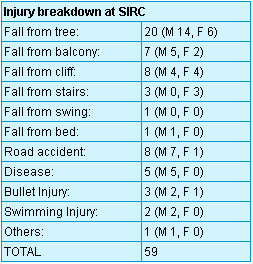 The broken bones and severed spinal columns, the psychological trauma and pressure sores of the spinally injured of Nepal indicate the poor state of health infrastructure, public services and the social safety net. Certainly, just about any other developmental indicator would expose our deprivation: under-five child mortality rate, the doctor-to-patient ratio outside Kathmandu Valley, the unavailability of drugs, or the prolapsed uterus.
But there are reasons to be particularly sensitive to the spinally injured. These are once-healthy women and men who were leading productive lives and providing for their families as working parents, wives or husbands. Due to falls from cliffs, trees, rooftops or trails, or crashes involving buses, jeeps or motorbikes, they are now paralysed-either completely as quadriplegics, or have lost control of their lower limbs and become paraplegic.
The terrible fact is that since their mental faculties are intact, the patients know that there is little hope of return to normal life. This is because the spine, once it has been severed, cannot be revived.
Able-bodied men and women thus become incapacitated while remaining mentally alert, having to rely on the sensitivity and magnanimity of family members. The burden on the family becomes heavy as the victims become complete dependents, with the result that that they slowly lose out in care and comfort.
Neglect of the paralysed within the home leads to mental depression and gradual physical decline. They lose control of bodily functions and develop bedsores. In a country where even major hospitals cannot prevent bedsores, which penetrate deep into the bodies and attack bones and vital organs, the dire situation at home can be imagined.
At the Spinal Injury Rehabilitation Centre, the focus is to try and help patients and their families to cope within the minimal support that our society is able to provide to the paralysed. Unfortunately, there is very little to be done for patients who have broken their backs in upper sections of the spine and are completely paralysed. In such cases, there is near-total reliance on the family members. However, other patients can be given physio- and occupational therapy, and the experience of the Centre is that life-energy can be revived in these patients.
And fortunately, there are also the occasional patients who can make dramatic recoveries for not having suffered a complete separation of the spinal column, and for having been discovered early, transported professionally, and treated with care and sensitivity.
The majority of the accidents leading to spinal injury are from falls. These falls tend to be from cliffs and trees, which women and men climb to collect fodder for livestock. It would be a different Nepal where villagers did not have to risk life and limb to climb inaccessible places to collect fodder grass. Women, in particular, are at risk because their phariyas come in the way as they reach out precariously on high branches to lop branches and leaves.
There is no data as to how many sustain injuries from falls every month across this country, and those that do find their way to Jorpati by way of hospital operating theatres are but a small number of the total. Many of those who sustain severe spinal injuries from falls die on the spot, or in villages before they are transported for treatment. Many will have their injuries compounded because of the lack of proper transport. Those who make it to hospitals to be operated by the country's handful of dedicated neuro- and orthopaedic surgeons receive minimal counseling and therapeutic guidance afterwards.