|
|
The most-used word in Nepali newspaper headlines in 2006 was the adjective 'historic'. It was a historic Jana Andolan, a historic eight-point pact, parliament passed a slew of historic proclamations, then there was a historic comprehensive peace agreement and a historic interim constitution.
Indeed, the year 2006 was perhaps the most historic in our history. Never in Nepal's nearly 240-year existence has there been a year as momentous as this. Only 1816 came close, when the Gorkha Kingdom nearly lost its independence and had to cede over half its territory to the British after a bruising war.
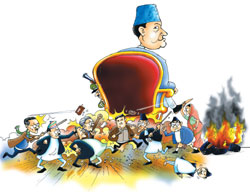
For the first time since Prithbi Narayan Shah set out in 1770 on his conquests, our nation this year prepared to sever links with its founding dynasty. This chapter in our history isn't over yet but when it is, 2006 could possibly go down as the year the crown was knocked off. As it turned out, the person most responsible in helping bring down Nepal's monarchy was the monarch himself.
King Gyanendra never tried to hide his loathing for the leadership of the political parties and his allergy to the democratic process. His Feburary 2005 takeover was an attempt to go it alone, but a year later even his advisers admitted the king had fatally miscalculated the domestic and international reaction.
January 2006 began with Gyanendra's regime internationally isolated. The US, UK, and India had stopped military aid and even China was advising the king to relent.
The war wasn't going well, the army was in the crosshairs of human rights watchdogs, and the royal dictatorship had pushed the Maoists and the parties into an alliance.
The Maoists, ending a ceasefire, blockaded highways, raided Tansen and Thankot. On the streets, the slogans of the seven-party alliance changed from "democracy" to "peace" the people started to spill out into the streets spontaneously. A war-weary nation had rejected the king's strategy to rule with an iron fist.
The municipal polls in February turned out to be a farce, and not just because of the boycott by the parties. King Gyanendra went on a series of televised walkabouts and started believing his own propaganda, mistaking public curiosity for support. He tried to convert orthodox Hindu reverence for monarchy into political clout. But even as he flew by helicopter from Pokhara to Birganj for a VHP ceremony in early April, Kathmandu's streets were choked with burning tyres as pro-democracy protests closed the capital.
The rallies spread and got bigger, and the royal regime responded by declaring a curfew. Civil society activists, politicians and journalists who defied it were jailed. The media ignored censorship to report on the civil-disobedience and the protests soon spread nationwide. Doctors, journalists, lawyers, ordinary citizens and even civil servants joined in.
Crowds of up to 200,000 people started massing up on the Ring Road. Nepal had never seen people power on this scale. As the situation grew untenable, India dispatched royal in-law Karan Singh to convince the king to relent and on 21 April he went halfway. The parties initially accepted it, but soon realised they had misjudged the level of anger on the streets.