
What percentage of the new medical graduates from the growing number of medical colleges will stay in Nepal? Of those that stay in Nepal, what demographic features characterises them versus those that leave? These were questions that Dr Mark Zimmerman and his colleagues set out to find in a study (based primarily on the findings of Nepal’s oldest medical college, Institute of Medicine ( IOM), Maharajgunj) published in the Aug 14, 2012 issue of the British Medical Journal.
These questions are obviously important for policy makers in Nepal to help determine which kind of medical graduates will stay home and render their services to Nepali society. Previous studies in high income countries have shown that medical graduates with rural backgrounds are more likely to work in rural locations. So, one of the question was, would the study from Nepal also replicate this finding?
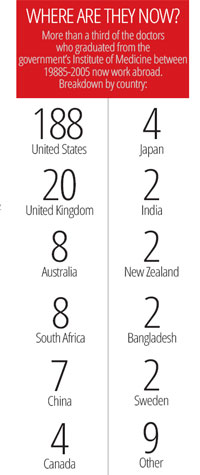
The authors tracked 710 graduate doctors from the first 22 classes (1983-2004) of IOM to their current practice locations. They analysed seven factors including gender, age entering medical school, place of birth, place of high school, type of pre-medical education, and academic rank. Results showed that from these 22 classes, roughly a third each were working in Nepal’s rural district (27 per cent), in Kathmandu (37 per cent) and abroad (36 per cent). Of those working abroad, 188 (73 per cent) were in the United States.
The fascinating finding was that those who had worked as paramedics prior to medical school (for example as health assistants) were twice as likely to be working in Nepal and 3.5 times as likely to be in rural Nepal compared to those graduates who only had a college science background. And in keeping with studies from high income countries, a rural birthplace was also independently associated with working in rural Nepal. Entrance to medical college at an older age also made it more likely that the doctor would work in rural areas.