
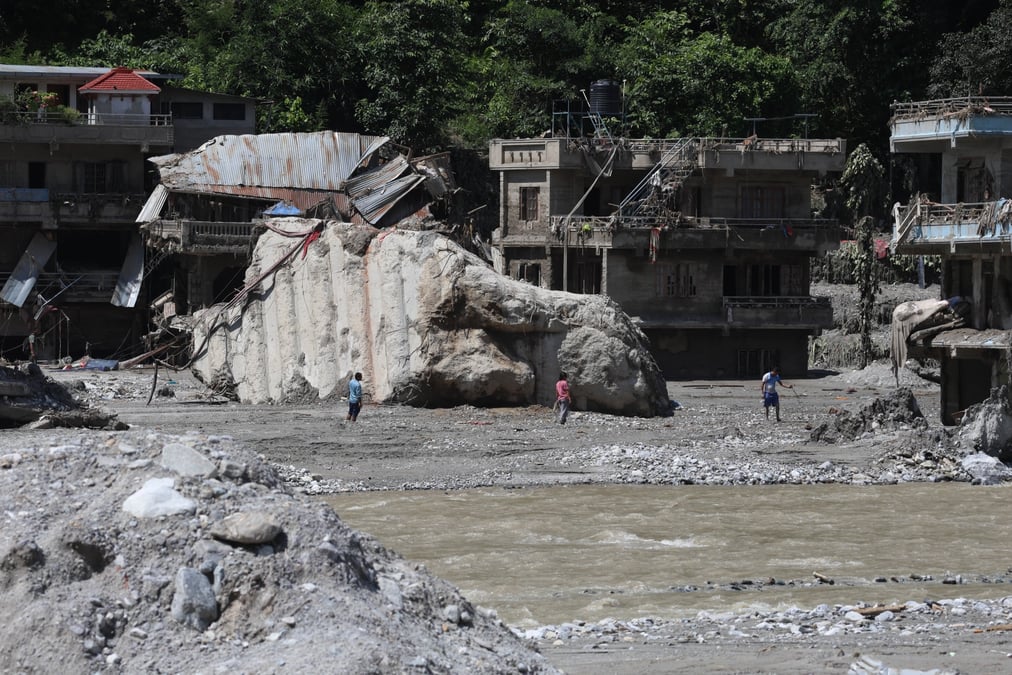
The Bhote Kosi-Trisuli disaster was not a ‘Himalayan tsunami’. It was a mountain collapse.
That may sound like a bureaucratic distinction but it is not. It is the difference between understanding what happened and getting the next response to it seriously wrong.
A tsunami is created when a large body of water is suddenly displaced, most often in the sea by an earthquake, volcanic eruption or an ocean landslide. The words itself come from a Japanese word, Tsu meaning harbour’ and nami, meaning wave.
Rasuwa had neither a harbour nor an ocean wave. It began somewhere else entirely, on a ruggedly high Himalayan slope and not under the sea. A vast mass of bedrock and glacier ice broke away, crashed into the valley below a set off a destructive flood that travelled through the river system.
Bodies are still being pulled from the river corridor and wreckage downstream. Families are still waiting for news of people who disappeared. That is why this cannot be reduced to a captivating, but false label.
The flood was real. The devastation was real. But the label is wrong. Calling it a ‘Himalayan tsunami’ may make for a powerful headline, but it crushes a complex mountain disaster into a misleading metaphor. It suggests that a great wave simply came down the valley. It did not. A mountain failed. Ice, rock, sediment and water moved together in a violent chain of events that began far above the riverbanks and ended in destruction downstream.
The evidence points to a major slope failure involving bedrock and glacier ice on the north face of Langtang Lirung. The mass fell around 1,200 meters into the Lhende Khola valley, broke apart into rock, ice and meltwater, and became a fast-moving debris flow. One estimate puts its leading edge covered the first 22 km at about 190 km/h, although scientists have cautioned that the speed estimate are still being reconciled.
The avalanche and debris flow appear to have obstructed the river. Water and debris built up behind the unstable blockage. When the blockage gave way, a violent surge of water, mud, rocks and sediment tore down the Bhote Kosi and Trisuli systems. It was an ice-rock avalanche that became a lethal debris flow and flood, not a tsunami.
There was no conventional glacial lake bursting. This was not a routine monsoon flood. Nor was it an ocean disaster transplanted into the Himalaya. It was a cascading mountain failure: slope collapse, ice-rock avalanche, river blockage, dam breach and flood.
That may sound more complicated than ‘Himalayan tsunami’. It is. But reality is more complicated than a catchphrase, and accuracy is not a luxury. It is the starting point for preparedness.
When we use the tsunami label, attention naturally goes to the flood wave below: river gauges, sirens, evacuation routes and rescue. All are necessary. But they are not enough. The danger began on a high, unstable slope. Therefore watching the river alone means detecting the disaster only after it is already under way.
Rasuwa should force Nepal to widen its view of Himalayan risk. For years, the focus has rightly been on glacial lakes and glacial lake outburst floods (GLOFs). But glaciers are not the only threat in a human induced warming mountain system. As glaciers retreat, they can remove support from valley walls.
As permafrost thaws, it can weaken the frozen ground that binds fractured rock together. Meltwater can enter cracks. Heavy rain can add pressure. Rapid changes in snow and ice can alter the balance of an already unstable slope.
The Himalaya is not only losing ice. In many places, it is also losing stability. Human induced climate change is likely to be a major driver of the conditions that weakened the Langtang slope, but it did not act alone. Mountains fail for many reasons, fractured geology, slope angle, seismic activity, water pressure, weather and gravity.
No serious observer should reduce one event to one cause. But it is equally wrong to ignore the larger setting. A warming cryosphere is changing the physical conditions of the high Himalaya. It is making some slopes, glaciers and frozen landscapes less predictable and more dangerous.
Rasuwa is a final wake-up call about the disasters the Himalaya must now expect and are relatively new: cascading events in which changing glaciers, thawing permafrost, unstable rock, blocked rivers and exposed infrastructure combine into one single crisis.
That warning does not stop at Nepal’s border. The Hindu Kush Himalaya contains the largest concentration of glaciers outside the polar regions, an estimated 54,000 glaciers covering about 60,000 sq km. Water from its snow and ice feed over ten major river systems of Asia, on which over two billion people depend downstream.
About 240 million people live within the mountain regions itself. This is not an empty mountain frontier. It actually is one of the world’s most consequential mountain systems.
This is why Rasuwa should also be a case for an International Center for Glaciers and Permafrost: a laser-focused institution for cryosphere risk, adaptation and resilience. Not a ceremonial institution, and not another office producing reports after disaster strikes. It should be a working center for glaciated countries everywhere, connecting satellite monitoring, field science, permafrost observation, slope-stability analysis, glacier-risk assessment, early warning, data sharing and adaptation policy.
The need is global. The Andes, the Alps, the Caucasus, Central Asia, the Arctic and other glacierised regions face their own versions of a changing cryosphere. But the Hindu Kush Himalaya is where the human stakes are particularly high: a vast, rapidly changing high-mountain ice system above some of the most populated river basins on Earth.
The ICG should help countries move from reacting to disasters to adapting to the risks that can now be seen coming. It should identify dangerous glacierised slopes before they collapse, map where avalanches could block rivers and trigger dam-break floods, and help governments protect roads, hydropower plants, settlements, trade corridors and other critical infrastructure in narrow mountain valleys.
Additionally, it should also strengthen cross-border science, shared warning systems and adaptation planning, because ice, rock and water do not stop at national borders.
These risks cannot be managed through fragmented projects, isolated datasets and post-disaster sympathy. The world of nature, does not recognise which country or ministry is responsible for glaciers, which agency watches rivers, or where a border line appears on a map. Ice, rock and water move according to physics, our institutions must learn to work accordingly.
Adaptation in the Himalaya can no longer mean only building back after floods. It must mean understanding unstable glaciers, thawing permafrost and failing mountain slopes before they become disasters.
A mountain fell in Rasuwa. The question now is whether Nepal, the region and the wider world will recognise the danger before the next slope gives away.
Arup Rajouria is a climate and diplomatic strategist working on climate resilience, glacier risk and international cooperation.