
 |
Anyone who has even a passing interest in the history of the subcontinent knows the circumstances in which the maharaja of Jammu and Kashmir acceded to India and the subsequent decades of bloody consequences. But few know the story of the accession of Manipur to India. A state tucked away in India's northeast, its ruler too had wanted to retain his independent status, goading Sardar Vallabbhai Patel, then India's Home Minister, to remark, "Isn't there a brigadier in Shillong?" Soon, the maharaja was virtually imprisoned in his residence, and intimidated to agree to the merger of his state with India. A battalion of the Indian army was deployed on 15 October, 1949 to oversee the transfer of power.
Now switch to Pakistan, whose leaders are extremely conflicted about the persona and ideology of Muhammad Ali Jinnah. Was his lifestyle that of the traditional Muslim? The answer was at least clear to President Gen Zia ul-Haq, who would mark out the pages on Jinnah's dietary habits in Stanley Wolpert's Jinnah of Pakistan before presenting to his guests. Gen Zia's aim was to portray that he was remarkably different from the founder of Pakistan. Pakistani journalist Khaled Ahmed notes, "The Quaid's daughter, Dina, living in New York, was secretly asked to deny that her father ever drank alcohol or ate ham." Dina refused to oblige.
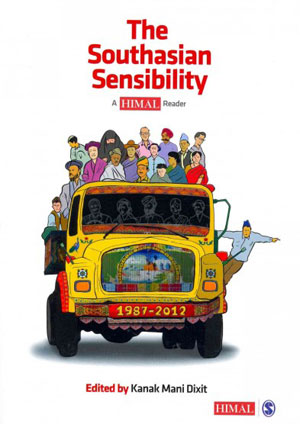
These two incidents are narrated in chapters in The Southasian Sensibility, a book Kathmandu's Himal magazine has launched to commemorate its 25th year of publication. The essays have not been written specially for the book but culled from the many past issues of Himal. Your presumption that the book is dated evanesces as you thumb through it, for you realise the essays, written at different points over the last 25 years, tell us about the persistence of our memories, and the manner in which the present in South Asia remains shackled to the past.
Partly, this is because the essays invariably depict the traumatic project the idea of building a modern nation-state can degenerate into. Ahmed's essay, written in 1998, demonstrates that the contest to give a certain persona to Jinnah is an extension of the passionate debate over the kind of personality secular or Islamic Pakistan should acquire.
Since 1998, flying bullets and exploding bombs have become additional arguments in the fiery exchanges between Islamists and others, prompting Pervez Hoodbhoy to write, Why Pakistan is not a nation. To become one, he says Pakistan needs peace, internally and externally, provide economic justice, and become a welfare state through the whittling down of massive holdings of landlords and assets of its army personnel. Hoodbhoy adds, 'Most countries have armies but, as some have dryly remarked, only in Pakistan does an army have a country.'